
Editorial and preliminary paper on People of the British Isles project
Both freely accessible.
A British approach to sampling:
People of the British Isles: preliminary analysis of genotypes and surnames in a UK-control population:The acronym ‘PoBI’ may not yet be familiar to human geneticists in the way that ‘HGDP’, ‘WTCCC’ or ‘HapMap’ are, but a paper in this issue of EJHG1 that introduces the ‘People of the British Isles’ project to the scientific community aims to change this. The PoBI project will collect up to 5000 DNA samples from diverse regions of the British Isles, taking great care to sample individuals with several generations of ancestry in rural locations. These samples are intended to serve as controls for future medical genetic studies, and to provide insights into the peopling of the British Isles over the last few millennia. [. . .] Although readers will have to wait for future publications to discover the insights from these large-scale genetic analyses, the current paper describes the sampling strategy and initial 3865 samples in some detail, outlines an approach to investigating fine-scale population structure using surnames, and presents some preliminary genetic analyses of a handful of chosen loci. [. . .]
In addition to collecting blood, the project recorded surnames. Using data from a census performed in 1881, these were classified as ‘local’ or ‘non-local’, and the two classes examined separately. The authors then modelled a population such as that from central England as a mixture between south-western (taken to represent Ancient Britons) and eastern (Anglo Saxon) populations, and estimated the contribution of each population to the central England autosomal genotypes. These contributions differed between the local surname class (mostly eastern) and the non-local class (half and half), which the authors take as evidence of subtle population structure. Published genetic analyses using much larger numbers of markers have already detected low, but significant levels of genetic structure within Britain in more straightforward ways,4, 5 even with less stringently ascertained samples (Figure 1): Europe-wide south-east to north-west gradients extend into the British Isles. We can look forward to deeper insights into genetic differentiation and its causes when large-scale genetic analyses of the PoBI samples are available.
[. . .] anthropological and evolutionary geneticists should rejoice in the assembly of this resource, the foresight of The Wellcome Trust in funding the project over a decade or so, and hope that resources are available for establishing more cell lines and performing more genome-wide sequencing, so that both the full set of samples and their sequences can be made widely available.
It is obvious why British people interested in their ancestry, and medical geneticists working with British subjects should welcome PoBI, but why should others pay attention? PoBI will not provide information about global genetic diversity in the way that HGDP7 and HapMap8 do, but its microcosmic survey of genetic variation in a set of small islands off the western coast of the Eurasian continent is revealing the level of differentiation that builds up over millennia via events well documented by archaeology and history, so these alternative data sets can be compared to address questions about the initial peopling of the area, and its subsequent reshaping by internal and external forces. And if the characteristics of the British – politeness, eccentricity, or drunken loutishness, according to your viewpoint and experience – have any genetic basis, perhaps PoBI can provide a starting point for identifying it!
There is a great deal of interest in a fine-scale population structure in the UK, both as a signature of historical immigration events and because of the effect population structure may have on disease association studies. Although population structure appears to have a minor impact on the current generation of genome-wide association studies, it is likely to have a significant part in the next generation of studies designed to search for rare variants. A powerful way of detecting such structure is to control and document carefully the provenance of the samples involved. In this study, we describe the collection of a cohort of rural UK samples (The People of the British Isles), aimed at providing a well-characterised UK-control population that can be used as a resource by the research community, as well as providing a fine-scale genetic information on the British population. So far, some 4000 samples have been collected, the majority of which fit the criteria of coming from a rural area and having all four grandparents from approximately the same area. Analysis of the first 3865 samples that have been geocoded indicates that 75% have a mean distance between grandparental places of birth of 37.3 km, and that about 70% of grandparental places of birth can be classed as rural. Preliminary genotyping of 1057 samples demonstrates the value of these samples for investigating a fine-scale population structure within the UK, and shows how this can be enhanced by the use of surnames.
Swedish population structure
Via Dienekes, The Genetic Structure of the Swedish Population:
An analysis of genetic differentiation (based on pairwise Fst) indicated that the population of Sweden's southernmost counties are genetically closer to the HapMap CEU samples of Northern European ancestry than to the populations of Sweden's northernmost counties. [. . .] We have shown that genetic differences within a single country may be substantial, even when viewed on a European scale.The paper is in PLoS ONE (i.e., it's open access). More:
Few of whites' best friends are black
Friends for better or for worse: Interracial friendship in the United States as seen through wedding party photos (pdf):
Four findings stand out. First, the few survey estimates of close adult interracial friendships may overstate their actual prevalence, especially whites’ reporting of close friendships with blacks. My results show that very few whites have black friends who are close enough to be in their wedding party (3.7%), less than all previous estimates among adults. I reasoned that estimates of cross-race friendships for whites based on the wedding party photos would be lower than those based on existing survey measures because wedding parties include only the closest friends who may often have to conform to intergenerational norms about racial contact and the expectations of extended family. Wedding parties also limit the pool of friends to a small number and cannot be exaggerated out of normative pressure. Compared with what would be expected if there were homogenous opportunity for friendships, whites are most likely to have a close E/SE Asian friend and least likely to have a black friend. These results suggest that Jackman and Crane’s (1986: p. 460) declaration using data from 1979 still rings true: “only a tiny minority of whites could rightly claim that ‘some of their best friends’ are black.”
Second, I hypothesized that there would be an asymmetry, by race, of inviting a friend to be in the wedding party and being invited to be in a friend’s wedding party, with whites being invited more than they invite friends of other races. Adjusting for group size, whites and E/SE Asians are equally likely to invite and be invited, but whites invite blacks only half as much as blacks invite whites, and E/SE Asians invite blacks only one- fifth as much as blacks invite E/SE Asians. This finding is consistent with the notion that whites are less accepting of interracial friendships, a finding that is no longer detectable in survey-based attitudinal data.
More evidence of Sephardic ancestry in some new world Hispanic groups
Velez et al. The impact of Converso Jews on the genomes of modern Latin Americans. Hum Genet. 2011 Jul 26. [abstract]
Modern day Latin America resulted from the encounter of Europeans with the indigenous peoples of the Americas in 1492, followed by waves of migration from Europe and Africa. As a result, the genomic structure of present day Latin Americans was determined both by the genetic structure of the founding populations and the numbers of migrants from these different populations. Here, we analyzed DNA collected from two well-established communities in Colorado (33 unrelated individuals) and Ecuador (20 unrelated individuals) with a measurable prevalence of the BRCA1 c.185delAG and the GHR c.E180 mutations, respectively, using Affymetrix Genome-wide Human SNP 6.0 arrays to identify their ancestry. These mutations are thought to have been brought to these communities by Sephardic Jewish progenitors. Principal component analysis and clustering methods were employed to determine the genome-wide patterns of continental ancestry within both populations using single nucleotide polymorphisms, complemented by determination of Y-chromosomal and mitochondrial DNA haplotypes. When examining the presumed European component of these two communities, we demonstrate enrichment for Sephardic Jewish ancestry not only for these mutations, but also for other segments as well. Although comparison of both groups to a reference Hispanic/Latino population of Mexicans demonstrated proximity and similarity to other modern day communities derived from a European and Native American two-way admixture, identity-by-descent and Y-chromosome mapping demonstrated signatures of Sephardim in both communities. These findings are consistent with historical accounts of Jewish migration from the realms that comprise modern Spain and Portugal during the Age of Discovery. More importantly, they provide a rationale for the occurrence of mutations typically associated with the Jewish Diaspora in Latin American communities.
Sorbs autosomally distinct from Germans
Population-genetic comparison of the Sorbian isolate population in Germany with the German KORA population using genome-wide SNP arrays (abstract; provisional pdf):
Background
The Sorbs are an ethnic minority in Germany with putative genetic isolation, making the population interesting for disease mapping. A sample of N=977 Sorbs is currently analysed in several genome-wide meta-analyses. Since genetic differences between populations are a major confounding factor in genetic meta-analyses, we compare the Sorbs with the German outbred population of the KORA F3 study (N=1644) and other publically available European HapMap populations by population genetic means. We also aim to separate effects of over-sampling of families in the Sorbs sample from effects of genetic isolation and compare the power of genetic association studies between the samples.
Results
The degree of relatedness was significantly higher in the Sorbs. Principal components analysis revealed a west to east clustering of KORA individuals born in Germany, KORA individuals born in Poland or Czech Republic, Half-Sorbs (less than four Sorbian grandparents) and Full-Sorbs. The Sorbs cluster is nearest to the cluster of KORA individuals born in Poland. The number of rare SNPs is significantly higher in the Sorbs sample. FST between KORA and Sorbs is an order of magnitude higher than between different regions in Germany. Compared to the other populations, Sorbs show a higher proportion of individuals with runs of homozygosity between 2.5 Mb and 5 Mb. Linkage disequilibrium (LD) at longer range is also slightly increased but this has no effect on the power of association studies. Oversampling of families in the Sorbs sample causes detectable bias regarding higher FST values and higher LD but the effect is an order of magnitude smaller than the observed differences between KORA and Sorbs. Relatedness in the Sorbs also influenced the power of uncorrected association analyses.
Conclusions
Sorbs show signs of genetic isolation which cannot be explained by over-sampling of relatives, but the effects are moderate in size. The Slavonic origin of the Sorbs is still genetically detectable. Regarding LD structure, a clear advantage for genome-wide association studies cannot be deduced. The significant amount of cryptic relatedness in the Sorbs sample results in inflated variances of Beta-estimators which should be considered in genetic association analyses.
Dienekes releases ancestry analysis tool
For people with 23andMe or Family Finder data (background; download). Don't take the component names too literally or assume this particular analysis is the final word, but the tool allows you to compare your personal results with those for various populations included in Dienekes' admixture runs. Definitely do not take the results from Dodecad Oracle mixed mode (which lists combinations of two populations that would produce admixture proportions most similar to yours) literally. It might be useful for people with more broadly mixed ancestry. But from what I'm seeing, people of Northwestern European ancestry will frequently be shown as, for example, 7/8 Scottish and 1/8 Italian, when they have minimal Scottish and no Italian ancestry. Dienekes acknowledges "mixed mode should be used with caution". I think it throws away too much information to ever have much precision within Europe. The future will be very large databases and assignment of individual segments to specific geographic locations.
Advice for women and men
Some woman: "In the end, infertility can make you feel less human. As cultivated as we are, we hold on to a deep-rooted belief that our worth is tied to how well, and how much, we reproduce. I've seen women and men shrink like salted slugs during IVF treatment. [. . .] Many women are still listening to their bosses instead of their gynecologists and their guts. They still trust that their mid to late 30s is a fine time to start trying for children. True, they could get lucky. But the question should be asked: Would you prefer to have children earlier and naturally or later, by dosing yourself up with drugs, submitting to surgery and paying tens of thousands of dollars? [. . .] The first thing I'd like to tell women ages 26 to 34 is: Start having babies. I know it's not polite or funny. But I don't want others to go through what I'm going through now." (Holly Finn; My Fertility Crisis; We hear about fertility treatments when they're successful. But for millions of women, they mean regret, heartbreak, shame and silence.)
Winston Churchill: "There is no finer investment for any community than putting milk into babies" - radio broadcast, 1943. "You must have four children. One for Mother, one for Father, one for Accidents, one for Increase".
Julian Huxley: "If we want to maintain the race, at a high level, physically and mentally, everybody sound in body and mind should marry and have enough children to perpetuate their stock and carry on the race."
Ötzi (Tyrolean Iceman) genome coming "soon"
Someone at a genealogical DNA forum posts a reply received from the Institute for Mummies and the Iceman in Bolzano, Italy: "The Iceman genome will be published soon including his Y haplogroup. You may understand that we cannot release any information in advance." The information is apparently scheduled to be released 'October 20-22, 2011, at the next Bolzano Mummy Congress called "Mummies from the Ice".'
Irish DNA Atlas project launched
From an article in an Irish genealogy newsletter (pdf): "Over the past decade or so genealogists around the world have become increasingly intrigued by the possibilities afforded through the advances in genetic genealogy to augment or confirm our traditional record based research. This new group project is yet another first for Irish genealogy building on the Society’s unparalleled record of innovative projects and initiatives. The Society’s Director of Archival Services, Séamus O’Reilly, FGSI, will spearhead this new group project in conjunction with Dr. Gianpiero Cavalleri of the Royal College of Surgeons in Ireland aimed at promoting an awareness, appreciation and knowledge of genetic genealogy. The project will compile an Irish DNA Atlas through the collection of birth briefs and DNA samples. [. . .]
Dr. Cavalleri explained the objective of the project as ‘seeking to create a collection of DNA samples from individuals of Irish origin, which can then be used to explore human genetic variation in the Irish population. Understanding human genetic variation in the Irish population is required for two principal purposes; (1) to further our knowledge of the population history of Ireland and (2) to help us understand how genes influence health in Ireland.’ He said that ‘the diversity of the Irish genome is a valuable, yet largely unexplored, resource of the Irish nation. As an island population on the edge of Europe, Ireland has a rich cultural heritage that is the product of ancient migrations to the region. Understanding and preserving this history enriches our culture. Whilst historical records and archaeological studies have uncovered many wonderful aspects of Irish history, there are many questions left unanswered and DNA can help address these.’
The Aims of the Irish DNA Atlas are (1) To create a DNA collection that allows genetic analysis of population structure within Ireland, and ethnic groups across the island. Analysis of such a collection will reveal ancient demographic movements and inform on the ancestry of specific regions and ethnic groups within Ireland. (2) To create a DNA collection to act as controls in population based studies of health in Ireland. The Project aims to recruit individuals representing each of the 32 counties of Ireland. Each participant should have all eight great grandparents from that county – so that their DNA represents that particular region of Ireland. By recruiting people from every county the project hopes to build a “DNA atlas” of the island of Ireland. This new group project is not confined to GSI Members, anybody can participate. For further information or to participate please contact Séamus O’Reilly on Irish.DNA@familyhistory.ie"
Svante Paabo to sequence Upper Paleolithic (early modern) Europeans
Paabo collected samples of 19,000 year old bone from Iberia and intends to test the theory that Northern Europeans derive from a Last Glacial Maximum refugium in SW Europe. This Franco-Cantabrian refuge will almost certainly turn out to be a much less important (though still real) source of ancestry for Northern Europeans than was assumed a few years ago. Results should be interesting.
El padre del genoma del neandertal investiga el enterramiento del Mirón:
Google translation below:
El padre del genoma del neandertal investiga el enterramiento del Mirón:
Svante Pääbo, prestigioso científico en el campo de la Paleogenética, ha iniciado una colaboración con el Instituto Internacional de Investigaciones Prehistóricas de la Universidad de Cantabria para estudiar el enterramiento paleolítico que se exhumó en la campaña de 2010 en la cueva del Mirón, en Ramales de la Victoria. Invitado por el catedrático de la UC Manuel González Morales y por su colega norteamericano Lawrence G. Strauss, de la Universidad de Nuevo México, directores de los trabajos en la cueva del Mirón, Pääbo ha recogido muestras y conocido de primera mano este proyecto arqueológico.
Neandertales y sapiens
-¿Qué motivo le ha traído a Cantabria?
-El descubrimiento del pasado año de un enterramiento en la cueva del Mirón, un hallazgo muy singular e interesante para nosotros ya que esto nos permitirá contar con el ADN de esqueletos del Paleolítico Superior, de los que hasta ahora no disponíamos. He visitado la excavación y se trata de un yacimiento fascinante por la larga secuencia de ocupación que presenta.
-¿Qué puede aportar este hallazgo a sus proyectos de investigación?
-Nos interesa para poder analizar qué relación tiene este individuo de tiempos de la última glaciación con la población actual europea. Estimamos que tiene 19.000 años y ahora hemos tomado muestras para obtener el ADN y contar con una datación directa del hueso. Los isótopos nos permitirán conocer, entre otros aspectos, qué régimen alimenticio tenía, si consumía más carne o plantas... [. . .]
-¿Y sus próximos retos?
-En primer lugar, completar el mapa genómico del neandertal. En segundo lugar, conocer mejor quiénes eran los contemporáneos de los neandertales en el sudeste de Asia y en China; para ello estamos trabajando con los restos aparecidos en las cuevas de Denisova, al sur de Siberia. Y en tercer lugar, estamos estudiando los humanos modernos (sapiens sapiens) que reemplazaron a los neandertales.
-¿Qué teorías manejan al respecto?
-Existe la idea entre algunos geneticistas que la población del norte de la Europa actual procede del suroeste con motivo de la última glaciación hace 20.000 años. Se refugiaron allí para protegerse del frío. En el Magdaleniense Superior (Paleolítico Superior) parece que grupos de población volvieron al norte. Trataremos de aportar luz y ver si las poblaciones actuales de países como Holanda, Bélgica, Alemania... están relacionadas con individuos como éste del Mirón, sin comparten características genéticas.
Google translation below:
The beautiful woman in medieval Iberia: Rhetoric, cosmetics, and evolution
From a 2005 Ph.D. thesis by an Italian:
Literary portraits of the beautiful woman in medieval Iberia tend to emphasize several physical features, such as long, blond hair, or light-colored and hairless skin. This study examines the specific features of the beautiful woman in several major works and genres from medieval Iberia. It also traces the rhetorical sources of these portraits to the Classical and medieval Latin traditions, whose influence is evident in other early vernacular literatures of Europe. It then analyzes several medieval cosmetic treatises in Latin and in vernacular languages that attest to medieval women's beautifying practices, such as the use of hair-dyes, depilatories, and skin-whitening creams.
The comparison of the literary and cosmetic evidence shows a canonical view of feminine beauty that encompasses different cultural areas in medieval Iberia. This view is also consistent with ancient as well as with twenty-first century conceptions of beauty. The findings suggest that the ideal of feminine beauty in medieval Iberia is not unique, but rather a manifestation of near-universal male preferences shaped by sexual selection in the course of human evolution. [. . .]
Most cosmetic treatises devote considerable space to the maintenance of well-groomed, long, and healthy hair. They also include many recipes for hair-dyes (blond and black). In Spanish literature, blond hair appears to be more typical of learned poetry and appears to be associated with nobility: "rruvios, largos cabellos / segund doncellas d’estado" (Marqués de Santillana 11-12). In the cantigas it is not mentioned, and in the Andalusian and Arabic tradition hair is black, not without exceptions (see Chapter Three).
[Claudio Da Soller. The beautiful woman in medieval Iberia: Rhetoric, cosmetics, and evolution. University of Missouri - Columbia, 2005.]
Some left response to latest Gould exposure
Nature editorial urges "caution when it comes to questioning the work of scientists who are no longer with us."
Jonathan "reads Madison Grant angrily" Marks takes a slipperier tack:
At least we know Marks and Nature editor didn't coordinate their responses.
Of course, the fact that people like Gould frequently seem incapable of or uninterested in scientific objectivity hardly constitutes a convincing argument that people like Morton are similarly handicapped.

This month sees the latest episode: an assault on the work of US evolutionary biologist and celebrated author Stephen Jay Gould, who died in 2002. Although the critique leaves the majority of Gould's work unscathed, it carries a special sting because it deconstructs a posthumous attack that Gould launched on nineteenth-century physician Samuel Morton. In a 1978 paper (S. J. Gould Science 200, 503–509; 1978) and in his 1981 book The Mismeasure of Man, Gould argued that Morton's measurements of the cranial capacity of hundreds of skulls from worldwide populations, reported in works published between 1839 and 1849, were unconsciously biased, by what he claimed was the physician's prejudice that caucasians were more intelligent, and therefore would have larger skulls. As Gould was canny enough to realize, a charge of unconscious bias sticks faster in science than one of fraud.Nature editor isn't seething with indignation at the temerity of Lewis et al., or anything. He just wishes they would have published this paper while Gould was alive. Gould can't be faulted for failing to ever acknowledge or respond to a similar paper published 23 years ago -- eight years before Gould brought out a "revised" edition of Mismeasure of Man -- since that undergraduate effort was a "more modest" one:
Just as important is the readiness of the scientific community to undertake such studies, and to see them through the sometimes difficult publication process. The criticism of Gould was rejected by the journal Current Anthropology, and spent eight months in the review process at PLoS Biology. And although an undergraduate did publish a more modest study scrutinizing Gould in 1988, it is remarkable that it has taken more than 30 years for a research group to check Gould's claims thoroughly. Did Gould's compelling writing and admirable anti-racist motivations help to delay scrutiny of his facts? Quite possibly, and this is regrettable. Although future historians will be happy to scrutinize our most persuasive and celebrated luminaries, today's scientists should not leave the job to them.
Jonathan "reads Madison Grant angrily" Marks takes a slipperier tack:
So we have: (1) Gould never accused Morton of "misconduct" (2) no one ever took seriously as an example of bias in science Gould's wholly self-invented fantasy of Morton unconsciously mismeasuring "threateningly large black skulls" (3) everyone knows this aspect of Gould's work was already "convincingly challenged" by the 1988 paper (4) Gould was biased but that just proves Gould was right.Gould’s analysis of Morton is widely read, frequently cited, and still commonly assigned in university courses (refs.). Morton has become a canonical example of scientific misconduct...Let’s pause right there. Who says it’s an example of misconduct at all, much less a canonical one? Gould didn’t; Gould argued that Morton fudged unconsciously. I wrote chapters on “Bogus Science” and on “Scientific Misconduct” in my book, Why I Am Not a Scientist (their Ref. 4), and didn’t mention Gould’s treatment of Morton, and I mentioned Morton himself only in passing, as a phrenologist. (Perhaps unsurprisingly , that interest of Morton’s – the scientific aspects of head bumps – doesn’t get a mention in the new paper.)
So why didn’t I cite it as a canonical example of misconduct? Two reasons: First, Gould himself didn’t think it was; and second, even Gould’s argument for unconscious fudging had been convincingly challenged in a paper published in Current Anthropology 23 years ago (their ref. 14).[. . .]
So I will take away two lessons from this. First, about Stephen Jay Gould. Gould, like everybody else in science, tended to see what he was looking for. That’s a good science studies lesson. Second, about this paper. For the most part, it is paranoid positivist rhetoric mixed with slovenly-argued bombast, and a warmed-over critique of Gould, not a significant new contribution to knowledge. If it were, it might have been publishable in a real journal, like Current Anthropology.
At least we know Marks and Nature editor didn't coordinate their responses.
Of course, the fact that people like Gould frequently seem incapable of or uninterested in scientific objectivity hardly constitutes a convincing argument that people like Morton are similarly handicapped.

Some links
Ahnenkult: An Uyghur redhead
Peter Frost: Big Other? "It is even doubtful whether the east-west flow of ideas explains the rise of the European world to global dominance between 1500 and 1900—the main theme of Diamond’s book. This rise to dominance was fueled by a technological revolution that occurred largely in northwestern Europe [. . .] Europe took off economically and geopolitically only when it developed its own intellectual resources."
John Hawks: Where did Neanderancestors live? "I discussed this exact issue with David Reich last week. There is no strong fossil argument for an African ancestor at that time, Europe and West Asia are anatomically and archaeologically just as plausible. My inclination is to suspect Africa because of the deep genetic variation still retained in that population, but that variation could have been retained in other ways -- particularly since every scenario of human origins now must involve population mixture." Apparently continuing a twitter conversation: "With Ngandong date change last week, no H. erectus fossil is late enough to be part of a Denisovan population. [. . .] The hinge point in paleoanthropology right now is the European Middle Pleistocene. Neandergenes don't fit fossil record. That is, Neandergene analysis seems to rule out substantial Neandertal ancestry from Atapuerca et al. Instead, Neandergenes appear to derive from Africa after 250-400 kya. Is Atapuerca/Petralona/Arago a dead end? Or can we find a model that fits data and allows some substantially deeper Neandertal local ancestry? And while we're at it, can we get any Denisovan ancestry to be consistent with Asian Homo erectus? The Denisovan genome analysis seems to rule out any substantial mixture with Neandertals... ...but Okladnikov is literally 3 days' walk. There's simply no biogeographic barrier. The populations need not have been here at same time, but if not where were they? If we can't resolve the European Mid Pleistocene problem, fossils may never help with Denisovan problem."
Arthur R. Jensen and Frank Miele: Ratio Scale Measurement of Mental Processes by Means of Mental Chronometry (mp4 video)
Why is Google keeping a list of Jewish names? Anti-semitism, no doubt.
Tribe on Papua New Guinea meets white man for the first time
Light-skinned black women rated more attractive
Shocking, perhaps, but here are interviewer ratings of black womens' attractiveness vs. skin color from wave 3 of Add health:
 Variables:
Row H3IR1 S35Q1 PHYSICAL ATTRACTIVENESS OF R-W3
Column H3IR17 S35Q17 RESPONDENT SKIN COLOR-W3
Control BIO_SEX3 BIOLOGICAL SEX-W3
Filter H3OD4B(1) S1Q4B RACE-BLACK/AFRICAN AM-W3(=Marked)
Please make no unkind inferences concerning a possible relationship between degree of European admixture and attractiveness. The obvious conclusion is Kanazawa's critics were right: biased raters downgrade the beauty of African American women owing to their racism and brainwashed adherence to Eurocentric beauty standards. This insidious form of racism apparently extends to more literal sexual marketplaces:
Gwen and Alicia were especially coveted because of their skin color. In a rigid hierarchy that clinical psychologist Melissa Farley—founder of Prostitution Research & Education, a San Francisco–based think tank—calls “eroticized racism,” the “snow bunnies” (white girls) outclass the “ducks” (black girls). “Maybe one out of 50 callers would request a black or Latina,” says Caroline. “Most asked for ‘the girl next door’—a blonde, thin teenager with big breasts. That’s candy to ants.” [Sex Trafficking of Americans: The Girls Next Door]Note: Kanazawa's methods may well be flawed. I personally wouldn't be comfortable drawing the conclusion he did based on the data he did. I actually expect racial differences (or similarities) in average rated physical attractiveness have little to do with actual sexual attraction/behavior. To the extent that ratings of physical attractiveness reflect subconscious judgments of youth, health, symmetry, and so on, we should be able to meaningfully rank attractiveness across races; but this does not make even an "attractive" black woman an ideal or preferred sexual partner for a normal white man. Sorry Severn (commenter at Mangan's who is flipping out about Kanazawa's "bad science" and who coincidentally says he has dated black women).
I'll sheepishly admit I'm a longtime regular at strip clubs. I'll often get black strippers with slightly desperate looks on their faces sitting at my table trying really hard to be friendly to me hoping they can sell me a lap dance. Meanwhile the blonde strippers in the club don't even have to approach anyone; the male customers swarm the stage when they get up to dance. In a strip club it's kind of obvious who men find the most attractive. I admit this is not a scientific study, just my personal observation. [A comment at Mangan's]
Neolithic Y DNA from Southwestern France
A post by Dienekes brings to my attention a paper in PNAS, "Ancient DNA reveals male diffusion through the Neolithic Mediterranean route":
Dienekes writes:
R1b and LP in Western Europe are in all likelihood associated with the dispersal of Indo-European languages.
These findings add to ancient DNA evidence indicating large-scale post-Neolithic population replacement in Europe. Coon and other traditional physical anthropologists, it turns out, probably had a better handle on European prehistory 70 years ago than population geneticists did five years ago.
The Neolithic is a key period in the history of the European settlement. Although archaeological and present-day genetic data suggest several hypotheses regarding the human migration patterns at this period, validation of these hypotheses with the use of ancient genetic data has been limited. In this context, we studied DNA extracted from 53 individuals buried in a necropolis used by a French local community 5,000 y ago. The relatively good DNA preservation of the samples allowed us to obtain autosomal, Y-chromosomal, and/or mtDNA data for 29 of the 53 samples studied. From these datasets, we established close parental relationships within the necropolis and determined maternal and paternal lineages as well as the absence of an allele associated with lactase persistence, probably carried by Neolithic cultures of central Europe. Our study provides an integrative view of the genetic past in southern France at the end of the Neolithic period. Furthermore, the Y-haplotype lineages characterized and the study of their current repartition in European populations confirm a greater influence of the Mediterranean than the Central European route in the peopling of southern Europe during the Neolithic transition.Note: contra the authors' assertion, lactase persistence was probably not carried by Neolithic central Europeans; the most common European LP-associated allele has been absent in all central European Neolithic samples tested to date.
Dienekes writes:
R-M269 which, because of its apparent young Y-STR age has been tied by some to either the Mediterranean or Central European Neolithic is conspicuous absently from both at the moment. It may yet surface in a Neolithic context, but its absence this late from a region where, today, it is abundant only adds to its mystery.In fact, the amateur estimates using actual mutation rates put the spread of R1b into Western Europe clearly post-Neolithic.
R1b and LP in Western Europe are in all likelihood associated with the dispersal of Indo-European languages.
These findings add to ancient DNA evidence indicating large-scale post-Neolithic population replacement in Europe. Coon and other traditional physical anthropologists, it turns out, probably had a better handle on European prehistory 70 years ago than population geneticists did five years ago.
DNA tests show Ingmar Bergman not his mother's biological child
Who was the mother of Ingmar Bergman?
The mystery is even greater given that Karin Bergman, who kept extensive diaries, recording both events and thoughts, was by all accounts unaware that Ingmar was not the child to whom she gave birth July 14,1918 but a surrogate child. [. . .]
The analysis, which reached her April 12, 2011, established with certainty that Ingmar Bergman was not the son of Karin Bergman, supporting Tillberg’s hypothesis about her own family. It is not yet certain who Bergman’s mother was, but a great deal of circumstantial evidence suggests that it was Tillberg’s grandmother, Hedvig Sjöberg (later Tillberg), who in July 1918 gave birth to a son in Stockholm who was immediately given up for adoption.
Racial differences in genetic load?
Another point of confusion in Kanazawa's deleted post:
A few years ago, an academic geneticist affirmative-action beneficiary made the opposite claim: that due to a population bottleneck, Europeans harbor more deleterious variation than Africans. John Hawks pointed out the impossibility of that study's conclusion around the time it was published:
There are many biological and genetic differences between the races. However, such race differences usually exist in equal measure for both men and women. For example, because they have existed much longer in human evolutionary history, Africans have more mutations in their genomes than other races. And the mutation loads significantly decrease physical attractiveness (because physical attractiveness is a measure of genetic and developmental health). But since both black women and black men have higher mutation loads, it cannot explain why only black women are less physically attractive, while black men are, if anything, more attractive.Actually, the ancestors of present-day non-Africans existed for the same amount of time as the ancestors of present-day Africans. Any racial differences in the number of deleterious variants per genome would need to be explained in terms of population differences in mutation rate, or strength of purifying selection, or some other relevant population genetics parameter.
A few years ago, an academic geneticist affirmative-action beneficiary made the opposite claim: that due to a population bottleneck, Europeans harbor more deleterious variation than Africans. John Hawks pointed out the impossibility of that study's conclusion around the time it was published:
What is amazing to me is that these same geneticists embrace hypotheses of population history that cannot possibly have happened. The other geneticists quoted in the article, Carlos Bustamante and his graduate student Kirk Lohmueller, wrote a paper earlier this spring arguing that deleterious mutations have reached high frequency in Europeans (moreso than Africans) because of a bottleneck during European history. The press reported this work as "Whites genetically weaker than blacks, study finds." The hypothesis in the paper is that protein-coding sites otherwise conserved in most mammals may differ among humans because of relaxed selection in a bottleneck.Empirically, there seem to be no major racial differences in genetic load. Compared to whites, blacks have much higher rates of spontaneous abortion and infant mortality -- superficially consistent with higher genetic load among blacks -- and an early attempt in Brazil to assess racial differences in genetic load by examining the effects of inbreeding did conclude that blacks have more lethal equivalents. However, a subsequent Brazilian study, with better controls, found no racial differences in inbreeding load:
Here's why they're wrong: their bottleneck is impossible. They propose that the European population was a small, isolated population of 5,700 effective individuals from 214,000 years ago up to the Last Glacial Maximum. I suppose I should take some encouragement that they believe Neandertals were European ancestors (because otherwise, where exactly would this small, isolated population of Europeans have lived). But it's still quite impossible -- it implies no gene flow between Africans and Europeans across that entire span. You see, that is the only way that genetic drift can lead to this kind of result -- large differences in frequencies between continents for hundreds of deleterious alleles. It takes a bottleneck of exceptional length, along with complete isolation.
In what has become a troubling trend, these details were hidden away in the online supplementary information of the paper.
A new investigation using sib and cousin controls, made in the same Brazilian area where whites and nonwhites (mulattoes and Negroes) had before shown inbreeding loads of different magnitudes, failed to support these findings. Our present data show that the number of lethons is the same in both ethnic groups. A review of all investigations on Brazilian whites and nonwhites suggests that the number of lethons may be accepted as roughly 2 in both ethnic groups.Similarly, "An analysis of consanguineous marriages in Nigeria" finds:
The total number of heterozygous deleterious genes carried per person in this population was estimated to be 8.71 +/- 3.92 (SD), which is not too different from estimates for several other racial groups.
Black women rated less physically attractive than other women; white men rated better looking than black men
Via the isteve comments section, I learn of a now-deleted Psychology Today blog entry by Satoshi Kanazawa, headlined "Why Are Black Women Rated Less Physically Attractive Than Other Women, But Black Men Are Rated Better Looking Than Other Men?" Prissy, terrier-faced "science" blogger / wannabe PC enforcer PZ Myers helpfully includes a link to a pdf copy of the post. (PC's own reaction includes this amazing bit: "Good grief…shades of Francis Galton! For those of you who don't know, creepy old man Galton ogled women and judged them for looks[!].")
Kanazawa explains:
 Kanazawa finds that black women are "far less attractive than white, Asian, and Native American women", while "races do not differ in physical attractiveness among men, as the following graph shows". In fact, the second graph clearly shows that white men have higher "mean latent physical attractiveness" scores than black men, and that the difference is statistically significant. Kanazawa goes on to write:
Kanazawa explains:
The physical attractiveness of each Add Health respondent is [rated] three times by three different interviewers over seven years.
From these three scores, I can compute the latent "physical attractiveness factor" by a statistical procedure called factor analysis. Factor analysis has the added advantage of eliminating all random measurement errors that are inherent in any scientific measurement. The latent physical attractiveness factor has a mean of 0 and a standard deviation of 1.
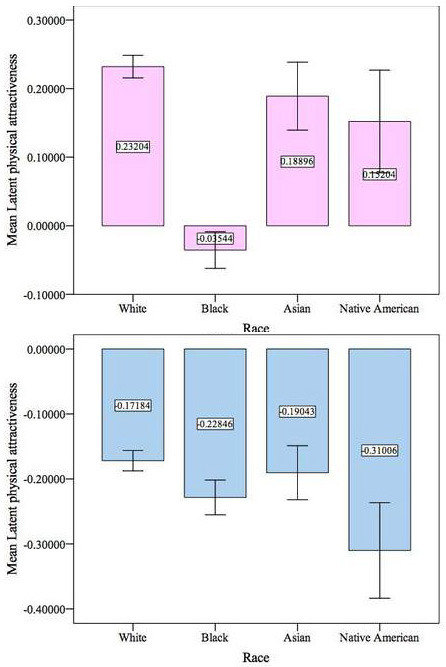
Black women are still less physically attractive than nonblack women net of BMI and intelligence. Net of intelligence, black men are significantly more physically attractive than nonblack men.Inconveniently for black men and Kanazawa, the real world does not control for intelligence. Further, if the association between intelligence and physical attractiveness rests on some underlying "good genes" factor, it makes little sense to try to "control" for intelligence when comparing races. The intelligence and attractiveness of someone with average genes for his race are what they are.
Subscribe to:
Posts (Atom)