Showing posts with label admixture. Show all posts

PoBI paper BTFO

We next analyzed UK Biobank population structure in conjunction with ancient DNA samples. Modern European populations are known to have descended from three ancestral populations: Steppe, Mesolithic Europeans and Neolithic farmers 21,22 . We projected ancient samples from these three populations as well as ancient Saxon samples 24 onto the UK Biobank PCs (Figure 3, Supplementary Figure 4, see Online Methods). These populations were primarily differentiated along PC1 and PC3, indicating higher levels of Steppe ancestry in northern UK populations.

Additionally, the lack of any ancient sample correlation with PC2 suggests that Welsh populations are not differentially admixed with any ancient population in our data set, and likely underwent Welsh-specific genetic drift. We confirmed these findings by projecting pan- European POPRES 26 samples onto the UK Biobank PCs (see Online Methods, Supplementary Figure 5) noting that of the continental European populations, Russians (who have the most Steppe ancestry) lie on one side and Spanish and Italians (who have least) 22 lie on the other side along PC1 and PC3, and that none of the continental European populations projected onto the same regions as the Welsh on PC2 and PC5.

In addition to the impact of ancient Eurasian populations, we know that the genetics of the UK has been strongly impacted by Anglo-Saxon migrations since the Iron Age 24 , with the Angles arriving in eastern England and the Saxons in southern England. The Anglo-Saxons interbred with the native Celts, which explains much of the genetic landscape in the UK. We analyzed a variety of samples from Celtic (Scotland and Wales) and Anglo-Saxon (southern and eastern England) populations from modern Britain in conjunction with the PoBI samples 20 and 10 ancient Saxon samples from eastern England 24 in order to assess the relative amounts of Steppe ancestry. [. . .] We consistently obtained significantly positive f4 statistics, implying that both the modern Celtic samples and the ancient Saxon samples have more Steppe ancestry than the modern Anglo-Saxon samples from southern and eastern England. This indicates that southern and eastern England is not exclusively a genetic mix of Celts and Saxons. There are a variety of possible explanations, but one is that the present genetic structure of Britain, while subtle, is quite old, and that southern England in Roman times already had less Steppe ancestry than Wales and Scotland.

Population structure of UK Biobank and ancient Eurasians reveals adaptation at genes influencing blood pressure. Kevin Galinsky, Po-Ru Loh, Swapan Mallick, Nick J Patterson, Alkes L Price doi: http://dx.doi.org/10.1101/055855

Note: I find it unlikely the pattern they observe is a holdover from Roman times. I suspect it will turn out the decrement of Steppe ancestry in England stems from a continual trickle of continental genes into England over the past 1000 years (from which the fringes of the British Isles were comparatively isolated).

Also supports my impression that the Wellcome Trust paper still overestimated the degree of Iron Age British admixture in modern England (given that the authors had assumed a simple two-way admixture, while the authors of the above preprint provide evidence "southern and eastern England is not exclusively a genetic mix of Celts and Saxons").

Related:

More ancient DNA from Britain supporting significant later Anglo-Saxon genomic impact

Genomic signals of migration and continuity in Britain before the Anglo-Saxons:

The purported migrations that have formed the peoples of Britain have been the focus of generations of scholarly controversy. However, this has not benefited from direct analyses of ancient genomes. Here we report nine ancient genomes (~1 ×) of individuals from northern Britain: seven from a Roman era York cemetery, bookended by earlier Iron-Age and later Anglo-Saxon burials. Six of the Roman genomes show affinity with modern British Celtic populations, particularly Welsh, but significantly diverge from populations from Yorkshire and other eastern English samples. They also show similarity with the earlier Iron-Age genome, suggesting population continuity, but differ from the later Anglo-Saxon genome. This pattern concords with profound impact of migrations in the Anglo-Saxon period. Strikingly, one Roman skeleton shows a clear signal of exogenous origin, with affinities pointing towards the Middle East, confirming the cosmopolitan character of the Empire, even at its northernmost fringes.
The full text is freely accessible. More:
Ancient sample ancestry within Britain

To place our ancient genomes within a detailed British context, we next plotted these in a background PCA using 3,075 published genotypes from British3, Irish23 and southern Netherlands samples24. The modern samples were analysed using SNP genotypes at ~250,000 loci and projected into a single plot using smartpca (Fig. 3a). As in Burton et al.3 the first component of the variation was informative for the structure within Britain. Given the close ancestral relationships between these populations and their well-known history of migrational exchange, a substantial overlap between regional groups was both expected and observed. However, by considering median values, one can see a clear progression from Irish samples at one pole through Scottish, Welsh, English to the Dutch cohort at the other extreme. In this plot the York Romans cluster centrally close to the modern Welsh median value, along with the Iron-Age genome. The local Anglo-Saxon is placed differently, closest to modern East Anglians between the English and Dutch medians.

This first component also offers an opportunity to compare within the English sample. Figure 3b shows a boxplot of PC1 values for each subsample and structure is evident, with higher median values in Eastern regions such as East Anglia, East Midlands, intermediate values in the southern and western parts and lower values in the north and northwest. This pattern is more clearly seen in a geographical plot of interpolated values (Fig. 5a). When the York Romans are compared together with each modern cohort, they are most similar to the Welsh distribution of PC1 values and differ significantly from all other regional groups, apart from those from North and Northwest England (Mann–Whitney test; Fig. 3b, Supplementary Note 2 and Supplementary Table 13). An interesting difference is the marked one between the Driffield Terrace ancient and contemporary Yorkshire samples (P=0.003), implying regional discontinuity. It is also worth noting that the PC1 coordinate of the Anglo-Saxon individual is closer to the median PC1 value of East Anglians, possibly reflecting a more pronounced contribution of Germanic immigrants to eastern British populations. However, we note the inherent uncertainty in drawing inference from a single sample.

Selection against Neanderthal introgression (two biorxiv preprints)

The Strength of Selection Against Neanderthal Introgression

Ivan Juric, Simon Aeschbacher, Graham Coop
doi: http://dx.doi.org/10.1101/030148

Hybridization between humans and Neanderthals has resulted in a low level of Neanderthal ancestry scattered across the genomes of many modern-day humans. After hybridization, on average, selection appears to have removed Neanderthal alleles from the human population. Quantifying the strength and causes of this selection against Neanderthal ancestry is key to understanding our relationship to Neanderthals and, more broadly, how populations remain distinct after secondary contact. Here, we develop a novel method for estimating the genome-wide average strength of selection and the density of selected sites using estimates of Neanderthal allele frequency along the genomes of modern-day humans. We confirm that East Asians had somewhat higher initial levels of Neanderthal ancestry than Europeans even after accounting for selection. We find that there are systematically lower levels of initial introgression on the X chromosome, a finding consistent with a strong sex bias in the initial matings between the populations. We find that the bulk of purifying selection against Neanderthal ancestry is best understood as acting on many weakly deleterious alleles. We propose that the majority of these alleles were effectively neutral-and segregating at high frequency-in Neanderthals, but became selected against after entering human populations of much larger effective size. While individually of small effect, these alleles potentially imposed a heavy genetic load on the early-generation human-Neanderthal hybrids. This work suggests that differences in effective population size may play a far more important role in shaping levels of introgression than previously thought.

The Genetic Cost of Neanderthal Introgression

Kelley Harris, Rasmus Nielsen
doi: http://dx.doi.org/10.1101/030387
Approximately 2-4% of the human genome is in non-Africans comprised of DNA intro- gressed from Neanderthals. Recent studies have shown that there is a paucity of introgressed DNA around functional regions, presumably caused by selection after introgression. This observation has been suggested to be a possible consequence of the accumulation of a large amount of Dobzhansky-Muller incompatibilities, i.e. epistatic effects between human and Neanderthal specific mutations, since the divergence of humans and Neanderthals approx. 400-600 kya. However, using previously published estimates of inbreeding in Neanderthals, and of the distribution of fitness effects from human protein coding genes, we show that the average Neanderthal would have had at least 40% lower fitness than the average human due to higher levels of inbreeding and an increased mutational load, regardless of the dominance coefficients of new mutations. Using simulations, we show that under the assumption of additive dominance effects, early Neanderthal/human hybrids would have experienced strong negative selection, though not so strong that it would prevent Neanderthal DNA from entering the human population. In fact, the increased mutational load in Neanderthals predicts the observed reduction in Neanderthal introgressed segments around protein coding genes, without any need to invoke epistasis. The simulations also predict that there is a residual Neanderthal derived mutational load in non-African humans, leading to an average fitness reduction of at least 0.5%. Although there has been much previous debate about the effects of the out-of-Africa bottleneck on mutational loads in non-Africans, the significant deleterious effects of Neanderthal introgression have hitherto been left out of this discussion, but might be just as important for understanding fitness differences among human populations. We also show that if deleterious mutations are recessive, the Neanderthal admixture fraction would gradually increase over time due to selection for Neanderthal haplotypes that mask human deleterious mutations in the heterozygous state. This effect of dominance heterosis might partially explain why adaptive introgression appears to be widespread in nature.

"Eight thousand years of natural selection in Europe" preprint - updated with Anatolian Neolithic and other data

Eight thousand years of natural selection in Europe

The arrival of farming in Europe around 8,500 years ago necessitated adaptation to new environments, pathogens, diets, and social organizations. While indirect evidence of adaptation can be detected in patterns of genetic variation in present-day people, ancient DNA makes it possible to witness selection directly by analyzing samples from populations before, during and after adaptation events. Here we report the first genome-wide scan for selection using ancient DNA, capitalizing on the largest genome-wide dataset yet assembled: 230 West Eurasians dating to between 6500 and 1000 BCE, including 163 with newly reported data. The new samples include the first genome-wide data from the Anatolian Neolithic culture, who we show were members of the population that was the source of Europe's first farmers, and whose genetic material we extracted by focusing on the DNA-rich petrous bone. We identify genome-wide significant signatures of selection at loci associated with diet, pigmentation and immunity, and two independent episodes of selection on height. [. . .]

Our sample of 26 Anatolian Neolithic individuals represents the first genome-wide ancient DNA data from the eastern Mediterranean. Our success at analyzing such a large number of samples is likely due to the fact that at the Barcin site–the source of 21 of the working samples–we sampled from the cochlea of the petrous bone 9 , which has been shown to increase the amount of DNA obtained by up to two orders of magnitude relative to teeth (the next-most-promising tissue) 3 . Principal component (PCA) and ADMIXTURE 10 analysis, shows that the Anatolian Neolithic samples do not resemble any present-day Near Eastern populations but are shifted towards Europe, clustering with Neolithic European farmers (EEF) from Germany, Hungary, and Spain 7 (Fig. 1b, Extended Data Fig. 2). Further evidence that the Anatolian Neolithic and EEF were related comes from the high frequency (47%; n=15) of Y-chromosome haplogroup G2a typical of ancient EEF samples 7 (Supplementary Data Table 1), and the low F ST (0.005-0.016) between Neolithic Anatolians and EEF (Supplementary Data Table 2). These results support the hypothesis 7 of a common ancestral population of EEF prior to their dispersal along distinct inland/central European and coastal/Mediterranean routes. The EEF are slightly more shifted to Europe in the PCA than are the Anatolian Neolithic (Fig. 1b) and have significantly more admixture from Western hunter-gatherers (WHG), shown by f 4 -statistics (|Z|>6 standard errors from 0) and negative f 3 -statistics (|Z|>4) 11 (Extended Data Table 3). We estimate that the EEF have 7- 11% more WHG admixture than their Anatolian relatives (Extended Data Fig. 2, Supplementary Information section 2).

On the presence of the "East Asian" EDAR variant in Scandinavian hunter-gatherers:
We find a surprise in six Scandinavian hunter-gatherers (SHG) from the Motala site in southern Sweden. In three out of six samples, we observe the haplotype carrying the derived allele of rs3827760 in the EDAR gene (Extended Data Fig. 5), which affects tooth morphology and hair thickness and has been the subject of a selective sweep in East Asia 24 , and today is at high frequency in East Asians and Native Americans. The EDAR derived allele is largely absent in present-day Europe except in Scandinavia, plausibly due to Siberian movements into the region millennia after the date of the Motala samples. The SHG have no evidence of East Asian ancestry 4,7 , suggesting that the EDAR derived allele may not have originated not in East Asians as previously suggested 24 . A second surprise is that, unlike closely related western hunter-gatherers, the Motala samples have predominantly derived pigmentation alleles at SLC45A2 and SLC24A5.
Polygenic selection on height in Europe:

We also tested for selection on complex traits. The best-documented example of this process in humans is height, for which the differences between Northern and Southern Europe have driven by selection 25 . To test for this signal in our data, we used a statistic that tests whether trait-affecting alleles are both highly correlated and more differentiated, compared to randomly sampled alleles 26 . We predicted genetic heights for each population and applied the test to all populations together, as well as to pairs of populations (Fig. 4). Using 180 height-associated SNPs 27 (restricted to 169 where we successfully targeted at least two chromosomes in each population), we detect a significant signal of directional selection on height (p=0.002). Applying this to pairs of populations allows us to detect two independent signals. First, the Iberian Neolithic and Chalcolithic samples show selection for reduced height relative to both the Anatolian Neolithic (p=0.042) and the Central European Early and Middle Neolithic (p=0.003). Second, we detect a signal for increased height in the steppe populations (p=0.030 relative to the Central European Early and Middle Neolithic). These results suggest that the modern South-North gradient in height across Europe is due to both increased steppe ancestry in northern populations, and selection for decreased height in Early Neolithic migrants to southern Europe. We do not observe any other significant signals of polygenetic selection in five other complex traits we tested: body mass index 28 (p=0.20), waist-to-hip ratio 29 (p=0.51), type 2 diabetes 30 (p=0.37), inflammatory bowel disease 21 (p=0.17) and lipid levels 16 (p=0.50).

More carriers of deeply diverged Y lineage (haplogroup A00) found in Cameroon

This possibly archaic African Y lineage was discovered a few years ago by hobbyists, and a project run and funded by hobbyists to collect and test additional A00 samples has started to report results:
There are some striking patterns in the results already. 85% of the A00 so far are from the Bangwa (Nweh) people, and 15% from the Nkongho-Mbo. This is despite the fact that nearly 57% of the samples collected were from Mbo, and only 37% were from Bangwa. Once all the results have been fully tabulated, we can provide more complete statistics. It will take a while to transcribe all the rich data from those handwritten sheets into electronic spreadsheets. [. . .]

What's next? Matthew would like to head back to the field quite soon, in the second half of October, when the school where he teaches has a break. Our current plan is for him to visit the region of the Bamileke people. Matthew, an ethno-historian, has said "The similarity in names, language, dancing style and all other aspects of life suggest that the Bangwa are 90 percent Bamileke." By testing a good number of Bamileke, we'll be able to see whether the heritage they share includes A00, or not. It is possible that the A00 among the Bangwa comes from the indigenous people who originally inhabited the hills, before they arrived several centuries ago, or it could also have been present among the Bamileke earlier. Our results should give strong evidence to answer that question.

The next field trips should be even more exciting. One of our goals is to collect the most diverse samples of A00 possible, to uncover its internal structure. By sequencing the Y-DNA of A00 lines that have diverged and settled in different parts of Cameroon, we should be able to get a good idea of when those different lineages had a common ancestor, and understand better how the peoples among whom it's found are related.

One trip will take Matthew westward into the lowland regions close to Nigeria, where the Banyangi and Ejagham peoples live, toward the Cross River, home of the endangered Cross River Gorilla. These villages are also on the roads that led to the old Nigerian port of Calabar, where captives from Cameroon's highlands, including some Bangwa, were sold into slavery in the past. He has never before sampled in the western regions, and only 16 Banyangi have been tested in his past research, but there are versions of Bangwa history which say that these peoples make up a significant element of their founders. Members of the A0 haplogroup have been found in Nigeria, but we have no idea yet whether A00 are also found in that direction. The famed Iwo Eleru cave is in southern Nigeria, where a skull with archaic features has been found that dates to only 13,000 years ago, suggesting long survival of diverse humans in that region.

In his other trip, he'll seek to sample members of several of the different Pygmy communities of Cameroon, who live to the South and East. Among the Pygmy peoples, Matthew collected 53 samples in 2006, and two of them belonged to A00! These communities are far from the highlands where the Bangwa and Mbo live, so we can expect that their A00 will be quite distinct. This should be extremely interesting!

Minor sub-Saharan and substantial Levantine admixture in Southern Europe

According to "The Role of Recent Admixture in Forming the Contemporary West Eurasian Genomic Landscape", something like a third of Southern Italian and Tuscan genetic ancestry appears to derive from the Levant in Roman times:

Moorjani et al [S?], who use a method based on allele frequency comparisons, and not haplotypes (ROLLOFF), found evidence for sub-Saharan African admixture in Sardinia 71±28 generations ago, at a proportion of 3%. These are the same Sardinians included in our analysis. In the largest Sardinian (sardi13) cluster in our analysis we infer West African admixture 66 (53-82) generations ago at a proportion of 2%.

S5.2 Continuous low level African admixture in the Mediterranean and Anatolia

We infer West African admixture across broad date ranges, but at low admixture proportions (admixture α < 0.07; Figs. 2 and S3) in several Mediterranean groups, consistent with a long term movement be- tween sub-Saharan Africa and southern Europe [S?,S?]. Specific West African admixture dating to the Arabic conquest of the Mediterranean [S?] is seen in Spanish (spani27: 1042 (740-1201CE)), Southern Italian and Sicilian (sicil30: 1105 (882-1250CE)), and Basque (basqu24: 886 (283-1162CE)) clusters. Earlier African admixture at low admixture proportion is inferred in the Cypriots (cypri12: 427(107- 734CE)), and a Sardinian cluster (sardi13: 36 (458BCE-430CE); α = 0.02). This latter event is con- sistent with the occurrence of A3b2-M13 (0.6%) and E1a-M44 (0.4%) African Y chromosome lineages in Sardinia [S?]. and the dating is more compatible with documented exchanges between the island and Mauretania Cesariensis in Roman times (2 nd century BCE to 2 nd century CE) than later displacements of northern-African males to Sardinia at the time of the Vandals rule (5 th century CE) [S?]. [. . .]

S5.3 A key role for the Levant in the genetic history of the Mediterranean

Early admixture involving source groups most similar to contemporary populations from in and around the Levant (which we define as the World Region containing individuals from Syria, Palestine, Lebanon, Jordan, Saudi, Yemen and Egypt) is seen at high proportions in several clusters from Italy dating to the first half of the first millennium CE, from Southern Italy (itali8: 295CE (72BCE-604CE); α = 0.34), Tuscany (tsi23: 400CE(30BCE-686); α = 0.29), and Sardinia, as well as in a large cluster from Armenia at an early date (armen27: 363BCE(1085BCE-383CE)). [. . .] these events loosely coincide with the formation of the pan-Mediterranean Roman Empire [S?], which may also have allowed increased gene flow from east to west Mediterranean. [. . .] We infer more recent Levant admixture in the French (frenc24: 728(424-1011CE)) and in a complex multiway event in a Spanish cluster (spani9: 668 (286-876CE)). The dates and sources of admixture in these cases are consistent with movements of Middle Eastern and North African individuals during the Islamic Conquest of Spain [S?], and suggest a legacy of this key moment in southern European history in the genomes of French as well as Spanish populations.

ASHG 2015: The lingering load of archaic admixture in modern human populations

The lingering load of archaic admixture in modern human populations.

K. Harris1,2 ; R. Nielsen2,3

1) Stanford University, Stanford, CA; 2) University of California Berkeley, Berkeley, CA; 3) Center for Bioinformatics, University of Copenhagen, Copenhagen, Denmark.

Founder effects and bottlenecks can damage fitness by letting deleterious alleles drift to high frequencies. This almost certainly imposed a burden on Neanderthals and Denisovans, archaic hominid populations whose genetic diversity was less than a quarter of the level seen in humans today. A more controversial question is whether the out-of-Africa bottleneck created differences in genetic load between modern human populations. Some previous studies concluded that this bottleneck saddled non-Africans with potentially damaging genetic variants that could affect disease incidence across the globe today (e.g. Lohmueller, et al. 2009; Fu, et al. 2014), while other studies have concluded that there is little difference in genetic load between Africans and non-Africans (e.g. Simons, et al. 2014; Do, et al. 2015). Although previous studies have devoted considerable attention to simulating the accumulation of deleterious mutations during the out-of-Africa bottleneck, none to our knowledge have incorporated the fitness effects of introgression from Neanderthals into non-Africans. We present simulations showing that archaic introgression may have had a greater fitness effect than the out-of-Africa bottleneck itself, saddling non-Africans with weakly deleterious alleles that accumulated as nearly neutral variants in Neanderthals. Assuming that the exome experiences deleterious mutations with additive fitness effects drawn from a previously inferred gamma distribution, we predict that the fitness of the average Neanderthal was about 50% lower than the fitness of the average human, implying the existence of strong selection against early Neanderthal-human hybrids. This is a direct consequence of mutation accumulation during a period of low Neanderthal population size that is thought to have lasted ten times longer than the out-of-Africa bottleneck (Pruefer, et al. 2014). Although our model predicts some transmission of deleterious Neanderthal variation to present-day non-Africans, it also predicts that many Neanderthal alleles have been purged away, depleting conserved genomic regions of Neanderthal ancestry as observed empirically by Sankararaman, et al. (2014). Our results imply that the deficit of Neanderthal DNA from functional genomic regions can be explained without the action of epistatic reproductive incompatibilities between human and Neanderthal alleles.

ASHG 2015: The genetic structure of the Saudi Arabian population

The genetic structure of the Saudi Arabian population.

H. Al-Saud1 ; SM. Wakil1 ; BF. Meyer1 ; M. Falchi2 ; N. Dzimiri1

1) Genetics Department, King Faisal Hospital and Research Centre, Riyadh, Saudi Arabia; 2) Department of Twin Research and Genetic Epidemiology, King’s College London, London, United Kingdom.

Saudi Arabia is the largest Gulf Cooperation Council (GCC) country. Its population consists of different tribes that originated in the northern, western, eastern, middle and south regions of Saudi Arabia, respectively. Due to political and cultural reasons, there has historically been very limited admixture between different tribes. People from the different Saudi tribes then migrated from Saudi Arabia, contributing to foundation of the populations now inhabiting other Gulf countries. Few population genetics research projects have been conducted on this highly consanguineous population that has been shown to have one of the highest prevalence in the world of recessive disorders and common metabolic diseases, especially diabetes. It is therefore important to identify the genetic substructures of the Saudi population, both to help in tracing the migratory genetic flows that contributed to other Gulf populations, and to permit designing of efficient genetic studies aimed at the identification of risk factors underlying common and rare diseases in the GCC countries. We carried out the largest population genetic study in Saudi Arabia to date, by genotyping 2,150 Saudi nationals sampled from different regions of Saudi Arabia using Axiom GWH-96 Array (Affymetrix) arrays. Model-based and model-free clustering were applied to these data, including in our analyses data on eight populations (encompassing Europe, America, Oceana, East Asia, Central South Asia, Middle East, Africa and Qatari populations) from the Human Genetic Diversity Project (HGDP) data set. We identified clear clustering of the Saudi samples into different subgroups, with some tribes showing similarity with both Central East Asian (Kalash Pakistan, Balochi Pakistan, Sindhi Pakistan, Makrani Pakistan and Brahui Pakistan subpopulations) European (Orkney Islands Europe, Russian Europe and Russian Caucasus subpopulations) and Qatari populations, while other tribes appear to show specificity of background.These data strongly support the presence of genetic stratification within the Saudi population, and suggest the presence of subgroups that are characterized by a unique genetic background different from other Arabian populations. Our findings constitute a valuable resource for the investigation of both general and population-specific genetic risk variants associated with different disorders in this population.

ASHG 2015: ancient Anatolians similar to European Neolithic farmers and distinct from modern Near Easterners

Genome-wide data on 34 ancient Anatolians identifies the founding population of the European Neolithic.

I. Lazaridis1,2 ; D. Fernandes3 ; N. Rohland1,2 ; S. Mallick1,2,4 ; K. Stewardson1,4 ; S. Alpaslan5 ; N. Patterson2 ; R. Pinhasi*3 ; D. Reich*1,2,4

1) Department of Genetics, Harvard Medical School, Boston, MA USA; 2) Broad Institute of MIT and Harvard, Cambridge, MA USA; 3) Conway Institute of Biomolecular and Biomedical Research, University College Dublin, Dublin, Ireland; 4) Howard Hughes Medical Institute, Harvard Medical School, Boston, MA USA; 5) Independent physical anthropologist, Netherlands.

It has hitherto been difficult to obtain genome-wide data from the Near East. By targeting the inner ear region of the petrous bone for extraction [Pinhasi et al., PLoS One 2015] and using a genome-wide capture technology [Haak et al., Nature, 2015] we achieved unprecedented success in obtaining genome-wide data on more than 1.2 million single nucleotide polymorphism targets from 34 Neolithic individuals from Northwestern Anatolia (~6,300 years BCE), including 18 at greater than 1× coverage. Our analysis reveals a homogeneous population that is genetically a plausible source for the first farmers of Europe in the sense of (i) having a high frequency of Y-chromosome haplogroup G2a, and (ii) low Fst distances from early farmers of Germany (0.004 ± 0.0004) and Spain (0.014 ± 0.0009). Model-free principal components and model-based admixture analyses confirm a strong genetic relationship between Anatolian and European farmers. We model early European farmers as mixtures of Neolithic Anatolians and Mesolithic European hunter-gatherers, revealing very limited admixture with indigenous hunter-gatherers during the initial spread of Neolithic farmers into Europe. Our results therefore provide an overwhelming support to the migration of Near Eastern/Anatolian farmers into southeast and Central Europe around 7,000-6,500 BCE [Ammerman & Cavalli Sforza, 1984, Pinhasi et al., PLoS Biology, 2005]. Our results also show differences between early Anatolians and all present-day populations from the Near East, Anatolia, and Caucasus, showing that the early Anatolian farmers, just as their European relatives, were later demographically replaced to a substantial degree.

ASHG 2015: Moorish admixture in Spain

Fine scale population structure of Spain and the genetic impact of historical invasions and migrations.

C. Bycroft1 ; C. Fernandez-Rozadilla1,2 ; A. Carracedo2 ; C. Ruiz-Ponte2 ; I. Quintela-García3 ; P. Donnelly1,4 ; S. Myers1,4

As well as being linguistically and culturally diverse, the Iberian Peninsula is unusual among European regions in that its demographic history includes a prolonged and large-scale occupation by people of predominately north-west African origin. Therefore, the Iberian Peninsula provides a unique opportunity for studying fine-scale population structure and admixture, and to test cutting-edge methods of detecting complex or subtle population genetic patterns.Previous studies using Y-chromosome, mtDNA as well as autosomal data have detected limited genetic structure in Iberia. However, powerful new methods and larger datasets mean it has recently become possible to detect and characterise genetic differentiation at a sub-national level. We performed the largest and most comprehensive study of Spanish population structure to date by analysing a dataset of ~1,400 Spanish individuals typed at ~700,000 SNPs. Using the fineSTRUCTURE method we detected striking and rich patterns of population differentiation within Spain, at scales down to tens of kilometres. Strikingly, the major axis of genetic differentiation in Spain runs from west to east, while conversely there is remarkable genetic similarity in the north-south direction.To infer details of historical population movements into Spain, we analysed Spain alongside a sample of ~6,000 individuals from Europe, North Africa, and sub-Saharan Africa. Across Spanish groups, we identify varying genetic contributions from north-west African ancestral populations, at times that all fall within the period of Islamic occupation. We also identify Basque-like admixture within Spanish groups to the south of the Basque-speaking region, implying southerly gene flow from this region. This analysis has revealed details of the strengths and weaknesses of different approaches to investigating population genetic history, as well as providing important new insights into the complex genetic history of Spain.

ASHG 2015: Historical mating patterns in the U.S.

Historical mating patterns in the U.S. revealed through admixture and IBD patterns from genome-wide data from over 800,000 individuals.

J. M. Granka1 ; Y. Wang1 ; E. Han1 ; J. K. Byrnes1 ; A. Kermany1 ; R. E. Curtis2 ; P. Carbonetto1 ; K. Noto1 ; M. J. Barber1 ; N. M. Myres2 ; C. A. Ball1 ; K. G. Chahine2

1) AncestryDNA, San Francisco, CA; 2) AncestryDNA, Provo, UT.

Within a diverse population like the United States, many individuals are admixed, with ancestry from many worldwide regions. Non-random mating and migration can result in non-random combinations of ancestries within ad­­­mixed individuals (i.e., certain sets of ancestries may be common, and others may be rare); such dynamics can also affect patterns of identity-by-descent (IBD) among admixed and non-admixed individuals. To shed insight into historical mating and migration, we study genome-wide genotype data of over 800,000 AncestryDNA customers, as well as a subset of over 400,000 born in the US. First, we use a supervised algorithm to estimate individuals’ genetic admixture proportions across 26 global regions. We measure correlations between the estimated ancestries, and find certain sets of ancestries to frequently co-occur in individuals’ estimates. Such relationships may reflect historical events; e.g., the association between ancestry from the Americas and the Iberian Peninsula could reflect Colonial Era admixture. In addition to historical mating patterns, however, the admixture inference procedure and the delineation of global regions could also impact such correlations. To disentangle whether these trends could reflect mating patterns and preferences, we examine associations between the estimated ancestries of the parents of over 10,000 trios. Observed correlations agree with many of those identified within individuals, and potentially reflect more recent historical trends. Thirdly, we extend our study to IBD patterns in an inferred IBD network among genotyped individuals. Sub-clusters of the IBD network, which can often be annotated by ethnicity or historical US migration, are often inter-connected by bridging IBD connections; we highlight several connected sub-clusters in light of findings from genetic ancestry. Finally, we corroborate findings from these three analyses, as well as their potential timescales, by examining over 500,000 AncestryDNA customer pedigrees. Associations of country-level birth locations between pairs of couples support many of the non-random associations of ethnicities and IBD connections identified using genetic data. Many of the associations we observe reflect historical phenomena, and while not conclusive about their cause, suggest that many individuals with admixed ancestry, including those in the US, have present-day genetic signatures reflecting the migration and subsequent non-random mating of their ancestors.

Ancient genomes from Iberia

Both papers are freely accessible.

A common genetic origin for early farmers from Mediterranean Cardial and Central European LBK cultures (pdf; supplementary material)

The spread of farming out of the Balkans and into the rest of Europe followed two distinct routes: an initial expansion represented by the Impressa and Cardial traditions, which followed the Northern Mediterranean coastline; and another expansion represented by the LBK tradition, which followed the Danube River into Central Europe. While genomic data now exist from samples representing the second migration, such data have yet to be successfully generated from the initial Mediterranean migration. To address this, we generated the complete genome of a 7,400 year-old Cardial individual (CB13) from Cova Bonica in Vallirana (Barcelona), as well as partial nuclear data from five others excavated from different sites in Spain and Portugal. CB13 clusters with all previously sequenced early European farmers and modern-day Sardinians. Furthermore, our analyses suggest that both Cardial and LBK peoples derived from a common ancient population located in or around the Balkan Peninsula. The Iberian Cardial genome also carries a discernible hunter-gatherer genetic signature that likely was not acquired by admixture with local Iberian foragers. Our results indicate that retrieving ancient genomes from similarly warm Mediterranean environments such as the Near East is technically feasible.

Ancient genomes link early farmers from Atapuerca in Spain to modern-day Basques (pdf; supplementary material)

The consequences of the Neolithic transition in Europe—one of the most important cultural changes in human prehistory—is a subject of great interest. However, its effect on prehistoric and modern-day people in Iberia, the westernmost frontier of the European continent, remains unresolved. We present, to our knowledge, the first genome-wide sequence data from eight human remains, dated to between 5,500 and 3,500 years before present, excavated in the El Portalón cave at Sierra de Atapuerca, Spain. We show that these individuals emerged from the same ancestral gene pool as early farmers in other parts of Europe, suggesting that migration was the dominant mode of transferring farming practices throughout western Eurasia. In contrast to central and northern early European farmers, the Chalcolithic El Portalón individuals additionally mixed with local southwestern hunter–gatherers. The proportion of hunter–gatherer-related admixture into early farmers also increased over the course of two millennia. The Chalcolithic El Portalón individuals showed greatest genetic affinity to modern-day Basques, who have long been considered linguistic and genetic isolates linked to the Mesolithic whereas all other European early farmers show greater genetic similarity to modern-day Sardinians. These genetic links suggest that Basques and their language may be linked with the spread of agriculture during the Neolithic. Furthermore, all modern-day Iberian groups except the Basques display distinct admixture with Caucasus/Central Asian and North African groups, possibly related to historical migration events. The El Portalón genomes uncover important pieces of the demographic history of Iberia and Europe and reveal how prehistoric groups relate to modern-day people.

The fine-scale genetic structure of the French population

The fine-scale genetic structure of the French population (preprint):

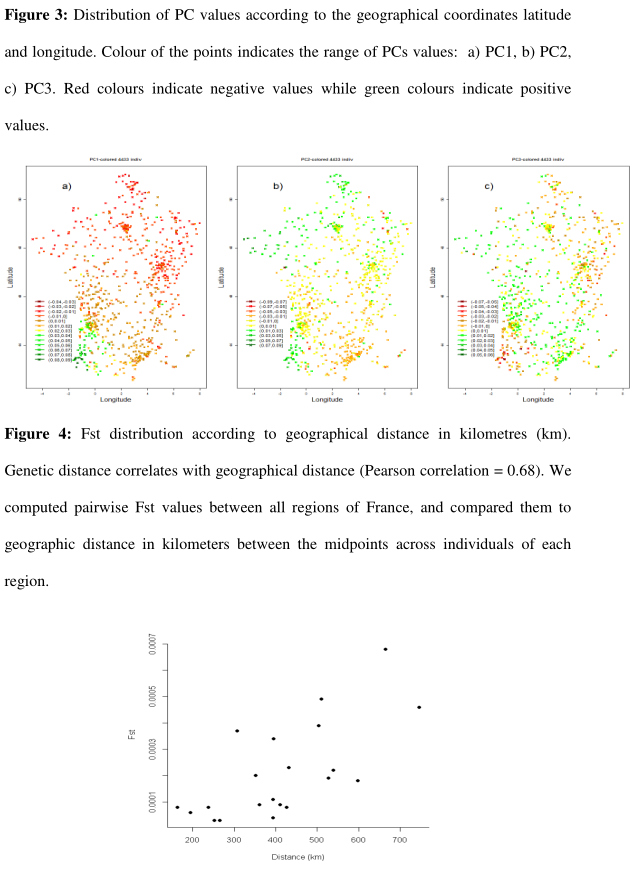
The existence of population stratification is a major problem in case-control association studies and there is a need for a better assessment of allele frequency variation within populations at all geographic scales. Such efforts have been conducted in different European countries where strong patterns of geographic variations were found. The genome-wide extent of variations in allele frequencies of common variants has however never been documented at the scale of France. In this study, we describe these patterns of variation using genome-wide SNP chip data from 4,433 individuals, recruited as part of the Three-City study and whose places of birth in France were available. We show that there is a strong correlation between the top three principal components extracted from the genetic data and the latitude and longitude of birth places. Using multiple linear regression models, we were able to determine the birth places within less than 197 km of the reported origin for 50% of the individuals. Using model-based clustering with seven main geographic regions, we found that individuals were assigned in majority to their true region of origin. However, we found that information on ancestry could not be retrieved by using a small panel of Ancestry-Informative Markers (AIMs).

Sewall Wright on race differences, group selection, and cultural selection among humans (1978)

[From Evolution and the Genetics of Populations, Volume 4: Variability Within and Among Natural Populations, pp. 439-457]

Racial Differentiation in Mankind

The existence of conspicuous diversity among human populations in physical appearance has been common knowledge at least since the time of ancient Egypt. The subject is discussed at length in numerous books on physical anthropology and need not be considered here in detail.

There is no question that all mankind constitutes a single species in view of the absence of any physiological bar to hybridization between the most diverse races or of any recognizable loss of vigor in the first or later generations.

There is also no question, however, that populations that have long inhabited widely separated parts of the world should, in general, be considered to be of different subspecies by the usual criterion that most individuals of such populations can be allocated correctly by inspection. It does not require a trained anthropologist to classify an array of Englishmen, West Africans, and Chinese with 100% accuracy by features, skin color, and type of hair in spite of so much variability within each of these groups that every individual can easily be distinguished from every other.

[. . .] It has been indicated earlier that such an evolutionary process as that of man is much more understandable if it occurred by the shifting balance process. Simultaneous sampling drive at thousands of sufficiently neutral loci provides different material in innumerable localities without appreciable cost, material that can give the basis for effective interdeme selection.

Was the population structure of primitive man favorable to this process? There have been a number of studies of the few remaining peoples at the hunting and gathering level of culture that bear on this matter. Birdsell (1972), in an intensive study of Australian aborigines in western Australia, has described their population structure. The primary territorial unit is the band, consisting of a group of related families. Marriage is exogamous but largely restricted to the tribe, a group of bands in which the same dialect is spoken. He estimates the average total number in a tribe to be about 500, with a breeding population of about 185 and an effective number of about 100. This is small enough for the building up of considerable differences among large areas at each nearly neutral polymorphic locus merely by sampling drift. There is thus the basis for operation of the shifting balance process. [. . .]

The actual process of interdeme selection may take different forms. At one extreme, the local appearance of a superior genetic system is followed by expansion of its territory accompanied by complete elimination of its neighbors until it occupies the entire range of the species. At the other extreme there is merely excess diffusion from the superior center. Neighboring populations are graded up until they reach the point (the crossing of a saddle in the surface of selective values) at which mass selection carries them autonomously to the new selective peak, or perhaps beyond, if they contribute something that improves on the latter. The locations of the population with the highest selective peak may shift from place to place in the course of time, as a group of neighboring populations step each other up to heights well above the general level.

Bigelow (1969) has emphasized the importance of tribal warfare in the operation of this process. A tribe that is generally successful because of superior intelligence, capacity for cooperation, and high frequency of the heroic virtues as well as physical prowess, tends to increase its territory and also to grade up what is left of the defeated group by hybridization. The process is illustrated by the incessant tribal warfare of the tribes of American Indians observed by the European settlers in America, in which some tribes such as the Iroquois expanded at the expense of their neighbors.

The heroic virtues, including willingness to sacrifice one's own life for the good of the tribe, are traits that can hardly be developed (insofar as they have a genetic basis) by purely individual selection. They may to some extent arise as a by-product of familial selection in which close relatives with heredities strongly correlated with that of an individual who gives his own life to save them. As noted earlier, the effectiveness of familial selection in general is testified to by the improvement of milk production in cattle and of egg production fowls, mainly by selection of males on the basis of the performance of close female relatives. The importance of this sort of intergroup selection in evolution has been emphasized as noted in chapter 7 by Hamilton. The increase in frequency of traits deleterious on the average to their possessors but beneficial to the deme may also, however, be increased by interdeme selection (referred to as intergroup selection in early articles) if the benefit to the deme sufficiently outweighs the damage to the individual. A more rigorous demonstration of this mode of evolution of "altruistic" characters as been given by Eshel (1972).

Not all interdeme selection in man has consisted of intertribal warfare. According to Birdsell, about 15% of marriage among Australian aborigines were intertribal; not enough as shown by the wide variability of gene frequencies to homogenize the whole population but enough to permit effective interdeme selection if exchange was asymmetrical, predominantly from the more to the less successful. That differences were not swamped was presumably due to the exchange being largely between neighboring tribes which differed little, as indicated by the semiclinal nature of the pattern of gene frequencies. The average effective immigration from the population as a whole, the m of formulas, was thus very much less than 0.15. [. . .]

Evolution Since the Origin of Agriculture [. . .]

We can form a better idea of the course of event than in any earlier period but the interpretation is confused by the exponential progress of a second evolutionary process, barely existent at all in any other animal, and little if any more rapid in the earlier history man than his biological evolution.

This is the evolution of culture with its line of transmission largely from speaker to listener, supplemented in the last three thousand years by transmission from writer to reader. It began to become of major importance with the origin of language, but during the hunting and gathering phase of human life the slow advance of culture is indicated by that in the fashioning of stone tools and weapons. It was probably accompanied by relatively rapid diffusion of knowledge of such advances as were made. The success of tribes thus probably depended to a greater extent on capabilities, determined by their genes, than on the possession of techniques not known to their neighbors.

The mode of evolution of culture is analogous to that of the genetic system. Invention is the analog of mutation. Diffusion of culture is the analog of gene flow. Cultural variation is continually subject to selection on the basis of utility. There is random cultural drift, exemplified by the breaking up of languages into dialects. Finally, the most favorable conditions for cultural advance is local isolation, providing the basis for simultaneous trial and error among many variants and the diffusion of the more successful ones in analogy with the shifting balance process in biological evolution. We think here of the multiple competing cultures in ancient Southwest Asia, the evolution of culture among the city states of ancient Greece, and in much divided Europe from the Dark Ages to modern times. The great empires of the ancient Southwest Asia of Alexander and of Rome constituted an overbalancing final phase in the process, giving widespread diffusion but less progress by trial and error.

There has undoubtedly always been a considerable but incomplete correlation between the two kinds of evolution. The state of the culture has been to a considerable extent an index of the rank of populations genetically in the distinctive human line of evolutionary advance, and reciprocally the demands of culture have been the primary selective agent in this advance in its later stages. Aspects of culture are continually being borrowed, but whether such borrowings are effectively integrated into the existent culture to form new peaks (as most conspicuously in the recent period in Japan), or are adopted only superficially and to the detriment of the previous culture, is also an index of genetic capability.

The treatment of either the genetic capabilities or the cultures of peoples as if they could be ranked on single scales is, of course, a gross simplification. If the multiple genetic aspects of mental ability could be measured more independently of culture than is the case, it would no doubt be found that each local race has its own unique combination of favorable qualities. At present only IQ seems to have a repeatability that permits evaluation of the contributions of genetic and nongenetic variabilities to its variability, discussed in the previous chapter, and this only within a particular culture.

On the other hand there have probably always been wide differences among the peoples of the world in average intellectual ability and cultural level from the standpoint of progress toward the situation in civilized man. This was presumably related to the environmental conditions. Men could not endure the northern winters without fire, the use of which is documented by hearths found in France dating back over half a million years and somewhat later in Hungary and in China but only about one-tenth as far back in Africa (Campbell 1974).

The capacity to anticipate and plan for the future is a mental attribute which would be favored under northern conditions and selected for insofar as it has a genetic basis. This would presumably have come to be more advanced in the temperate zone than in the tropics. [. . .]

Linguistic evidence indicates the establishment of an important center of diffusion in east-central Europe some 5,000 years ago from which wave after wave peoples moved in all directions. The Hittites carried an Indo-European language of the western (centum) type into Asia Minor and established an empire some 4,000 years ago. A thousand years later the Iranians, who had moved east into what is now southern Russia and Turkestan, brought an Indo-European language of the eastern (satem) type into the original cultural center and later established the Persian Empire. They also carried another Aryan dialect to India. Other tribes moving south from the east-central European center reached Greece in several waves which, after mixing with the indigenous people, produced classical Greek civilization.

Other waves moved to the southwest into Italy, giving rise to Latin and other Italic languages; to the west, giving rise to Celtic languages in what is now southern Germany, France, and the British Isles; and to the northwest into what is not northern Germany and Scandinavia, to give rise, in much altered form, to the Germanic languages. Subsequent migrations greatly expanded the areas occupied by derivatives of Latin and Germanic branches at the expense in Europe of the Celtic. All the tribal migrations were undoubtedly accompanied by much intermixture with indigenous peoples, but the diffusion of language also undoubtedly implies considerable gene flow.

[. . .] The history of Europe, especially western Europe, was thus prevailingly one of inflow of genes up to the relatively recent period in which it itself became a center of massive outflow.

Related posts:

Iron Age and Anglo-Saxon genomes from East England reveal British migration history

A preprint on some ancient DNA work in England is up. Researchers sequenced samples from seven early and middle Anglo-Saxon period and three late Iron Age (presumably Celtic) skeletons.

We  generated  a  principal  component  plot  of  the  ten  ancient  samples  together with  relevant  European  populations  selected  from  published  data 10,11  (Extended data  Figure  3).  The  ancient  samples  fall  within  the  range  of  modern  English  and Scottish  samples,  with  the  Iron  Age  samples  from  Hinxton  and  Linton  falling closer  to  modern  English  and  French  samples,  while  most  Anglo-­Saxon  era samples  are  closer  to  modern  Scottish  and  Norwegian  samples.  Overall,  though, population  genetic  differences  between  these  samples  at  common  alleles  are very  slight.

While  principal  component  analysis  can  reveal  relatively  old  population structure,  such  as  generated  from  long-­‐term  isolation-­‐by-­‐distance  models 12 , whole  genome  sequences  let  us  study  rare  variants  to  gain  insight  into  more recent  population  structure. [. . .]

There are  striking  differences  in  the  sharing  patterns  of  the  samples,  illustrated  by  the ratio  of  the  number  of  rare  alleles  shared  with  Dutch  individuals  to  the  number shared  with  Spanish  individuals  (Figure  2a).   The  middle  Anglo-­‐Saxon  samples from  Hinxton  (HS1,  HS2,  HS3)  share  relatively  more  rare  variants  with  modern Dutch  than  the  Iron  Age  samples  from  Hinxton  (HI1,  HI2)  and  Linton  (L).  The early  Anglo-­‐Saxon  samples  from  Oakington  are  more  diverse,  with  O1  and  O2 being  closer  to  the  middle  Anglo-­‐Saxon  samples,  O4  exhibiting  the  same  pattern as  the  Iron  Age  samples,  and  O3  showing  an  intermediate  level  of  allele  sharing, suggesting  mixed  ancestry.  The  differences  between  the  samples  are  highest  in low  frequency  alleles  and  decrease  with  increasing  allele  frequency.  This  is consistent  with  mutations  of  lower  frequency  on  average  being  younger, reflecting  more  recent  distinct  ancestry,  compared  with  higher  frequency mutations  reflecting  older  shared  ancestry.  

Comparing the relative number of rare alleles shared with the Dutch and Spanish samples, the researchers estimate 30% Anglo-Saxon admixture in the present-day East English and 20% in the Scottish and Welsh.

We  also  examined  using  the  same  method  30  modern  samples  from  the  UK10K project   16 ,  10  each  with  birthplaces  in  East  England,  Wales  and  Scotland.  Overall, these  samples  are  closer  to  the  Iron  Age  samples  than  to  the  Anglo-­‐Saxon  era samples  (Figure  2a).  There  is  a  small  but  significant  difference  between  the  three modern  British  sample  groups,  with  East  English  samples  sharing  slightly  more alleles  with  the  Dutch,  and  Scottish  samples  looking  more  like  the  Iron  Age samples.  To  quantify  the  ancestry  fractions,  we  fit  the  modern  British  samples with  a  mixture  model  of  ancient  components,  by  placing  all  the  samples  on  a linear  axis  of  relative  Dutch  allele  sharing  that  integrates  data  from  allele  counts one  to  five  (Figure  2b).  By  this  measure  the  East  England  samples  are  consistent with  30%  Anglo-­‐Saxon  ancestry  on  average,  with  a  spread  from  20%  to  40%, and  the  Welsh  and  Scottish  samples  are  consistent  with  20%  Anglo-­‐Saxon ancestry  on  average,  again  with  a  large  spread  (Supplementary  Table  2).  An alternative  and  potentially  more  direct  approach  to  estimate  these  fractions  is  to measure  rare  allele  sharing  directly  between  the  modern  British  and  the  ancient samples.  While  being  much  noisier  than  the  analysis  using  Dutch  and  Spanish outgroups,  this  yields  consistent  results  (Extended  Data  Figure  4  and Supplementary  Table  2).  In  summary,  this  analysis  suggests  that  only  20-­‐30%  of the  ancestry  of  modern  Britons  was  contributed  by  Anglo-­‐Saxon  immigrants, with  the  higher  number  in  East  England  closer  to  the  immigrant  source.  The difference  between  the  three  modern  groups  is  surprisingly  small  compared  to the  large  differences  seen  in  the  ancient  samples,  although  we  note  that  the UK10K  sample  locations  may  not  fully  reflect  historical  geographical  population structure  because  of  recent  population  mixing.
I have not thought about it deeply, but the rare variant comparison method used by the authors seems like it should produce reasonable results, at least for the relatively straightforward admixture estimates (with the understanding that Anglo-Saxons and Iron Age Britons are not the only two possible source populations for the modern British). I will say I was surprised to see Britain sharing a branch with Finland in this plot (even though it's a short one) to the exclusion of Denmark and Netherlands:

I've seen a few people interpret this study's estimates as a vindication of the ridiculous admixture estimates featured in the People of the British Isles project paper. For me, the ancient DNA results confirm my initial impression: the methods the POBI authors used to generate their estimates of ancient admixture were useless for divining what they thought they could divine.

That this 30% estimate informed by ancient DNA falls within the range of estimates suggested by the POBI authors is primarily a testament to the extremely broad range of possible admixture estimates they offered up (spanning 10% to 50%, depending on what one subjectively deemed "likely"). The POBI authors themselves were pushing for ~10% Anglo-Saxon admixture in the 19th-century Central and South English population (and if I recall correctly ~0% in the Welsh). POBI volunteers were primarily middle-aged or older people who could document four grandparents all born in particular locations. The UK10K modern British samples appearing in the ancient DNA paper are not screened in a similar manner, but are simply classified based on the sample donor's birth place. This means at least a couple generations (and probably disproportionately important generations, at that, as concerns mobility) of additional homogenization will have taken place.

So I have little doubt POBI samples from East Anglia (proxies for 19th-century East Anglians) would produce higher estimates of Anglo-Saxon admixture than "East England" UK10K samples (though apparently at present only microarray data, and not the whole genome sequencing data that would be necessary for the rare variant comparisons, is available for POBI samples). Levels up to 40% or higher Anglo-Saxon admixture in 19th-century East Anglians would not surprise me. And whatever the 19th-century number turns out to be, Anglo-Saxon admixture in England likely would have been progressively higher going back in time toward before the Norman conquest.

Gene flow into England over the past millennium (from Wales, Scotland, Ireland, and France) will have tended to make the English look less Anglo-Saxon and more "Iron Age". The Scandinavian component in the Normans and particularly their followers was probably outweighed by the French; and subsequently France probably remained one of the main sources of continental immigrants into England at least down to the Huguenots. It's said around 50,000 Huguenots came to England (against a 17th-century English population of around 5 million). 1% does not sound like an especially large wave (and it's certainly not by the standards of modern mass immigration), but these immigrants were concentrated in south and east England:

Huguenot settlement was concentrated in London and the south, East Anglia and the Fens
Even a relative trickle of continental immigrants over the past 1000 years might have had a noticeable cumulative effect on the English gene pool, and Scottish, Welsh, and Irish gene flow into England over the past millennium is likely even more significant. 24% of British claim Irish ancestry recent enough to be aware of, including 77% of those in London. Around 10% of the UK population is estimated to have an Irish grandparent.

Filtering recent Irish immigration into Scotland might also lead to higher estimates of Anglo-Saxon admixture there, as well (though recent English immigration too would need to be excluded). Recent English immigration into Wales may mean the 20% Anglo-Saxon admixture estimate is significantly inflated (though going off the 20% estimate for modern Welsh I would guess 19th-century Welsh speakers had at least ~10% Anglo-Saxon-like admixture).

According to the authors:

The  genetic  analyses  described  above  add  significantly  to  our  picture  of  Anglo-­Saxon  migration  into  Britain.   In  the  cemetery  at  Oakington  we  see  evidence  even in  the  early  Anglo-­Saxon  period  for  a  genetically  mixed  but  culturally  Anglo-­Saxon  community 21,22 ,  in  contrast  to  claims  for  strong  segregation  between newcomers  and  indigenous  peoples 7 .  The  genomes  of  two  sequenced  individuals are  consistent  with  them  being  of  recent  immigrant  origin,  from  different continental  source  populations,  one  was  genetically  similar  to  native  Iron  Age samples,  and  the  fourth  was  an  admixed  individual,  indicating  intermarriage.   Despite  this,  their  graves  were  conspicuously  similar,  with  all  four  individuals buried  in  flexed  position,  and  with  similar  grave  furnishing.  Interestingly  the wealthiest  grave,  with  a  large  cruciform  brooch,  belonged  to  the  individual  of native  British  ancestry  (O4),  and  the  individual  without  grave  goods  was  one  of the  two  genetically  “foreign”  ones  (O2),  an  observation  consistent  with  isotope analysis  at  West  Heslerton  which  suggests  that  new  immigrants  were  frequently poorer   23,24 .  Given  this  mixing  apparent  around  500CE,  and  that  the  modern population  is  no  more  than  30%  of  Anglo-­Saxon  ancestry,  it  is  perhaps  surprising that  the  middle  Anglo-­Saxon  individuals  from  the  more  dispersed  field  cemetery in  Hinxton  all  look  genetically  consistent  with  unmixed  immigrant  ancestry.  One possibility  is  that  this  reflects  continued  immigration  until  at  least  the  Middle Saxon  period.  
In fact, there's nothing really inconsistent with the "Anglo-Saxon apartheid" paper in the mixed earlier samples and unmixed later samples. The Anglo-Saxon period samples tested here are all female. It's easy to imagine intermarriage rates may have been higher among the earliest Anglo-Saxon settlers, when their fraction of the total British population would have been smallest -- especially if females were to any degree underrepresented among the incoming Anglo-Saxons.

From the "Anglo-Saxon apartheid" paper (Evidence for an apartheid-like social structure in early Anglo-Saxon England):

We have only considered the effects of differences in ethnic reproductive advantage and inter-ethnic marriage rate on patterns of genetic variation. If there were no sex bias in the intermarriage rate, then we would expect these effects to be equal for the different genetic systems (mitochondrial DNA, Y-chromosome, X-chromosome, autosomes). However, part of the motivation for this study was to seek an explanation for the discrepancy between archaeological estimates of the size of the Anglo-Saxon migration (Härke 1998, 2002; Hills 2003) and estimates based on Y-chromosome data (Weale et al. 2002; Capelli et al. 2003). There are three further factors that could exacerbate replacement of indigenous Y-chromosomes. The first is that when intermarriage does occur the offspring may be more likely to assume the identity of the father, thus reducing the effective intermarriage rate, as it would affect patterns of Y-chromosome diversity. The second is that forced extra-marital matings are more likely to occur between Anglo-Saxon men and native British women than the reverse since, as the law codes of Ine indicate, the degree of punishment was determined by the social status of the victim. The third is based on the theory that relatively ‘good condition’ males tend to out-reproduce females of a similar condition, whereas relatively ‘poor condition’ females tend to out-reproduce their male counterparts (Trivers & Willard 1973). From this, a strategy of sex-biased parental investment, whereby relatively wealthy parents favour wealth transfer to their sons, should emerge (Hartung 1976). Such a phenomenon is supported by genealogical data (Boone 1986) and should lead to an asymmetric increase in the population frequency of Y-chromosomes carried by wealthy men, when compared to the other genetic systems.

The motivation for this study was to reconcile the discrepancy between, on the one hand, archaeological and historical ideas about the scale of the Anglo-Saxon immigration (Hills 2003), and on the other, estimates of the genetic contribution of the Anglo-Saxon immigrants to the modern English gene pool (Weale et al. 2002; Capelli et al. 2003). We have shown that this discrepancy can be resolved by the assumption of an apartheid-like social structure within a range of plausible values for interethnic marriage and socially driven reproductive advantage following immigration (Woolf 2004). Perhaps most strikingly, our model indicates that, by using plausible parameter values, the genetic contribution of an immigrant population can rise from less than 10% to more than 50% in as little as five generations, and certainly less than fifteen generations. Similar processes are likely to have shaped patterns of genetic variation in other ‘conquest societies’ of the period, and perhaps more recently (Carvajal-Carmona et al. 2000).

Evolutionary significance of Denisovan admixture in Oceanians

Investigating the Evolutionary Importance of Denisovan Introgressions in Papua New Guineans and Australians
Previous research reported that Papua New Guineans (PNG) and Australians contain introgressions from Denisovans. Here we present a genome-wide analysis of Denisovan introgressions in PNG and Australians. We firstly developed a two-phase method to detect Denisovan introgressions from whole-genome sequencing data. This method has relatively high detection power (79.74%) and low false positive rate (2.44%) based on simulations. Using this method, we identified 1.34 Gb of Denisovan introgressions from sixteen PNG and four Australian genomes, in which we identified 38,877 Denisovan introgressive alleles (DIAs). We found that 78 Denisovan introgressions were under positive selection. Genes located in the 78 introgressions are related to evolutionarily important functions, such as spermatogenesis, fertilization, cold acclimation, circadian rhythm, development of brain, neural tube, face, and olfactory pit, immunity, etc. We also found that 121 DIAs are missense. Genes harboring the 121 missense DIAs are also related to evolutionarily important functions, such as female pregnancy, development of face, lung, heart, skin, nervous system, and male gonad, visual and smell perception, response to heat, pain, hypoxia, and UV, lipid transport, metabolism, blood coagulation, wound healing, aging, etc. Taken together, this study suggests that Denisovan introgressions in PNG and Australians are evolutionarily important, and may help PNG and Australians in local adaptation. In this study, we also proposed a method that could efficiently identify archaic hominin introgressions in modern non-African genomes.

Racial differences in brain shape

A press release:

Researchers at the University of California, San Diego and the School of Medicine have found that the three-dimensional shape of the cerebral cortex -- the wrinkled outer layer of the brain controlling many functions of thinking and sensation -- strongly correlates with ancestral background.
Modeling the 3D Geometry of the Cortical Surface with Genetic Ancestry

Knowing how the human brain is shaped by migration and admixture is a critical step in studying human evolution [ 1, 2 ], as well as in preventing the bias of hidden population structure in brain research [ 3, 4 ]. [. . .] The geometry of the cortical surface contains richer information about ancestry than the areal variability of the cortical surface, independent of total brain volumes. Besides explaining more ancestry variance than other brain imaging measurements, the 3D geometry of the cortical surface further characterizes distinct regional patterns in the folding and gyrification of the human brain associated with each ancestral lineage.

Self-reported vs. genetic ancestry in a large US cohort

Characterizing Race/Ethnicity and Genetic Ancestry for 100,000 Subjects in the Genetic Epidemiology Research on Adult Health and Aging (GERA) Cohort (free full text; supplementary material)
Using genome-wide genotypes, we characterized the genetic structure of 103,006 participants in the Kaiser Permanente Northern California multi-ethnic Genetic Epidemiology Research on Adult Health and Aging (GERA) Cohort and analyzed the relationship to self-reported race/ethnicity. Participants endorsed any of 23 race/ethnicity/nationality categories, which were collapsed into 7 major race/ethnicity groups. By self-report the cohort is 80.8% white and 19.2% minority; 93.8% endorsed a single race/ethnicity group, while 6.2% endorsed two or more. PC and admixture analyses were generally consistent with prior studies. Approximately 17% of subjects had genetic ancestry from more than one continent, and 12% were genetically admixed considering only non-adjacent geographical origins. Self-reported whites were spread on a continuum along the first two PCs, indicating extensive mixing among European nationalities. Self-identified East Asian nationalities correlated with genetic clustering, consistent with extensive endogamy. Individuals of mixed East Asian-European genetic ancestry were easily identified; we also observed a modest amount of European genetic ancestry in individuals self-identified as Filipinos. Self-reported African Americans and Latinos showed extensive European and African genetic ancestry, and Native American genetic ancestry for the latter. Among 3,741 genetically-identified parent-child pairs, 93% were concordant for self-reported race/ethnicity; among 2,018 genetically-identified full-sib pairs, 96% were concordant; the lower rate for parent-child pairs was largely due to inter-marriage. The parent-child pairs revealed a trend towards increasing exogamy over time; the presence in the cohort of individuals endorsing multiple race/ethnicity categories, creates interesting challenges and future opportunities for genetic epidemiologic studies. [. . .]

The initial analysis showed, as expected, a clear Ashkenazi cluster and a larger cluster depicting the northwest-southeast European cline (Price et al. 2008; Tian et al. 2008c).

In this Northern California sample, less than 1% of the self-identified "European/West Asian" group showed evidence of Amerindian ancestry, and less than half a percent showed evidence of black admixture.

As expected, all individuals who self-identified as European/West Asian had evidence of European/West Asian genetic ancestry. The next largest genetic ancestry component in this group was South Asian (4.3%), primarily attributable to individuals of West Asian ethnicity. Because there is a continuum of genetic ancestry from Europe to West Asia, Central/ South Asia to East Asia, genetic overlap exists for individuals whose national origins are geographically between these divisions (Li et al. 2008). Nearly 1% of this group also had evidence of Native American genetic ancestry, while a smaller fraction had evidence of African or East Asian genetic ancestry (0.3% and 0.4%, respectively). Nearly all individuals (99.7%) self-reporting African/African American race/ethnicity had evidence of African genetic ancestry; 91% also had evidence of European genetic ancestry, consistent with broad European admixture among African Americans. Native American and East Asian genetic ancestry occurred in this group at a similar low level as observed in the Europeans/West Asians (1.3% and 0.5%, respectively). Among self-reported East Asians, all had evidence of East Asian genetic ancestry; a sizeable proportion (21.7%) also had evidence of Pacific Islander genetic ancestry, but this likely represents difficulty in differentiating East Asian and Pacific Islander genetic ancestry. A modest subgroup (3.4%) had evidence of European/West Asian genetic ancestry (majority are self-reported Filipinos), while small proportions had evidence of African or Native American genetic ancestry (0.1% and 0.5%, respectively). Among the Latinos, nearly all had evidence of European/West Asian genetic ancestry; a similar high proportion (94.2%) had evidence of Native American genetic ancestry, and an additional 27.7% had evidence of African ancestry. A substantial number of self-reported Pacific Islanders had evidence of East Asian genetic ancestry (91.3%) in addition to Pacific Islander genetic ancestry (66.3%); these results are again likely due to close genetic similarity between East Asians and Pacific Islanders. There is also evidence of substantial European/West Asian and South Asian genetic ancestry in this group (57.6% and 26.1%, respectively). The former reflects a high rate of European admixture among some self-reported Pacific Islander groups, while the latter likely reflects Fijians of Indian origin.

Autosomal DNA from 2,500-year old Etruscans

Dienekes points to a Biology of Genomes poster ("Assessment of Whole-Genome capture methodologies on single- and double-stranded ancient DNA libraries from Caribbean and European archaeological human remains") that includes a PCA with a few Etruscan samples (the poster text mentions two samples, but the PCA includes three).

If you imagine a line running from the American and British samples (CEU and GBR) through the Spanish (IBS) and Tuscan (TSI) samples, I expect Southern Italian samples would be out past Tuscans on this line and Middle Easterners would be beyond Southern Italians.

The Etruscan samples are shifted north and/or west relative to modern Tuscans (exactly the opposite of what we'd expect if Etruscans had predominantly Near Eastern origins). Since, in the absence of other gene flow, Italic, Celtic, and Germanic admixture in Tuscany would be expected to pull Tuscans north/west relative to Etruscans, it's clear Tuscany has been influenced by southern/eastern gene flow within the past 2,500 years (with potential sources including Roman slaves, medieval slaves, Jews, and southern Italians).

Near Eastern admixture in Tuscany: signal of Etruscans, or medieval slaves?

Mitogenomes from The 1000 Genome Project Reveal New Near Eastern Features in Present-Day Tuscans
Background

Genetic analyses have recently been carried out on present-day Tuscans (Central Italy) in order to investigate their presumable recent Near East ancestry in connection with the long-standing debate on the origins of the Etruscan civilization. We retrieved mitogenomes and genome-wide SNP data from 110 Tuscans analyzed within the context of The 1000 Genome Project. For phylogeographic and evolutionary analysis we made use of a large worldwide database of entire mitogenomes (>26,000) and partial control region sequences (>180,000).

Results

Different analyses reveal the presence of typical Near East haplotypes in Tuscans representing isolated members of various mtDNA phylogenetic branches. As a whole, the Near East component in Tuscan mitogenomes can be estimated at about 8%; a proportion that is comparable to previous estimates but significantly lower than admixture estimates obtained from autosomal SNP data (21%). Phylogeographic and evolutionary inter-population comparisons indicate that the main signal of Near Eastern Tuscan mitogenomes comes from Iran.

Conclusions

Mitogenomes of recent Near East origin in present-day Tuscans do not show local or regional variation. This points to a demographic scenario that is compatible with a recent arrival of Near Easterners to this region in Italy with no founder events or bottlenecks.

Something I never see mentioned in these papers attempting to make inferences about the origins of Etruscans based on genetic variation in modern Tuscans:
Until recently, slaves have been invisible in the literature on medieval Tuscany, leading scholars to overlook them as a means of contact with the east. Historians abandoned this assumption when Giulio Prunai and Iris Origo documented the importation of hundreds of slaves to the region, conclusively demonstrating that the institution was widespread in medieval Tuscany.

[Michael P. Kucher. The Water Supply System of Siena, Italy: The Medieval Roots of the Modern Networked Cities.]

THE DOMESTIC ENEMY: THE EASTERN SLAVES IN TUSCANY IN THE FOURTEENTH AND FIFTEENTH CENTURIES:
Introduction. Among the unfamiliar minor episodes of history - those shadowy backwaters which so often repay exploration - there is one that is little known even by students of mediaeval Florence: the story of the slaves brought to Tuscany from the Black Sea and from Africa, during the fourteenth and fifteenth centuries, who came to form no inconsiderable proportion of the Florentine population. A traveller arriving in Tuscany at this time might well have been startled by the appearance of the serving-maids and grooms of the Florentine ladies. Mostly small and squat, with yellow skins, black hair, high cheek-bones and dark slanting eyes, many of them deeply marked by smallpox and by scars or tattooed patterns on their faces, they certainly seemed to belong to a different race from the Florentine. Sometimes, too, a lady would be attended by a negro, or by a taller, fair-haired woman, white-skinned, but also unmistakably foreign; and if the traveller had friends in one of the Florentine palazzi and went to call, he found several other exotic figures there, too: swarthy or yellow little girls of eleven or twelve, and sometimes a small Moorish boy, acting as nursemaids or playmates for the little Florentine merchant-princes.

All these were slaves: most of them Tartars, but some also Russian, Circassian or Greek, Moorish or Ethiopian. Every prosperous noble or merchant had at least two or three of them; many had more. Even a notary's wife, or a small shopkeeper's, would have at least one, and it was far from uncommon to find one among the possessions of a priest or nun. [. . .]

Where had they all come from? Who were they? And - we may add - what was the part they played in the domestic life of Tuscany? The answer to these questions forms a curious story. It may be pieced together from deeds of sale and enfranchisements and wills, from the ledgers of foundling hospitals, from the bills of lading of trading-ships, from court records and judgments and city stat- utes, from private letters and diaries and account-books. Out of all these docu- ments a picture emerges of a whole underworld of alien, uprooted creatures - the "displaced persons" of their time. Sometimes a few of them succeeded in escaping from servitude - but often only to form the dregs of the predatory population of outlaws who lived by robbery on the Tuscan roads, or who swelled the crowd during bread riots or political tumults. And by far the greater number of them remained (often even after enfranchisement), in their masters' houses, the necessary background of every domestic scene, speaking a curious half-in- comprehensible jargon, waiting at every table, listening at every door, and mingling (as to this, the records leave us no doubt) their blood with that of their Tuscan hosts. Domestici hostes, domestic enemies - that was Petrarch's name for these inmates of every household, so alien and yet so close, and the author of a treatise of domestic economy in Sicily, Caggio, held the same opinion. "We have," he wrote, "as many enemies as we have slaves."

The interest of this forgotten episode of history is a double one - social and ethnical. On the one hand it is curious to discover that Florentine society during the last centuries of the Middle Ages depended, even if to a lesser degree than that of Athens and Rome, on services of men who were un-free. Beneath the co- operative associations of the guilds - the Arti Maggiori e Minori - beneath even the oppressed, hungry rabble of the popolo minuto, the Tuscan cities held another class- made up of men and women without human or legal rights, without families of their own, without any recognized ties between them, with- out even a name, save that given to them by their master: the slaves.

Moreover, and perhaps this is the most interesting point- they came to form a sufficiently large proportion of the population to affect, by this strong alien infiltration, the Tuscan stock- and, perhaps, the Tuscan character. Many widely different strains had already contributed to the formation of the Tuscan people: Etruscan, Roman, Lombard, Frankish. And now there came this new blood from the East and, later on, from Africa - vigorous and vital, di genteferigna.* From the cities it spread - since slaves, as we shall see, were kept even in remote country villages - throughout the whole of Tuscany. We may see their features in many of the pictures of the time. To this day, if you watch a group of children squatting in a semicircle in the dust of a village street, their voices and hands upraised in the old Mediterranean game of morra, you will some- times see among them the crisp black curls, the dark skin and flashing eyes of an Arab boy, or the high cheek-bones and slanting eyes of a little Tartar.

[Iris Origo. The Domestic Enemy: The Eastern Slaves in Tuscany in the Fourteenth and Fifteenth Centuries. Speculum / Volume 30 / Issue 03 / July 1955, pp 321-366.]