"Male Homosexual Preference" and social stratification

I don't necessarily buy positive selection for genes predisposing to male homosexuality in stratified societies via pleiotropic effects in females. But I could easily believe that evolutionary mismatch leads to higher levels of homosexuality in denser (though population density is apparently not a significant predictor in their analysis) and/or more stratified societies, and that sexually antagonistic selection plays some role in slowing down selection against homosexuality.

Male Homosexual Preference: Where, When, Why? (PLoS ONE):

Male homosexual preference (MHP) has long been of interest to scholars studying the evolution of human sexuality. Indeed, MHP is partially heritable, induces a reproductive cost and is common. MHP has thus been considered a Darwinian paradox. Several questions arise when MHP is considered in an evolutionary context. At what point did MHP appear in the human evolutionary history? Is MHP present in all human groups? How has MHP evolved, given that MHP is a reproductively costly trait? These questions were addressed here, using data from the anthropological and archaeological literature. Our detailed analysis of the available data challenges the common view of MHP being a “virtually universal” trait present in humans since prehistory. The conditions under which it is possible to affirm that MHP was present in past societies are discussed. Furthermore, using anthropological reports, the presence or absence of MHP was documented for 107 societies, allowing us to conclude that evidence of the absence of MHP is available for some societies. A recent evolutionary hypothesis has argued that social stratification together with hypergyny (the hypergyny hypothesis) are necessary conditions for the evolution of MHP. Here, the link between the level of stratification and the probability of observing MHP was tested using an unprecedented large dataset. Furthermore, the test was performed for the first time by controlling for the phylogenetic non-independence between societies. A positive relationship was observed between the level of social stratification and the probability of observing MHP, supporting the hypergyny hypothesis. [. . .]

Minor sub-Saharan and substantial Levantine admixture in Southern Europe

According to "The Role of Recent Admixture in Forming the Contemporary West Eurasian Genomic Landscape", something like a third of Southern Italian and Tuscan genetic ancestry appears to derive from the Levant in Roman times:

Moorjani et al [S?], who use a method based on allele frequency comparisons, and not haplotypes (ROLLOFF), found evidence for sub-Saharan African admixture in Sardinia 71±28 generations ago, at a proportion of 3%. These are the same Sardinians included in our analysis. In the largest Sardinian (sardi13) cluster in our analysis we infer West African admixture 66 (53-82) generations ago at a proportion of 2%.

S5.2 Continuous low level African admixture in the Mediterranean and Anatolia

We infer West African admixture across broad date ranges, but at low admixture proportions (admixture α < 0.07; Figs. 2 and S3) in several Mediterranean groups, consistent with a long term movement be- tween sub-Saharan Africa and southern Europe [S?,S?]. Specific West African admixture dating to the Arabic conquest of the Mediterranean [S?] is seen in Spanish (spani27: 1042 (740-1201CE)), Southern Italian and Sicilian (sicil30: 1105 (882-1250CE)), and Basque (basqu24: 886 (283-1162CE)) clusters. Earlier African admixture at low admixture proportion is inferred in the Cypriots (cypri12: 427(107- 734CE)), and a Sardinian cluster (sardi13: 36 (458BCE-430CE); α = 0.02). This latter event is con- sistent with the occurrence of A3b2-M13 (0.6%) and E1a-M44 (0.4%) African Y chromosome lineages in Sardinia [S?]. and the dating is more compatible with documented exchanges between the island and Mauretania Cesariensis in Roman times (2 nd century BCE to 2 nd century CE) than later displacements of northern-African males to Sardinia at the time of the Vandals rule (5 th century CE) [S?]. [. . .]

S5.3 A key role for the Levant in the genetic history of the Mediterranean

Early admixture involving source groups most similar to contemporary populations from in and around the Levant (which we define as the World Region containing individuals from Syria, Palestine, Lebanon, Jordan, Saudi, Yemen and Egypt) is seen at high proportions in several clusters from Italy dating to the first half of the first millennium CE, from Southern Italy (itali8: 295CE (72BCE-604CE); α = 0.34), Tuscany (tsi23: 400CE(30BCE-686); α = 0.29), and Sardinia, as well as in a large cluster from Armenia at an early date (armen27: 363BCE(1085BCE-383CE)). [. . .] these events loosely coincide with the formation of the pan-Mediterranean Roman Empire [S?], which may also have allowed increased gene flow from east to west Mediterranean. [. . .] We infer more recent Levant admixture in the French (frenc24: 728(424-1011CE)) and in a complex multiway event in a Spanish cluster (spani9: 668 (286-876CE)). The dates and sources of admixture in these cases are consistent with movements of Middle Eastern and North African individuals during the Islamic Conquest of Spain [S?], and suggest a legacy of this key moment in southern European history in the genomes of French as well as Spanish populations.

Autosomal DNA from Atapuerca pre- or proto-Neanderthals

DNA from Neandertal relative may shake up human family tree

The Sima people, who lived before Neandertals, were thought to have emerged in Europe. Yet their teeth, jaws, and large nasal cavities were among the traits that closely resembled those of Neandertals, according to a team led by paleontologist Juan-Luis Arsuaga of the Complutense University of Madrid. As a result, his team classified the fossils as members of Homo heidelbergensis, a species that lived about 600,000 to 250,000 years ago in Europe, Africa, and Asia. Many researchers have thought H. heidelbergensis gave rise to Neandertals and perhaps also to our species, H. sapiens, in the past 400,000 years or so. [. . .]

After 2 years of intense effort, paleogeneticist Matthias Meyer of the Max Planck Institute for Evolutionary Anthropology has finally sequenced enough nuclear DNA from fossils of a tooth and a leg bone from the pit to solve the mystery. [. . .] They scanned this DNA for unique markers found only in Neandertals or Denisovans or modern humans, and found that the two Sima fossils shared far more alleles—different nucleotides at the same address in the genome—with Neandertals than Denisovans or modern humans. “Indeed, the Sima de los Huesos specimens are early Neandertals or related to early Neandertals,” suggesting that the split of Denisovans and Neandertals should be moved back in time, Meyer reported at the meeting. [. . .]

“It resolves one controversy—that they’re in the Neandertal clade,” says paleoanthropologist Chris Stringer of the Natural History Museum in London. “But it’s not all good news: From my point of view, it pushes back the origin of H. sapiens from the Neandertals and Denisovans.” The possibility that humans were a distinct group so early shakes up the human family tree, promising to lead to new debate about when and where the branches belong.

Darren Curnoe points out:
What are the broader implications of the research for understanding the evolution of living humans?

First, the finding pushes the age of the shared human-Neanderthal ancestor well beyond 400,000 years ago, suggesting our species, H. sapiens, might also be at least this old.

Also, with the Atapuerca group living in Europe, it’s even possible that our species evolved in this or an adjacent region of Eurasia, and later migrated back into Africa.

And being close to the common ancestor, the Atapuerca fossils give us real insights into what it must have looked like and the ancestral body form of our own species.

The fossils from Europe, Asia and Africa from around this time are physically very diverse, with some researchers thinking they represent multiple species, only one of which could be the ancestor of living humans.

Question is, which one?

This new research suggests the European branch is closest among them all and deserves much more attention in this regard.

In contrast, we don’t know, and will doubtless ever know, whether Homo naledi had anything to do with the evolution of living humans, least of all whether its brain, mind or behaviour were anything like our own.

ASHG 2015: growth rate estimates from whole Y chromosome sequences

Estimation of growth rates for populations and haplogroups using full Y chromosome sequences.

F. L. Mendez; G. D. Poznik; C. D. Bustamante; 1000 Genomes Project Consortium

Department of Genetics, Stanford University, Stanford, CA.

Evolutionary processes affecting a population influence gene genealogies across the genome. Coalescent theory provides the mathematical framework to connect realized genealogies to the underlying evolutionary processes. However, in most cases, information about the genealogies is obtained only indirectly through the observation of genetic variation. Therefore, in general, very limited information about any individual locus is available. As the longest non-recombining portion of the human genome, the Y chromosome accumulates mutations relatively quickly. When large amounts of sequence are used, the Y chromosome provides an unparalleled ability to resolve the structure and coalescence times of its genealogy. Because patterns of variation in the Y chromosome are only influenced by processes affecting men, they can be used to study both demographic and social phenomena. The 1000 Genomes Project includes whole Y-chromosome data from more than 1000 men and has an extensive representation of most lineages that have experienced recent massive expansions in size. Though the dynamics of population growth have likely changed over time, we are more interested in the growth rates at the times of these rapid expansions than on an average effect. To study this, we have developed a new method that takes advantage of the temporal resolution provided by Y-chromosome data and of historical data, while accounting for the uncertainties associated with the coalescent and mutational processes. We estimate the growth rates for several branches of the Y-chromosome tree, including those in Europe, sub-Saharan Africa and South Asia. We estimate that several lineages within the European R1b, sub-Saharan African E1b, and South Asian R1a haplogroups experienced growth rates of at least 20-60% per generation at the onset of their massive expansions, some 3-5 thousand years ago. These high growth rates are comparable to those experienced by human populations during the 20th century. However, we find that most observed genealogies are unlikely to be the result of whole population expansion or of natural selection.

ASHG 2015: Population differentiation analysis of 54,734 European Americans

Population differentiation analysis of 54,734 European Americans reveals independent evolution of ADH1Bgene in Europe and East Asia.

K. J. Galinsky1,2 ; G. Bhatia2,3 ; P. Loh2,3 ; S. Georgiev4 ; S. Mukherjee5 ; N. J. Patterson2 ; A. L. Price1,2,3

Population differentiation is a widely used approach to detect the action of natural selection. Existing methods search for unusual differentiation in allele frequencies across discrete populations, e.g. using FST. Loci that are unusually differentiated with respect to the genome-wide FST or with respect to a null distribution of F­ST are reported as signals of selection. These approaches are particularly powerful for closely related populations with large sample sizes.However, population genetic data often is not naturally partitioned into discrete populations. We developed a test for selection that uses SNP loadings from principal components analysis (PCA). For a given PC reflecting geographic ancestry, under the null hypothesis of no selection, the square of the SNP loadings, rescaled by a scaling factor derived from the eigenvalue of the PC, follows a chi-square (1 d.o.f.) distribution. This statistic is able to infer selection with genome-wide significance, a key consideration in genome scans for selection. We confirmed via simulations that this statistic has correct null calibration under a wide range of demographies and is well-powered to detect selection at large sample sizes.We applied the method to a cohort of 54,734 European Americans genotyped on genome-wide arrays. PCs were inferred using our FastPCA software (running time: 57 minutes). The top 4 PCs corresponded to clines of Irish, Eastern European, Northern European, Southeast European and Ashkenazi Jewish ancestry, validated via PCA projection of samples of known ancestry. We detected genome-wide significant signals of selection at 4 known selected loci (LCT, HLA, OCA2 and IRF4) and 3 novel loci: ADH1B, IGFBP3 and IGH. 2 of the 3 novel loci could not be detected using discrete-population tests (or other existing tests). The ADH1B gene is associated with alcoholism (via the same coding SNP rs1229984 producing a signal in our selection scan) and has been shown to be under recent selection in East Asians (via a haplotype-based test for recent selection); we show here that it is a rare example of independent evolution on two continents. The IGFBP3 gene and IGH locus have been implicated in breast cancer and multiple sclerosis, respectively. Our results show that application of our PC-based selection statistic to large data sets can infer novel, genome-wide significant signals of selection at loci linked to disease traits.

ASHG 2015: The lingering load of archaic admixture in modern human populations

The lingering load of archaic admixture in modern human populations.

K. Harris1,2 ; R. Nielsen2,3

1) Stanford University, Stanford, CA; 2) University of California Berkeley, Berkeley, CA; 3) Center for Bioinformatics, University of Copenhagen, Copenhagen, Denmark.

Founder effects and bottlenecks can damage fitness by letting deleterious alleles drift to high frequencies. This almost certainly imposed a burden on Neanderthals and Denisovans, archaic hominid populations whose genetic diversity was less than a quarter of the level seen in humans today. A more controversial question is whether the out-of-Africa bottleneck created differences in genetic load between modern human populations. Some previous studies concluded that this bottleneck saddled non-Africans with potentially damaging genetic variants that could affect disease incidence across the globe today (e.g. Lohmueller, et al. 2009; Fu, et al. 2014), while other studies have concluded that there is little difference in genetic load between Africans and non-Africans (e.g. Simons, et al. 2014; Do, et al. 2015). Although previous studies have devoted considerable attention to simulating the accumulation of deleterious mutations during the out-of-Africa bottleneck, none to our knowledge have incorporated the fitness effects of introgression from Neanderthals into non-Africans. We present simulations showing that archaic introgression may have had a greater fitness effect than the out-of-Africa bottleneck itself, saddling non-Africans with weakly deleterious alleles that accumulated as nearly neutral variants in Neanderthals. Assuming that the exome experiences deleterious mutations with additive fitness effects drawn from a previously inferred gamma distribution, we predict that the fitness of the average Neanderthal was about 50% lower than the fitness of the average human, implying the existence of strong selection against early Neanderthal-human hybrids. This is a direct consequence of mutation accumulation during a period of low Neanderthal population size that is thought to have lasted ten times longer than the out-of-Africa bottleneck (Pruefer, et al. 2014). Although our model predicts some transmission of deleterious Neanderthal variation to present-day non-Africans, it also predicts that many Neanderthal alleles have been purged away, depleting conserved genomic regions of Neanderthal ancestry as observed empirically by Sankararaman, et al. (2014). Our results imply that the deficit of Neanderthal DNA from functional genomic regions can be explained without the action of epistatic reproductive incompatibilities between human and Neanderthal alleles.

ASHG 2015: The genetic structure of the Saudi Arabian population

The genetic structure of the Saudi Arabian population.

H. Al-Saud1 ; SM. Wakil1 ; BF. Meyer1 ; M. Falchi2 ; N. Dzimiri1

1) Genetics Department, King Faisal Hospital and Research Centre, Riyadh, Saudi Arabia; 2) Department of Twin Research and Genetic Epidemiology, King’s College London, London, United Kingdom.

Saudi Arabia is the largest Gulf Cooperation Council (GCC) country. Its population consists of different tribes that originated in the northern, western, eastern, middle and south regions of Saudi Arabia, respectively. Due to political and cultural reasons, there has historically been very limited admixture between different tribes. People from the different Saudi tribes then migrated from Saudi Arabia, contributing to foundation of the populations now inhabiting other Gulf countries. Few population genetics research projects have been conducted on this highly consanguineous population that has been shown to have one of the highest prevalence in the world of recessive disorders and common metabolic diseases, especially diabetes. It is therefore important to identify the genetic substructures of the Saudi population, both to help in tracing the migratory genetic flows that contributed to other Gulf populations, and to permit designing of efficient genetic studies aimed at the identification of risk factors underlying common and rare diseases in the GCC countries. We carried out the largest population genetic study in Saudi Arabia to date, by genotyping 2,150 Saudi nationals sampled from different regions of Saudi Arabia using Axiom GWH-96 Array (Affymetrix) arrays. Model-based and model-free clustering were applied to these data, including in our analyses data on eight populations (encompassing Europe, America, Oceana, East Asia, Central South Asia, Middle East, Africa and Qatari populations) from the Human Genetic Diversity Project (HGDP) data set. We identified clear clustering of the Saudi samples into different subgroups, with some tribes showing similarity with both Central East Asian (Kalash Pakistan, Balochi Pakistan, Sindhi Pakistan, Makrani Pakistan and Brahui Pakistan subpopulations) European (Orkney Islands Europe, Russian Europe and Russian Caucasus subpopulations) and Qatari populations, while other tribes appear to show specificity of background.These data strongly support the presence of genetic stratification within the Saudi population, and suggest the presence of subgroups that are characterized by a unique genetic background different from other Arabian populations. Our findings constitute a valuable resource for the investigation of both general and population-specific genetic risk variants associated with different disorders in this population.

ASHG 2015: Reconstructing genetic history of Siberian and Northeastern European populations

Reconstructing genetic history of Siberian and Northeastern European populations.

E. Wong1 ; A. Khrunin2 ; L. Nichols2 ; D. Pushkarev3 ; D. Khokhrin2 ; D. Verbenko2 ; O. Evgradov4 ; J. Knowles4 ; J. Novembre5; S. Limborska2 ; A. Valouev1

Siberia and Western Russia are home to some of the least studied ethnic groups in the world, and their genetic history holds keys to understanding peopling of the world. We present whole-genome sequencing data from 28 individuals belonging to 14 distinct indigenous populations from that region. We used these datasets together with an additional 32 modern-day and 15 ancient human genomes to build and compare autosomal, Y-DNA and mtDNA trees and delineate genetic history. Our analyses uncover complex migratory processes that shaped the genetic landscapes in Asia and Europe. Admixture events between ancient Siberian groups resulted in distinct ancestries of nowadays Western and Eastern Siberians. Western Siberians share genetic affinity with modern Europeans. Both can trace their ancestry to the lineage of a 24,000-year-old Siberian Mal’ta boy. For Eastern Siberians, they have much weaker genetic affinity with Europeans and their ancestor separated from East Asians much later (approximately 10,000 years ago). Major migration wave from Eastern Siberians into Western Siberian groups occurred approximately 7,000 years ago, and it extended into Northeastern Europe. This is based on the admixtures we observed between Siberians and lineages represented by the 5,000-year-old hunter-gatherer Ire8 from Pitted Ware Culture excavated in Sweden, the 2,900-year-old Iron age Hungarian IR1 from the Mezocsat Culture, and modern-day northeastern Europeans. Our whole-genome data based on a broad sample of populations in Siberia and Western Russia provides new insights at a high-resolution into the genetic history of Eurasians.

Population genetic differentiation of height and body mass index across Europe

From Visscher and colleagues:

Population genetic differentiation of height and body mass index across Europe

Across-nation differences in the mean values for complex traits are common1, 2, 3, 4, 5, 6, 7, 8, but the reasons for these differences are unknown. Here we find that many independent loci contribute to population genetic differences in height and body mass index (BMI) in 9,416 individuals across 14 European countries. Using discovery data on over 250,000 individuals and unbiased effect size estimates from 17,500 sibling pairs, we estimate that 24% (95% credible interval (CI) = 9%, 41%) and 8% (95% CI = 4%, 16%) of the captured additive genetic variance for height and BMI, respectively, reflect population genetic differences. Population genetic divergence differed significantly from that in a null model (height, P < 3.94 × 10⁻⁸; BMI, P < 5.95 × 10⁻⁴), and we find an among-population genetic correlation for tall and slender individuals (r = −0.80, 95% CI = −0.95, −0.60), consistent with correlated selection for both phenotypes. Observed differences in height among populations reflected the predicted genetic means (r = 0.51; P < 0.001), but environmental differences across Europe masked genetic differentiation for BMI (P < 0.58).

ASHG 2015: ancient Anatolians similar to European Neolithic farmers and distinct from modern Near Easterners

Genome-wide data on 34 ancient Anatolians identifies the founding population of the European Neolithic.

I. Lazaridis1,2 ; D. Fernandes3 ; N. Rohland1,2 ; S. Mallick1,2,4 ; K. Stewardson1,4 ; S. Alpaslan5 ; N. Patterson2 ; R. Pinhasi*3 ; D. Reich*1,2,4

1) Department of Genetics, Harvard Medical School, Boston, MA USA; 2) Broad Institute of MIT and Harvard, Cambridge, MA USA; 3) Conway Institute of Biomolecular and Biomedical Research, University College Dublin, Dublin, Ireland; 4) Howard Hughes Medical Institute, Harvard Medical School, Boston, MA USA; 5) Independent physical anthropologist, Netherlands.

It has hitherto been difficult to obtain genome-wide data from the Near East. By targeting the inner ear region of the petrous bone for extraction [Pinhasi et al., PLoS One 2015] and using a genome-wide capture technology [Haak et al., Nature, 2015] we achieved unprecedented success in obtaining genome-wide data on more than 1.2 million single nucleotide polymorphism targets from 34 Neolithic individuals from Northwestern Anatolia (~6,300 years BCE), including 18 at greater than 1× coverage. Our analysis reveals a homogeneous population that is genetically a plausible source for the first farmers of Europe in the sense of (i) having a high frequency of Y-chromosome haplogroup G2a, and (ii) low Fst distances from early farmers of Germany (0.004 ± 0.0004) and Spain (0.014 ± 0.0009). Model-free principal components and model-based admixture analyses confirm a strong genetic relationship between Anatolian and European farmers. We model early European farmers as mixtures of Neolithic Anatolians and Mesolithic European hunter-gatherers, revealing very limited admixture with indigenous hunter-gatherers during the initial spread of Neolithic farmers into Europe. Our results therefore provide an overwhelming support to the migration of Near Eastern/Anatolian farmers into southeast and Central Europe around 7,000-6,500 BCE [Ammerman & Cavalli Sforza, 1984, Pinhasi et al., PLoS Biology, 2005]. Our results also show differences between early Anatolians and all present-day populations from the Near East, Anatolia, and Caucasus, showing that the early Anatolian farmers, just as their European relatives, were later demographically replaced to a substantial degree.

ASHG 2015: Moorish admixture in Spain

Fine scale population structure of Spain and the genetic impact of historical invasions and migrations.

C. Bycroft1 ; C. Fernandez-Rozadilla1,2 ; A. Carracedo2 ; C. Ruiz-Ponte2 ; I. Quintela-García3 ; P. Donnelly1,4 ; S. Myers1,4

As well as being linguistically and culturally diverse, the Iberian Peninsula is unusual among European regions in that its demographic history includes a prolonged and large-scale occupation by people of predominately north-west African origin. Therefore, the Iberian Peninsula provides a unique opportunity for studying fine-scale population structure and admixture, and to test cutting-edge methods of detecting complex or subtle population genetic patterns.Previous studies using Y-chromosome, mtDNA as well as autosomal data have detected limited genetic structure in Iberia. However, powerful new methods and larger datasets mean it has recently become possible to detect and characterise genetic differentiation at a sub-national level. We performed the largest and most comprehensive study of Spanish population structure to date by analysing a dataset of ~1,400 Spanish individuals typed at ~700,000 SNPs. Using the fineSTRUCTURE method we detected striking and rich patterns of population differentiation within Spain, at scales down to tens of kilometres. Strikingly, the major axis of genetic differentiation in Spain runs from west to east, while conversely there is remarkable genetic similarity in the north-south direction.To infer details of historical population movements into Spain, we analysed Spain alongside a sample of ~6,000 individuals from Europe, North Africa, and sub-Saharan Africa. Across Spanish groups, we identify varying genetic contributions from north-west African ancestral populations, at times that all fall within the period of Islamic occupation. We also identify Basque-like admixture within Spanish groups to the south of the Basque-speaking region, implying southerly gene flow from this region. This analysis has revealed details of the strengths and weaknesses of different approaches to investigating population genetic history, as well as providing important new insights into the complex genetic history of Spain.

ASHG 2015: Historical mating patterns in the U.S.

Historical mating patterns in the U.S. revealed through admixture and IBD patterns from genome-wide data from over 800,000 individuals.

J. M. Granka1 ; Y. Wang1 ; E. Han1 ; J. K. Byrnes1 ; A. Kermany1 ; R. E. Curtis2 ; P. Carbonetto1 ; K. Noto1 ; M. J. Barber1 ; N. M. Myres2 ; C. A. Ball1 ; K. G. Chahine2

1) AncestryDNA, San Francisco, CA; 2) AncestryDNA, Provo, UT.

Within a diverse population like the United States, many individuals are admixed, with ancestry from many worldwide regions. Non-random mating and migration can result in non-random combinations of ancestries within ad­­­mixed individuals (i.e., certain sets of ancestries may be common, and others may be rare); such dynamics can also affect patterns of identity-by-descent (IBD) among admixed and non-admixed individuals. To shed insight into historical mating and migration, we study genome-wide genotype data of over 800,000 AncestryDNA customers, as well as a subset of over 400,000 born in the US. First, we use a supervised algorithm to estimate individuals’ genetic admixture proportions across 26 global regions. We measure correlations between the estimated ancestries, and find certain sets of ancestries to frequently co-occur in individuals’ estimates. Such relationships may reflect historical events; e.g., the association between ancestry from the Americas and the Iberian Peninsula could reflect Colonial Era admixture. In addition to historical mating patterns, however, the admixture inference procedure and the delineation of global regions could also impact such correlations. To disentangle whether these trends could reflect mating patterns and preferences, we examine associations between the estimated ancestries of the parents of over 10,000 trios. Observed correlations agree with many of those identified within individuals, and potentially reflect more recent historical trends. Thirdly, we extend our study to IBD patterns in an inferred IBD network among genotyped individuals. Sub-clusters of the IBD network, which can often be annotated by ethnicity or historical US migration, are often inter-connected by bridging IBD connections; we highlight several connected sub-clusters in light of findings from genetic ancestry. Finally, we corroborate findings from these three analyses, as well as their potential timescales, by examining over 500,000 AncestryDNA customer pedigrees. Associations of country-level birth locations between pairs of couples support many of the non-random associations of ethnicities and IBD connections identified using genetic data. Many of the associations we observe reflect historical phenomena, and while not conclusive about their cause, suggest that many individuals with admixed ancestry, including those in the US, have present-day genetic signatures reflecting the migration and subsequent non-random mating of their ancestors.

Ancient genomes from Iberia

Both papers are freely accessible.

A common genetic origin for early farmers from Mediterranean Cardial and Central European LBK cultures (pdf; supplementary material)

The spread of farming out of the Balkans and into the rest of Europe followed two distinct routes: an initial expansion represented by the Impressa and Cardial traditions, which followed the Northern Mediterranean coastline; and another expansion represented by the LBK tradition, which followed the Danube River into Central Europe. While genomic data now exist from samples representing the second migration, such data have yet to be successfully generated from the initial Mediterranean migration. To address this, we generated the complete genome of a 7,400 year-old Cardial individual (CB13) from Cova Bonica in Vallirana (Barcelona), as well as partial nuclear data from five others excavated from different sites in Spain and Portugal. CB13 clusters with all previously sequenced early European farmers and modern-day Sardinians. Furthermore, our analyses suggest that both Cardial and LBK peoples derived from a common ancient population located in or around the Balkan Peninsula. The Iberian Cardial genome also carries a discernible hunter-gatherer genetic signature that likely was not acquired by admixture with local Iberian foragers. Our results indicate that retrieving ancient genomes from similarly warm Mediterranean environments such as the Near East is technically feasible.

Ancient genomes link early farmers from Atapuerca in Spain to modern-day Basques (pdf; supplementary material)

The consequences of the Neolithic transition in Europe—one of the most important cultural changes in human prehistory—is a subject of great interest. However, its effect on prehistoric and modern-day people in Iberia, the westernmost frontier of the European continent, remains unresolved. We present, to our knowledge, the first genome-wide sequence data from eight human remains, dated to between 5,500 and 3,500 years before present, excavated in the El Portalón cave at Sierra de Atapuerca, Spain. We show that these individuals emerged from the same ancestral gene pool as early farmers in other parts of Europe, suggesting that migration was the dominant mode of transferring farming practices throughout western Eurasia. In contrast to central and northern early European farmers, the Chalcolithic El Portalón individuals additionally mixed with local southwestern hunter–gatherers. The proportion of hunter–gatherer-related admixture into early farmers also increased over the course of two millennia. The Chalcolithic El Portalón individuals showed greatest genetic affinity to modern-day Basques, who have long been considered linguistic and genetic isolates linked to the Mesolithic whereas all other European early farmers show greater genetic similarity to modern-day Sardinians. These genetic links suggest that Basques and their language may be linked with the spread of agriculture during the Neolithic. Furthermore, all modern-day Iberian groups except the Basques display distinct admixture with Caucasus/Central Asian and North African groups, possibly related to historical migration events. The El Portalón genomes uncover important pieces of the demographic history of Iberia and Europe and reveal how prehistoric groups relate to modern-day people.

Group Size and Social Interaction: a Canada-US Comparison of Interracial Marriage

Group Size and Social Interaction: a Canada-US Comparison of Interracial Marriage (pdf)
Abstract: While black-white intermarriage is uncommon in the United States, blacks in Canada are just as likely to marry whites as to marry blacks. Asians, in contrast, are more likely to marry whites in the US than in Canada. We test the claim that high rates of interracial marriage are indicative of high levels of social integration against Peter Blau's "macrostructural" thesis that relative group size is the key to explaining differences in intermarriage rates across marriage markets. Using micro-data drawn from the American Community Survey and the Canadian Census, we demonstrate that the relative size of racial groups accounts for over two-thirds of the US-Canada difference in black-white unions and largely explains the cross-country difference in Asian-white unions. Under broadly similar social and economic conditions, a large enough difference in relative group size can become the predominant determinant of group differences in the prevalence of interracial unions.

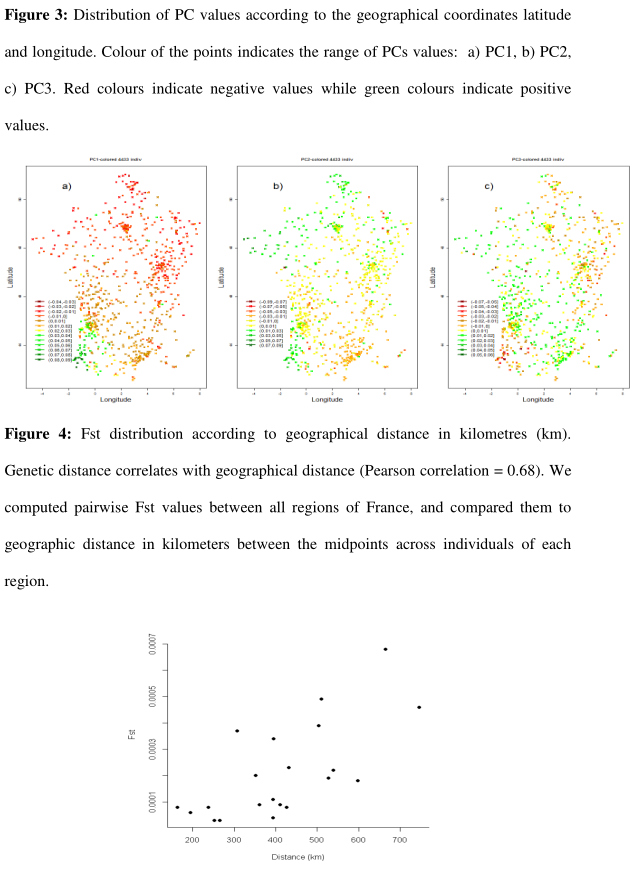
The fine-scale genetic structure of the French population

The fine-scale genetic structure of the French population (preprint):

The existence of population stratification is a major problem in case-control association studies and there is a need for a better assessment of allele frequency variation within populations at all geographic scales. Such efforts have been conducted in different European countries where strong patterns of geographic variations were found. The genome-wide extent of variations in allele frequencies of common variants has however never been documented at the scale of France. In this study, we describe these patterns of variation using genome-wide SNP chip data from 4,433 individuals, recruited as part of the Three-City study and whose places of birth in France were available. We show that there is a strong correlation between the top three principal components extracted from the genetic data and the latitude and longitude of birth places. Using multiple linear regression models, we were able to determine the birth places within less than 197 km of the reported origin for 50% of the individuals. Using model-based clustering with seven main geographic regions, we found that individuals were assigned in majority to their true region of origin. However, we found that information on ancestry could not be retrieved by using a small panel of Ancestry-Informative Markers (AIMs).

Ethnic origins of the Washington Post's top 28 American Communists of all time

In 2013, the Washington Post decided to come up with a list of "America’s top communists of all time". Unsatisfied, Washington Post blogger Dylan Matthews came up with his own list of America's "top Communists" (which he then promoted on twitter, spawning the comment thread that featured Ross Douthat's exaggeration of Maoism at Harvard). I've combined (and somewhat arbitrarily sorted) the lists below (the italicized text comes from the original lists; most of the quoted, bracketed text comes from wikipedia).

Summary: 9/28 who made the list are Jewish (including two who are half-Jewish); 5/28 are black; 4/28 potentially have half or more New England ancestry (and no one else on the list appears to have 1/4 or more New England ancestry); 3/28 have half or more Irish ancestry (and 6/28 are at least a quarter Irish); 3/28 are at least half Southern (and 4/28 likely a quarter or more Southern); 2/28 are half-Scandinavian; 1/28 is Finnish.

This fairly arbitrary list of prominent Communists is of course not representative of CPUSA membership as a whole, which was even more heavily Jewish and foreign (and even lighter on New England-descended children of rich families, notwithstanding moldbug's attempts to hold up John Reed -- the only person on this list who falls into that category -- as in any way representative of US Communists.)

At least 4/9 Jews on the list (White, the Rosenbergs, and Dohrn) are known to have spied for the Soviets or been involved in terrorist activity, along with 2/3 Southerners (Browder and Hiss). As far as I know this can be said of only 1/4 of those of early New England-stock on the list (Bentley, who also happens to be the one who ended up turning on her handlers and exposing Soviet intelligence operations in the US). More representative samples are even more extreme:

Jews were also vastly overrepresented in high-profile cases among those invoking the Fifth Amendment right not to incriminate oneself, so that public hearings like McCarthy's inevitably highlighted the Jewish role in communism. For example, in 1952, of 124 people questioned by the Senate Committee on Homeland Security and Government Affairs, Weingarten identifies 79 Jews, 32 non-Jews and 13 with unknown ethnicity. All invoked the Fifth.

Even more remarkably, of the 42 people who were dismissed from their positions at the Fort Monmouth Laboratories in New Jersey on suspicion of constituting a spy ring (the same one that Julius Rosenberg belonged to), 39 were Jews and one other was married to a Jewish woman.

Also see:

Party leaders / labor leaders

Earl Browder

Leader of the U.S. Communist Party from the early 1930s until his expulsion in 1945. Under his guidance, the party reached its peak membership of nearly 100,000 and developed influence in key sectors of American life. Collaborated with Soviet intelligence agencies; expelled after Soviet criticism for minimizing the role of the party.

["Earl Browder was born in Wichita, Kansas on May 20, 1891, the eighth child of an American-born father sympathetic to populism.[1] He joined the Socialist Party of America in Wichita in 1907 at the age of 16 and remained in that organization until the party split of 1912". Southern (Tennessee and Virginia) ancestry.]

William Foster

Foster, a trade union militant, secretly joined the party in the early 1920s and ran for U.S. president in 1928 and 1932. He died in Moscow.

[From Beyond the American Pale: The Irish in the West, 1845-1910:

William Z. Foster was one of America's most militant Communists. That much is well known. Less so is that Foster's working-class parents were born in Ireland and that his christening as William Edward took place in a Catholic church in New Jersey. He grew up in one of Philadelphia's toughest Irish neighborhoods, the aptly named Skittereen. By any accounting, William Z. Foster (the "Z." was given to him by the Communist Party) was a part of the Irish strain in American labor.

But Foster was also part of labor's western heartland. He spent most of his working life in the West and learned his hardest lessons there.

]

Jay Lovestone

Lovestone was the party's leader in the 1920s but was expelled by Stalin in 1929. He became a key figure in the American Federation of Labor and worked with the CIA to combat communism in unions overseas.

["Lovestone was born Jacob Liebstein into a Litvak [Jewish] family in a shtetl called Moǔchadz in Grodno Governorate (then part of the Russian Empire, now in Grodno Region, Belarus)."]

Eugene Dennis

Two longtime party leaders. Dennis fled to Moscow in the 1920s to escape criminal prosecution for communist organizing, later became U.S. party leader. Dennis was the lead defendant in the trial of party leadership in 1949 on charges of conspiring to teach and organize the overthrow of the U.S. government. Jailed in the early 1950s, he resumed leadership role after leaving prison, swung support to hard-liners and died of cancer in 1961.

["He began life as Francis Xavier Waldron Jr. on August 10, 1905, in Seattle, Washington. His father was Irish American, and his mother, Nora Vieg, of Norwegian descent."]

Gus Hall

Hall became the leader of the declining party in the early 1960s. Opposed Gorbachev's policies of glasnost and perestroika, later promoted North Korea as a communist model. Died in 2000.

["Hall was born Arvo Kustaa Halberg in 1910 to Matt (Matti) and Susan (Susanna) Halberg in Cherry, a rural community on Northern Minnesota's Mesabi Iron Range.[2] Hall's parents were Finnish immigrants from the Lapua region, and were politically radical: they were involved in the Industrial Workers of the World (IWW) and were early members of the Communist Party USA (CPUSA) in 1919.[3] The Mesabi Range was one of the most important immigration settlements for Finns, who were often active in labor militancy and political activism.[4][5] Hall's home language was Finnish, and he conversed with his nine siblings in that language for the rest of his life.[2] He did not know political terminology in Finnish and used mostly English when meeting with visiting Finnish Communists.[2]"]

James P. Cannon

I mean, c'mon, dudes. You can't do a list of American Communists and just include folks who sided with Stalin against Trotsky. Cannon was converted to the cause on a trip to Russia in 1928, during which he read one of Trotsky's critiques of the Third International (better known as Comintern), the Soviet Union's international coalition of Communist Parties, and was persuaded. [. . .] The move got him and his co-conspirators expelled. No matter; they formed the Communist League of America (Opposition), which in 1934 merged with the trade unionist American Workers Party, run by the noted Marxist Christian pacifist A.J. Muste, to form the Workers Party.

[From James P. Cannon and the Origins of the American Revolutionary Left, 1890-1928:

A Midwestern, native-born Bolshevik whose parents were Irish immigrants, Cannon shared much with other centrally important individuals in the communist milieu of the 1920s and beyond, among them William Z. Foster, Earl Browder, and Jay Lovestone.

Cannon's benefactors were not his Rosedale chums, the old-style Irish patriots. "I was sick and fed up with the Irish by then. . . . [W]hen I looked around and saw all the god-damned Irishmen were either cops or politicians or grafters and contractors and prosecuting attorneys, I said to hell with it. I disaffiliated." Rescuing him from jail were Kansas City's "radical socialistic Jews," one component of the mass base of the foreign-language federation's left wing.

Released from his cell, Cannon surveyed the revolutionary Left and saw the carnage of the state's campaign of terror and suppression. Alexander Bittelman later characterized 1920 as "the worst year in the history of our movement." As he brooded in the office one day, his clothes a seedy match for his mood, Cannon was suddenly and unexpectedly confronted by three determined Jewish comrades. They hustled him down to a Jewish merchant's clothing store, where he was introduced as a distinguished revolutionary. "The Irish community had thought that I was a damn ne'er-do-well," Cannon recalled, "[b]ut there it was a great honor--editor of the paper and a speaker for socialism." Outfitted with a new suit of clothes, the socialists demanded that the merchant cut the price down to wholesale, and kick in an extra five-dollar reduction as his own contribution. It was all for "Comrade Cannon," and it slashed $30 worth of apparel to a mere $15, which the hard-bargaining radicals handed over to the haberdasher. "I walked out of the store with a brand new suit of clothes and an uplifted spirit that kept me going for a long time," Cannon remembered with fondness. "Now, how could I quit on people like that?" A revolutionary native son thus sealed a pact with immigrant left-wingers.

]

Max Shachtman

While Cannon stayed true to the Marxist flame, his ally Max Shachtman had a more interesting trajectory. While he followed Cannon to the Communist League of America, and then to the Workers Party, and then to the Socialist Workers Party, in 1940 he clashed with Cannon and Trotsky over World War II. The latter wanted to maintain a position of unconditional defense of the Soviet Union, which would entail honoring the Molotov-Ribentropp Agreement between the Soviets and Nazi Germany, supporting the Soviet "Winter War" against Finland, and backing of the Soviet/Nazi divvying up of Poland. [. . .] Where Shachtman went next was pretty surprising. He started a new party, the Workers Party (a call-back to the Trotskyist party he and Cannon had formed in 1936), which advocated for a so-called "Third Camp" that rejected the two imperialist camps of a) the then-allied Soviets and Nazis and b) the U.S. and British opposing them. [. . .] By the time of his death in 1972, Shachtman was arguing against unilateral withdrawal from Vietnam and refused to endorse George McGovern because of his support for it. [. . .] By that point, he had totally broken with the Trotskyist movement and had become a godfather of sorts to the neoconservative one. As Jeet Heer has noted, Shachtman's follower Albert Wohlstetter was a mentor to Paul Wolfowitz and Richard Perle, and Shachtman was close to Senator Henry "Scoop" Jackson (D-Wash.), who was infamously hawkish on defense and whose office employed Perle, Wolfowitz, Elliott Abrams, and Douglas Feith at various points. After the 1972 split in the Socialist Party, Shachtman's followers started the Social Democrats USA, whose members, including Abrams and UN ambassador Jeane Kirkpatrick, featured prominently in the Reagan administration.

["Shachtman was born to a Jewish family in Warsaw, Poland, which was then part of the Russian Empire. He emigrated with his family to New York City in 1905."]

Harry Haywood

Harry Haywood is probably the most important theoretician the Communist Party in the U.S. produced. He served on the Central Committee of the party from 1927-1938, including a 1931-1938 stint on the Politburo. he also lived for four and a half years in the Soviet Union, where he was an active member of the Soviet Communist Party. His chief idea was that African-Americans living in the "black belt" in the South have a right to national self-determination, same as any other national group under Stalin's theories of nationalism. They should secede and form a Marxist workers' state, he argued. The area in question looks like this: In the 1950s, he judged that the Communist Party had fallen down on its commitment to black Americans, and realigned himself with Mao Zedong, who at the time was feuding with Soviet leadership. Eventually he and other Maoists started the "New Communist Movement" of the 1970s and 1980s, which sought to capitalize on revolutionary energy generated by opposition to the war in Vietnam and had some success in organizing black auto workers in Detroit.

[Black.]

"Activists"

John Reed

Harvard grad, prominent journalist, Greenwich Village bohemian and radical enthusiast, who was portrayed by Warren Beatty in his 1981 film “Reds.’’ In Moscow during the Russian Revolution, he wrote the widely praised book “Ten Days That Shook the World.” After helping found the U.S. party, returned to Moscow to fight for recognition from the Comintern against rival American sects. He died of cholera in 1920 at age 32 and was buried in the Kremlin Wall. File photo

["John Reed was born on October 22, 1887, in his maternal grandmother's mansion in Portland, Oregon, with Chinese servants[1] in today's Goose Hollow neighborhood. He wrote of paying a nickel to a "Goose Hollowite" (young toughs in a gang in the working-class neighborhood below King's Hill) to keep from being beaten up. A memorial bench overlooks the site of Reed's birthplace in Washington Park [2] His mother, Margaret Green Reed, was the daughter of a leading Portland citizen who had made a fortune through three enterprises: as owner of the first gas works in Oregon, owner of the first pig iron smelter on the west coast, and as second owner of the Portland water works.[3] John's father, Charles Jerome Reed, was the representative of an agricultural machinery manufacturer who had come to town from the East. With his ready wit, he quickly won acceptance in Portland’s business community.[4] The family's wealth came from the Green side, not the Eastern-transplanted Reed side." No doubt had significant New England ancestry via upstate New York, but also had some Welsh and German Pennsylvania and New York ancestry.]

Bayard Rustin

In his youth, he was a member of the Young Communist League — the youth branch of the Communist Party USA — owing to the fact that the Communists were just about the only political party in the 1930s to be fully opposed to segregation. "Living in Harlem, he saw that whenever blacks got into trouble, it was invariably the Communists who were willing to defend them," his biographer, John D'Emilio, writes. "Other radical groups, like the Socialist Party or assorted Trotskyist organizations, promised gains only after the revolution." His ties to the party would get him investigated by the FBI once he became a well-known leader of the civil rights movement.

[Black.]

Hilary Putnam

He also used to be a Maoist. In the late 1960s, he was a member of the Progressive Labor Party, a still in existence group that rejected the Soviet Union of the time as a perversion of true Marxism-Leninism and embraced developing world regimes like those in China and Vietnam instead. Putnam was targeted by the Harvard administration in the late 1960s for his views, despite being a tenured professor, and in turn was intensely critical of more conservative faculty who he thought were collaborating with the Vietnam war or promoted scientific racism.

In 1973, Putnam quit the party and has said he regrets his membership.

[1/2 Jewish and 1/2 Southern/mid-Atlantic.]

Bernardine Dohrn and Bill Ayers

The Progressive Labor Party, of which Putnam was a member, was the chief rival of the Revolutionary Youth Movement (RYM), a group, also Maoist in orientation, within the anti-war Students for a Democratic Society group. RYM later renamed itself the Weathermen, and then the Weather Underground, and began a campaign of bombings meant to defeat the U.S. government, end the war in Vietnam, and create a socialist workers' state in America.

Among its most prominent leaders were the married couple of Bernardine Dohrn and Bill Ayers. The latter came from a prominent Chicago family, and his father ran the biggest electrical utility in Illinois. That connection got Dohrn hired by the Chicago firm Sidley Austin, despite her inability to join the Illinois bar. She's currently a clinical associate professor of law at Northwestern.

[Dohrn: half-Jewish, half-Swedish. "While in high school, Dohrn's father changed the family name from Ohrnstein to Dohrn because he wanted to avoid being accused by his customers of "Jewing" them out of their money. Dohrn attended Miami University of Ohio, where she tried to get into one of the most exclusive sororities but was rejected because of her father's Jewish background. She then transferred to the University of Chicago in her junior year. This change of academic location sharpened her social awareness of inequality and racial discrimination." [Klaus P. Fischer. America in White, Black, and Gray: A History of the Stormy 1960s]

Ayers: "Ayers grew up in Glen Ellyn, a suburb of Chicago, Illinois. His parents are Mary (née Andrew) and Thomas G. Ayers, who was later chairman and chief executive officer of Commonwealth Edison (1973 to 1980),[4] and for whom Northwestern's Thomas G. Ayers College of Commerce and Industry was named.[5][6] He attended public schools until his second year in high school, when he transferred to Lake Forest Academy, a small prep school.[7] Ayers earned a Bachelor of Arts in American Studies from the University of Michigan in 1968. (His father, mother and older brother had preceded him there.)[7]"

Ayers's father is 1/2 Scottish, 1/4 post-1790 German, and 1/4 Southern and Mid-Atlantic via the Midwest. His mother is 1/2 (Scottish-surnamed) Canadian and at least 1/4 (probably 1/2) post-1790 German.]

Angela Davis

Davis, a philosopher and protege of the critical theorist Herbert Marcuse, was a longtime member of CPUSA. That membership, indeed, got her fired from UCLA's philosophy faculty, at the direction of then-California governor Ronald Reagan. Shortly thereafter, she was tried for her alleged involvement in a hostage-taking incident at a courthouse in Marin County, California. She owned the guns used in the event but was found not guilty.

[Black.]

Entertainers / "intellectuals"

Woody Guthrie

Oklahoma-born singer and songwriter joined the party in California. Major figure in evolving folk-song movement, singer for party benefits and, eventually, famous for "This Land Is Your Land" and other songs. Inspired several generations of folk singers, including Pete Seeger and Bob Dylan. Hear Woody Guthrie.

["Guthrie was born in Okemah, a small town in Okfuskee County, Oklahoma, the son of Nora Belle (née Sherman) and Charles Edward Guthrie.[4] His parents named him after Woodrow Wilson, then Governor of New Jersey and the Democratic candidate soon to be elected President of the United States." 3/4 Southern, 1/8 Irish, 1/8 New England.]

W.E.B. DuBois

African American intellectual, author of “The Souls of Black Folks,” founder of the NAACP. Moved close to the party in 1930s and 1940s, moved to Ghana in 1961 and joined the U.S. party that year.

[Black.]

Paul Robeson

Talented African American athlete, actor and singer who secretly joined the party. Robeson was identified with communist causes for years. Despite knowledge of Soviet persecution of Jews, he refused to publicly criticize the Soviet Union. He charged the United States with committing genocide against blacks and praised Stalin. Blacklisted and in declining health, his career never recovered.

[Black.]

Howard Fast

Best-selling novelist, author of books such as "Spartacus" and "Freedom Road." Fast was a prominent communist activist in 1940s and 1950s, left the party in 1956 and published a scathing attack on it called "The Naked God." Worked as Hollywood screenwriter and published a popular book series, "The Immigrants." Before his death in 2003, he repudiated his anti-communism, writing another autobiography that praised the party.

[Jewish.]

James Burnham

Burnham, an ally of Shachtman's in the Socialist Workers Party, resigned in 1940 after the latter was purged. However, unlike Shachtman, he combined his resignation with a wholesale rejection of Marxism, which became clear in his 1941 book, The Managerial Revolution. He argued that Nazism, Italian fascism, Bolshevik Communism, and New Deal liberalism all moved in the direction of societies governed by a special class of "managers" that controlled the means of production. He was clear that the New Deal was the mildest form of this, but argued it undermined support for capitalism all the same. He predicted that this sort of managerial system would eventually replace capitalism altogether.

Burnham moved even further to the right in the 1940s and 1950s, becoming an ardent Cold War hawk and helping William F. Buckley found the National Review. In 1983, Ronald Reagan gave him a Presidential Medal of Freedom, as seen in the above photo.

[Zero grandparents born in America. Father born in England. Maternal grandmother born in Ireland. Of Highland Scottish ancestry via Prince Edward Island on maternal grandfather's side. Raised Catholic.]

Max Eastman

Eastman, like Burnham and, to a lesser extent, Shachtman, was a Trotskyist who became a true right-winger by the end of his life. He was the one who raised the funds so that John Reed (the Warren Beatty character in Reds; Eastman was played by Edward Herrmann) could go observe the October Revolution in Russia. He performed a true service to Trotsky by making Lenin's Testament — a document that, while also critical of Trotsky, made it clear the Soviet leader did not want Joseph Stalin to succeed him — widely known in the West, and was friends with Trotsky until his assassination in 1940.

But by then Eastman was distancing himself from Marxism and becoming enamored of free market economists like Ludwig von Mises and Friedrich Hayek. In his role as an editor at Reader's Digest, Eastman serialized the latter's The Road to Serfdom, which includes an account of Eastman's alienation from socialism. Eastman joined the free market Mount Pelerin Society, as well as the anti-Communist American Committee for Cultural Freedom, and was briefly a fan of Joseph McCarthy's (though he later labeled him a "reactionary"). He was one of the initial editors of National Review, whose board he left when he felt it had become too explicitly Christian.

He's also responsible for one of my all-time favorite quotes about Marxist philosophy: "Hegelism is like a mental disease; you can't know what it is until you get it, and then you can't know because you have got it."

[Eastman's father was a Congregational minister, likely of predominantly New England stock. However, his mother was of Pennsylvania ancestry, including German, and evidently Eastman and his sister "attributed their progressive ideas to their mother’s influence."]

Pete Seeger

The original Post list had Woody Guthrie, but his friend and fellow folk singer Seeger was a card-carrying CPUSA member for many decades. He joined the Young Communist League in 1936 and the actual party in 1932, and, along with Guthrie and the Almanac Singers, wrote anti-war songs in 1941 until the Soviet Union was invaded, at which point he switched to supporting intervention.

[Roughly 3/4 New England, 1/8 mid-Atlantic, 1/8 French]

Miscellaneous communists

J. Robert Oppenheimer

Prominent physicist and secret U.S. party member in the late 1930s. Dropped out of party activities after being selected to head the Manhattan Project. Despite numerous efforts by Soviet intelligence to contact him, steadily moved away from the party as he played major role in postwar U.S. atomic policy. Lost his security clearance in 1954 amid charges of communism and lying to U.S. security. Directed the Institute for Advanced Study in Princeton, N.J., from 1947 to 1966, a year before his death.

["Oppenheimer was born in New York City on April 22, 1904,[7] the son of Julius Oppenheimer, a wealthy Jewish textile importer who had immigrated to the United States from Germany in 1888, and Ella Friedman, a painter."]

Alger Hiss

Hiss and Whittaker Chambers were protagonists in a spy case that helped establish anti-communism as major factor in American political life and that boosted the career of Richard M. Nixon.

[One grandparent born in Ireland, other three in Maryland.]

Whitaker Chambers

Chambers was the star government witness in the spy case. Hiss, a high-ranking State Department official, was convicted of perjury for lying about Chambers's charge that Hiss had provided him with secret government documents in the 1930s. The case riveted the nation and remains controversial today, despite overwhelming evidence that Chambers told the truth.

["Whittaker Chambers was born in Philadelphia, Pennsylvania,[. . .] His family moved to Lynbrook, Long Island, New York, in 1904, where he grew up and attended school. His parents were Jay Chambers and Laha (Whittaker). Chambers described his childhood as troubled because of his parents separation and caring for their mentally ill grandmother. Chambers' brother committed suicide shortly after withdrawing from his first year of college. Chambers would cite his brother's troubled life and eventual suicide as one of many reasons that he was drawn to communism as a young man.[4]

After graduating from South Side High School in neighboring Rockville Centre in 1919, Chambers worked at a variety of jobs before attending Williams College in 1920. He later enrolled as a day student at Columbia University.[4] At Columbia his fellow students included Meyer Schapiro, Louis Zukofsky, Clifton Fadiman, John Gassner, Lionel Trilling [. . .]

In 1930 or 1931,[8] Chambers married the young artist Esther Shemitz (1900–1986).[4] [9] Shemitz, who had studied at the Art Students League and integrated herself into New York City's intellectual circles, met Chambers at the 1926 textile strike at Passaic, New Jersey."

Appears to be 9/16 (post-1790) Irish and Scottish; on the predominantly colonial American half of his ancestry, it looks like three great-grandparents were born in Pennsylvania, and one in New Hampshire (but with a father who was born in England).]

Elizabeth Bentley

A Vassar grad dubbed ''the blond spy queen,'' Bentley joined the party, worked for and eventually became the lover of Jacob Golos, the U.S. party's contact with Soviet intelligence. After Golos's death in 1943, she took over supervision of his espionage rings, most of them composed of government employees in Washington. Unstable and depressed by Soviet efforts to push her aside, Bentley went to the FBI in 1945, setting off a major investigation of Soviet espionage. Although unable to prosecute anyone because of a lack of hard evidence, the government confirmed her charges through decrypting of Soviet messages. Bentley helped stoke the anti-communist fervor of the 1940s and 1950s.

["Elizabeth Terrill[4] Bentley was born in New Milford, Connecticut to Charles Prentiss Bentley, a dry-goods merchant, and May Charlotte Turrill, a schoolteacher.[5] In 1915 her parents had moved to Ithaca, New York, and by 1920 the family had moved to McKeesport, Pennsylvania and then to Rochester, New York.[6] Her parents were described as strait-laced old family Episcopalian New Englanders." She does appear to be predominantly of early New England ancestry. Golos was Jewish.]

Julius and Ethel Rosenberg

The Rosenbergs were low-level communists. Julius, an engineer, volunteered to assist Soviet espionage and developed a highly effective ring of former college classmates working in the defense industry during World War II. Turned over vital information on jet propulsion, radar, sonar and the proximity fuse, as well as atomic bomb information provided by Ethel's brother, David Greenglass, a machinist at Los Alamos, N.M. Convicted of conspiracy to commit espionage, the Rosenbergs went to the electric chair rather than reveal members of their ring, becoming martyrs to the pro-Soviet left. A campaign to clear their names continues today, despite abundant evidence that they were guilty.

["Julius Rosenberg was born to a family of Jewish immigrants in New York City on May 12, 1918. . . . Ethel Greenglass was born on September 28, 1915, to a Jewish family in New York City."]

Harry Dexter White

As Neil's interview with Benn Steil explains, Harry Dexter White was a senior FDR-era Treasury department official, who eventually was tasked with negotiating the Bretton Woods agreement, which would establish the World Bank, IMF, and General Agreements on Tariffs and Trade (GATT, now the WTO). White was not an official member of the Communist Party, but he did pass state secrets to the Soviet Union during World War II. Steil notes in his book that White's actual economic views didn't appear all too Marxist, but it seems clear that at least at some moments in time, White sympathized with the Soviet economic model. "Russia is the first instance of a socialist economy in action," he wrote in a 1944 manuscript. "And it works!"

["Harry Dexter White was born in Boston, Massachusetts, the seventh and youngest child of Jewish Lithuanian[3] immigrants, Joseph Weit and Sarah Magilewski, who had settled in America in 1885."]

If Harvard picked the president we wouldn't have had FDR

The leftism that dominated Harvard from the 1960s onward did not originate with the people who founded Harvard.

If Harvard Picked The President:

If Harvard picked the president, half the men who have occupied the Oval Office in the past 128 years never would have made it to the White House.

According to records of Harvard straw polls over The Crimson’s 139-year history, the winner of the poll at Harvard—this year, Barack Obama by a wide margin—has won the real thing only 50 percent of the time. [. . .]

Over that time, the political views of the student body have shifted along with—and sometimes against—the tides of history. Harvard picked Republicans—the party of Calvin Coolidge and Theodore Roosevelt, Class of 1880, but also of losing contenders like Charles Evan Hughes—in every contest from 1884 to World War II, save 1912. In that year, as the Republican Party split its vote between incumbent President William Howard Taft and Roosevelt, who decided four years after his term ended that he had not had enough of the presidency, Democrat Woodrow Wilson managed to take the most Crimson votes. The same phenomenon occurred on a national level.

Even the Harvard pedigree of Franklin D. Roosevelt, Class of 1904 and a president of The Harvard Crimson, was insufficient to take the top of The Crimson’s poll. As the rest of the country voted overwhelmingly for Roosevelt, the student body picked Herbert Hoover—the man hated nationwide for supposedly bringing on the scourge of the Great Depression—then Alfred M. Landon and Wendell Willkie, all by significant margins. Clearly, economic woes dogged the Harvard voter far less than the ordinary election-goer. [. . .]

In 1960, a Democrat won the poll by an absolute majority for the first time: Harvard alumnus and youth favorite John F. Kennedy ’40.

The post-WWII Harvard student body was very disproportionately Jewish: "At least 19 percent of Harvard freshmen enrolling in the class of 1946 were Jewish. Between 1950 and 1970 the percentage of Jewish students at Harvard and Columbia would be well in the 20 percent bracket, averaging 25 percent during the two decades." The shift left at Harvard also followed an increased emphasis on "meritocracy" that led to fewer students from the old Protestant upper class:
Harvard was not, the Rollo Book insisted, "a rich-man's college": "More than half of the students earn a significant part of their college expenses and about thirty per cent receive financial aid from the College in the form of scholarships, beneficiary aid, or loans." [. . .]

Despite the shift in rhetoric, change in Harvard's actual practices came only gradually. Nevertheless, Bender's accession to the chairmanship of the Committee on Admission and on Scholarships and Financial Aids did produce some identifiable shifts in the character of the student body. In his first year in office, Bender raised incoming freshman median scores on the SAT from 583 to 609 on the verbal section and 598 to 625 on the mathematical section. At the same time, the percentage of entering freshmen from private schools declined from 52 percent in 1952 to 47 percent in 1953. This was the first time in Harvard's peacetime history that public school graduates outnumbered private school graduates. [. . .]

By 1957, faculty power had been rising for over a decade, and faculty members everywhere sought to apply more meritocratic standards in selecting undergraduates. That fall, their efforts received a powerful boost from an unexpected source when, on Octorber 4, the Soviet Union launched Sputnik, the world's first satellite. [. . .]

Harvard's scientists seized the opportunity to increase pressure on the Admission Office. [. . .]

As the Admission and Scholarship Committee convened in the spring of 1958 to conduct the annual business of selection, it faced heavy pressure -- from an increasingly assertive faculty, from applicants empowered by knowing their SAT scores, and from the growing national obsession with scientific brilliance -- to give greater weight to scholastic talent than ever before. The freshmen who enrolled that fall showed every sign of being the strongest class academically in Harvard's history. In one year, median combined SATs had risen by 50 points, from 1285 to 1335 -- the second-largest increase ever recorded at Harvard. [. . .] In a related trend, the number of students from public schools reached an all-time high of 54 percent [. . .] -- a development that could only be welcomed by faculty calling for more meritocracy. [. . .]

Bender had hit on a central dilemma: in a changing society, would Harvard be best served by continuing to favor the children of the upper class or should it attach itself to a potentially rising class of academically talented boys from the nation's public schools? "Are we interested in keeping Harard an institution which will be socially acceptable for young gentlemen to attend?" he asked. "Or are young gentlemen a vanishing rose and would we be better off without them?" How the Special Committee answered these questions would reveal a great deal about Harvard's strategy for maintaining its preeminence in a world in which the Protestant upper class was already losing its hegemony.

[Jerome Karabel. The Chosen: The Hidden History of Admission and Exclusion at Harvard, Yale . . .]

The New Deal coalition:
The New Deal coalition [. . .] united the many enemies of the old Puritan ethic: Catholic immigrants, Jewish intellectuals, southern gentlemen, black sharecroppers, Appalachian mountain folk, Texas stockmen and California hedonists.

The various groups who supported Roosevelt all believed that the national government should play a larger economic role.

More on student radicalism at Harvard (including catching Digby Baltzell in some misleading omissions)

We were previously shocked to discover that the general tenor of the 1970s pro-Khmer Rouge Harvard Crimson was Jewish.

You will be further surprised to learn that 1960s student radicalism didn't start at Harvard, and 1960s student radicalism at Harvard didn't start with "WASPs".

The excerpts below come from The Protestant Establishment Revisited (along with other sources, where noted, to correct Baltzell).

Note that Baltzell is pushing a ridiculous narrative of his own (namely, that "WASPs" doomed themselves by being too exclusionary), is eager to maximize the role of his subjects (elite "WASPs"), and leans heavily on a slanted source (a Jewish radical who in ranting about inter-leftist squabbles was evidently more interested in airing his hostility toward "WASPs" than in historical accuracy); yet he still acknowledges the primacy of Jews in 1960s student radicalism:

While the main reasons for the turmoil on the best campuses in America during the 1960s were the black revolution and the war in Vietnam, it would not be an exaggeration to suggest that the turmoil was also closely related to the decline of the WASP establishment and the rise of other groups, especially the affluent and newly suburbanized Jews, to elite status. Nevertheless, in viewing the generation gap within the old-stock upper class that resulted in its children's radical behavior, let us bear in mind that throughout the 1960s only a small minority of students were, as the saying went, "radicalized." Although in stable times students have always held more or less the same political opinions as their parents, those of the 1960s moved steadily away from the values of the Republican WASP establishment. For instance, in a 1960 presidential straw poll taken at Harvard, John F. Kennedy received 60 percent of the vote--more than Franklin Roosevelt or any other Democratic candidate had ever mustered on that campus since the Civil War. [. . .]

In the late 1960s, the student meritocracy at Harvard was very much like Princeton's--the ratio of students from private and public schools being a similar 40 and 60 percent. Harvard had, of course, been heterogeneous and meritocratic for a longer time, with its proportion of Jewish students higher than at Princeton and far higher than in President Lowell's day. In this connection, it is important to stress one factor in the generation gap within the upper class: the brighter young people were far more opposed to a general, blanket anti-Semitism than were their parents. [. . .] But for a clue to the values and attitudes of the brightest sons of the fourth-generation WASP establishment, let us look at the behavior of private school graduates at Harvard in the late 1960s.

The Berkeley campus revolution came in 1964, Columbia's in 1968, and Harvard's in the spring of 1969. The book on Harvard by S.M. Lipset and David Riesman includes a study of all the student revolts on that campus since the "Great Rebellion" of 1823, when John Quincy Adams's son John was expelled. "Harvard's year of the 'bust,' 1968-69," write these two authors, "was the most momentous year in the University's history in the century since Eliot took office." The history of that second Great Rebellion in 1969 has been thoroughly documented and need not be gone into here. But one thing is worth stressing: it was the sons of the WASP establishment who finally occupied the central administration building--an act that led to President Pusey's disastrous summoning of the local police.

This assertion ("it was the sons of the WASP establishment who finally occupied the central administration building") is, to say the least, questionable, as we'll see below.

Student radicalism at Harvard, as on most other campuses, was led by members of the SDS. Students for a Democratic Society was founded at Port Huron, Michigan, in 1962, and its Harvard chapter was by 1966 the largest in the nation. One of its founders at Harvard (his father was an ADA Democrat and a member of the Kennedy administration) was a great-grandson of James Stillman, John D. Rockefeller's banker.

Baltzell is referring here to Nat Stillman (Whit Stillman's brother), who was at one point "a vice-president of Harvard-Radcliffe Students for a Democratic Society". A fact not reported by Baltzell: "According to Nat Stillman, an early Harvard SDS leader who joined and later left the group, well over half of the Harvard SDS executive committee in its early days was made up of people who identified with or were members of the old-line Communist party, U. S. A."

Also not reported by Baltzell: Harvard SDS was "organized in 1964 by Carl Offner '64 and Michael Ansara". These appear to be the actual founders of the Harvard SDS chapter, and the surnames do not strike me as "WASP". Michael Ansara was also the leader of the University Hall occupation, and Offner, as a graduate student, was still involved at that time as well.

Lastly, it's interesting to note that Stillman too turns out to have apparent Jewish ancestry. While Nat Stillman's father was a grandson of Rockefeller's banker, not mentioned by Baltzell (and something I was not previously aware of) is that his (Deputy to the Under Secretary of Commerce in the Kennedy administration, John Sterling Stillman's) maternal grandmother was Jewish (or probably half-Jewish), a daughter of one Marcus Derckheim Boruck (who was apparently a newspaper editor and politician in mid/late 19th-century San Francisco). While this inheritance may be of little significance genetically, to the extent Nat and his father were aware of this minority ancestry it would not surprise me if it exerted some influence on their identity / politics.

By the time of the rebellion, the Harvard SDS had broken into two opposing factions, as left-wing movements often do: the more conservative SDS caucus and the more radical PL group, linked to the Maoist Progressive Labor party. From our point of view, the most useful description of the contrasting roles of these two wings in the 1969 "bust" is found in the book Push Comes to Shove: The Escalation of Student Protests by Steven Kelman, a student at Harvard between 1966 and 1970. Kelman came to Harvard as a convinced socialist and was the leader of the Young People's Socialist League (YPSL) on the campus. From his first day there, he strongly disapproved of, indeed despised, the "pallid preppies." "On the second day," he wrote in his diary," I saw a tall, bond, not-quite-fat kid around the dorm. . . . One time he was gazing down at the rest of the world from his pedestal on the ledge of the staircase one floor up, and once against, later in the afternoon, downstairs. His eyes eyed me in a superciliousness so classic that I felt like photographing it. The lips seemed delicately positioned so that he could voice his contempt without saying one audible word . . . Disgusting prep school kid!" This reversal of the kike-on-sight syndrome held by private school boys in the 1930s prevails throughout the Kelman book. Young Kelman somehow never seemed to apply the "preppie" epithet, however, to preppies of Jewish background, some of whom were his friends.
But . . . I though moldbug explained Jewish radicals were driven only by an unexceptionable desire to assimilate with elite "WASPs".

"Who's in Harvard SDS?" Kelman asks, and immediately discards the Freudian approach in the Yale psychologist Kenneth Kenisston's "sycophantic accoun in The Young Radicals."

As more of a follower of Marx [Kelman writes], I think it would be useful to apply a class analysis to the sole phenomenon to which SDS refuses to apply this method: themselves, of course. Family income: average for U.S., $8,000 a year; average for Harvard, $17,000 a year; average for SDS, $23,000 a year (Source: poll of family incomes taken in Soc. Sci. 125, an SDS-run course taken almost entirely by New Leftists.) Secondary school education: of the 150-odd Harvard students arrested after the occupation of University Hall, approximately 50 percent attended prep school, with the largest representation from the most exclusive ones like St. Paul's. Just over 40 percent of the Harvard student body as a whole comes from prep schools.

Kelman divides the affluent SDS membership into the "hereditary left," which dominated the SDS caucus, and the Maoist PL group, made up of preppies whom he calls "WASP" rebels." The SDS at Harvard, according to Kelman, "never could have gotten started without the initial services of the hereditary radicals." This group became radical in the same way a Boston Irishman's son becomes a Democrat--by instinct. Their fathers had come of age in the 1930s and were now members of the increasingly affluent American intelligentsia. According to Kelman:

Irving Howe estimates that during the thirties and forties a million Americans may have passed through membership in the Communist party. Many are still radicals, if only under the table--or, to put it more accurately, at the dinner table--today. Around these talkative dinner tables the hereditary radicals absorbed from early childhood certain notions about who the bad guys and who the good guys are. . . . The hereditary radicals came to Harvard with their political commitments already well established.

Although the hereditary radicals founded and kept SDS going at Harvard in the 1960s, they lost out tot he Maoist PL leaders in the April 1969 rebellion--the taking over of University Hall and the calling of the police by President Pusey. Thus, according to Kelman, "almost none of the leaders of the New Left caucus, up to and including SDS co-chairman Kazin, were arrested. . . . The hereditary radicals tried to conceal their fears in a hocus-pocus of SDS rhetoric, . . . but the real source of their hesitancy was easier to understand . . . they might get jail and expulsion. That was more than Mom and Dad had led them to bargain for."

The hereditary radicals "combined the confidence and optimism of members of a rising social group," says Kelman--and, one might add, the sophisticated caution born of the experience of their fathers. The WASP rebels, on the other hand, seemed to have many of the characteristics (perhaps in the extreme) of most of their declining class. Kelman reflects on his WASP rebel classmates as follows:

The sight of an aristocrat who has lost the will to live is aesthetically degrading. These declining members of the American aristocracy are not at all similar to the standard aristocratic stereotypes. They are neither self-confident men at the top, uncaring of those below, nor the humane, social-service oriented democratic aristocrats.

The left should normally expect [Kelman continues] good strong hostility and opposition from the upper class--the enemy is nothing if not powerful. If some aristocrats want to rebel, though, that's their right. But the pale, delicate face of the used-up aristocrat who goes into SDS reminds one of nothing so much as Spengler's Decline of the West. The American upper class has been an aristocracy produced by primitive dog-eat-dog competition, and it is only now that enough generations have passed for it to begin to produce soft, declining offspring who are not "up" to its standards. . . . It is in the guilty aristocrat that we see clearly politics not for politics' sake, but for self-expression, the possibility of recapturing a lost vitality that one feels to weak to create for oneself.

I'm not inclined to take Kelman as credible even on this point, but I have no trouble believing that those scions of elite "WASPs" who did become radicals were on the whole lacking in confidence and poor specimens of their class, typically resentful of their peers and easily manipulable by foreign cultural streams.

The "declining aristocrats," as Kelman calls them, were all members of PL, not a "single one of them in the New Left caucus." But it was the PL preppies who carried their convictions--shallow and temporary as they were, and born of their declining self-confidence and frustration--to the ultimate conclusion in taking over University Hall, and being brutalized and arrested in doing so. The occupation of University Hall by the "pallid preppies" was a vital, symbolic event in the history of class relations in this country. Nothing since The Protestant Establishment was written, I should imagine, better illustrates what was happening to the WASP upper class, especially in its fourth generation. Imagine the reactions of the Harvard clubmen in their fathers' and grandfathers' generation had they witnessed "virtually everyone around the exclusive clubs wearing red armbands," as preppie David Bruce, Kelman's roommate in his sophomore year, reported to him during the bust. Kelman's views of his despised preppie classmates may seem to say more about his own relations with his ideological peers than about them. But perhaps his views were not so far off base.

From what I can tell, Kelman appears to have been almost entirely off base. Here's another radical chiding Seymour Martin Lipset for relying on Kelman:

You devote a page and a half of your conclusion (p. 250-251) to a discussion of the militant "worker-student alliance" (WSA) faction of SDS, which was led by the Maoist group "Progressive Labor Party" (PLP). You repeatedly state as fact, quoting Kelman, that the most militant student leaders during the turbulent spring of 1969 were "the scions of well-to-do WASP elite" (p. 250), "scions of privileged WASP America" (p. 251), "the children of the true blue, of the WASP elite, linked by social origins to the classes which had manned the clubs" (p. 251). You devote a half-page of sociological theorizing to conjectures aimed at explaining this fascinating phenomenon.

However, anyone who sat through a few SDS meetings during that period (as I did) knows differently. There was no mystery about who the PLP-ers were. Leading the most important caucus in SDS, they were vocal participants in every debate, and were always proud to identify themselves as "party members". It is a fact taht, at the time of the takeover of University Hall, there were precisely five PLP-ers at Harvard. Of them, three(3) were ethnically Jewish. "WASP elite"??

In the same part of the conclusion you refer to "the students arrested in University Hall, almost all of whom were WSA" (p. 250). At that time, the entire WSA caucus consisted of no more than 40-50 people. (By the summer it had increased to almost a hundred.) Over 170 students were arrested at University Hall. So no more than one fourth "were WSA"! The majority of SDS members were unaffiliated with any caucus, and many of the participants in SDS-led demonstrations (including the building seizure) were not even SDS members. The group of students arrested was not nearly so monolithic as your faith in Kelman's reporting leads you to believe. In fact, the WSA caucus was out-voted on some key points. (For example, the majority of arrested students chose a popular "movement lawyer" by the name of Flynn who was intensely disliked by the WSA people for ideological reasons.)

[Serge Lang. The File (1977-1979): Case Study in Correction.]

Ansara was anti-PL/WSA, while Offner was a member of the WSA. Jared Israel and Norm Daniels are the strikingly WASP names Google turns up as founders / leaders of the Harvard PL faction. (Hilary Putnam, another person mentioned as having been a member of PL at Harvard, was half Jewish; and his father was a scion not of elite northeastern "WASPs", but of small-town Midwestern farmers who look to have been ultimately of Southern and Mid-Atlantic ancestry.) The Progressive Labor party itself was "Created in 1962 by Milton Rosen". Back to Baltzell:
Four days after the occupation, the executive editor of the Crimson "Bared his soul, in the proud Crimson tell-it-like-it-is tradition, with a piece entitled 'Non-Politics on the Battlefront.'" The following excerpts cannot be faulted as coming from an anti-prep-school point of view:

What was most euphoric was us and what we were to each other. We were brothers and sisters. We did reach out and hold onto each other . . . we were very human and very together.

None of the above is very political stuff. But there was a group of us in University Hall who were not very political people. It was a strange group, not well-defined at all, that included some girls, some people from the Loeb (Drama Center), a couple of guys from the Fly Club, at least one from the Lampoon, and one in a tuxedo who had just come from a party and was drunk. There were others. Some of us didn't even know what the six demands were.

The executive editor of the Crimson, a graduate of Saint Paul's, as was his father before him, had everything that meritocratic Harvard now looks for. He was a good athlete, very popular, and a top scholar. Not long after Kelman's book was written, this wealthy and gifted preppie took his own life. One wonders what will happen to the rest of the gilded-Harvard youth who led the rebellion that spring.

What will happen to freedom in the fourth generation from the robber barons, which dropped out and rebelled in its youth during the late 1960s? Their problem partly reflected a severe crisis of class authority in America, highlighted in a series of tragic events from the assassination of President Kennedy to the Watergate affair. It would be too facile to blame the current decline of authority in America, or the tragic fate of the editor of the Harvard Crimson in 1969, entirely on the suicidal, exclusionary values of the WASP establishment. Perhaps the very strengths of an establishment in one generation preclude its functioning successfully in another. At any rate, when I wrote The Protestant Establishment during the administration of President Kennedy, I still had faith in the ability of the WASP establishment assimilate talented men and women of other ethnic and religious origins into its ranks. I have no such faith today. I remain convinced, though, that modern republican, political institutions, in both England and America, have traditionally been based on hierarchical social systems where class authority and the threat of class ostracism have been major agents of social control. A free press is a vital virtue in any democracy; like all virtues, however, it becomes a vice when carried too far and the fear of media exposure becomes the major sanction of a normative system. An authoritative establishment, in the long run, is far more important to the protection of freedom and democracy.

But perhaps it is best to forget about the WASP establishment, and instead cultivate an open but hierarchical society where all men aspire to be like Washington or Jefferson, rather than one in which all men must overtly ape the values of Everyman, all the while covertly coveting the shallow comforts of affluence and power. Not long after the decline of the Federalist establishment (of which the "Rebellion of 1823" at Harvard was a sympton) and the rise of Jacksonian democracy, Tocqueville pointed out the affinities between materialism and egalitarianism, from which the following lines are taken:

There is in fact a manly and lawful passion for equality which incites men to wish all to be powerful and honored. This passion tends to raise the humble to the rank of the great; but there exists also in the human heart a depraved taste for equality which impels the weak to attempt to lower the powerful to their own level.
The name of the implied "WASP" Crimson executive editor who killed himself, which Baltzell fails to provide: Nicholas Gagarin. The father who also attended St. Paul's was not a "WASP" but a Russian prince (Andre Sergeievich Gagarin, born 1914 in St. Petersburg). And his mother certainly seems to have been rich, but also appears to have been part Irish. In omitting these facts while expounding on the "the suicidal, exclusionary values" of "WASPs" Baltzell goes well beyond discretion into deception. Nor does Baltzell mention that Nick Gagarin was evidently homosexual:
"I lived in Winthrop House from 1966 to 1969," he recalls. "In those days only Tom Hopkins '69"--the guy I was homophobic toward--"was flamboyantly 'out.' He was a magnet for a dozen embryonic gay Winthrop men. Our homoerotic world was very like the Oxford of Brideshead Revisited, with Tom as Anthony Blanche constantly egging us on. I was a cautious Charles Ryder; my Sebastian Flyte was Nick Gagarin '70--beautiful, aristocratic, charming, and responsive. It was a time of intense romantic friendships, resonant with youthful laughter and daring and rebellion. These friendships reached sexual consummation only rarely and hesitantly--for me, just four or five times. Late-night knocks on my door, awkward passionate embraces, long intense confessions..."

The transition from 1966 (when Newmeyer got to Winthrop House and the Ivy League was still pretty much a tweedy, traditional place) to 1969 (the year of the Strike, when he left) was extraordinary. Vietnam was the catalyst, but everything changed.

"The year 1969 marked the end of an era in sexual politics at Harvard," says Newmeyer. "Dress codes, parietal rules, same-sex Houses were on the way out. The civil-rights movement, the antiwar movement, the exploration of marijuana, the Strike--for us wannabe gays it all culminated in Stonewall. That was all we needed: we leapt out of the closet, became gay activists, and hesitated no longer about our sexuality. Actually, we pretty much concluded that it was a damn lucky thing to be gay in that blissful dawn."

Not for me. Not quite yet. And not for Nick Gagarin, ever. He committed suicide in 1971.

While that particular confirmation was published well after The Protestant Establishment Revisited, Baltzell undoubtedly read the following histrionic obituary from another Gagarin "friend" in the St. Paul's alumni magazine before he decided to pass off this half-Russian, part-Irish, mentally-unstable homosexual as an exemplary "WASP" doomed to tragedy by exclusive "WASP" values.
'66 - Nicholas Gagarin died at his home in Litchfield, Connecticut. November 25, 1971. He leaves his parents. Andrew S. Gagarin, '33, and Jamie Porter Gagarin: a sister, Mrs. Raoul Pujol, and two brothers, Michael, '59. and Peter Gagarin, '63.

The absurdity of it outweighs the tragedy. The brilliant young man with everything in the world shoots himself to death, in the middle of a blizzard early on Thanksgiving morning. The family grieves, friends are rounded up for a funeral, his ashes are scattered over the fields and hills that he loved. And here I sit, the old school chum, the roommate of so many academic years, the "closest friend," stuck with the problem of making a dead man live, when I still can't believe that he's dead.

Nick Gagarin was the most talented, intelligent, and enigmatic person I've ever met. Those of you who knew him at St. Paul's did not know him at all. He changed a great deal over the past five years and became, as I hope most of us have, something far removed from the captain of this and the president of that, a spoiled and arrogant product of a classy school. His warmth and humor increased as his shyness vanished. His interest in other people was immense. He physicalized everything he felt, and was at his best hugging and holding the people he loved.

His career at Harvard was the expected success: he wrote and published a novel, he was big cheese on the Crimson, and he spent time at Esalen in California where he broadened and tested himself. By the time he graduated in 1970, Nick Gagarin had become someone quite special.

Nick always talked about being "up" - he tried desperately to be high on life all the time, and was badly let down when he failed or others failed him. The dreams got bigger the more he questioned his ability to make them come true. The strange, remote, frightening, and rather wild side of him flourished.

And so with exquisite logic Nick took his own life. It's appalling and incredible and a waste and such a shame, blah blah blah, but that's the way he wanted it and one must respect that.

A horrible thing, I find, is how quickly the image fades. There's not much left except things he said that you remember and the letters he wrote that you kept.

I wish I could could end this without being corny and obvious but I can't, so you must each supply your own endings and learn from your own conclusions.

Andre Bishop, '66