How modern humans dispersed into Eurasia and Australasia, including the number of separate expansions and their timings, is highly debated [ 1, 2 ]. Two categories of models are proposed for the dispersal of non-Africans: (1) single dispersal, i.e., a single major diffusion of modern humans across Eurasia and Australasia [ 3–5 ]; and (2) multiple dispersal, i.e., additional earlier population expansions that may have contributed to the genetic diversity of some present-day humans outside of Africa [ 6–9 ]. Many variants of these models focus largely on Asia and Australasia, neglecting human dispersal into Europe, thus explaining only a subset of the entire colonization process outside of Africa [ 3–5, 8, 9 ]. The genetic diversity of the first modern humans who spread into Europe during the Late Pleistocene and the impact of subsequent climatic events on their demography are largely unknown. Here we analyze 55 complete human mitochondrial genomes (mtDNAs) of hunter-gatherers spanning ∼35,000 years of European prehistory. We unexpectedly find mtDNA lineage M in individuals prior to the Last Glacial Maximum (LGM). This lineage is absent in contemporary Europeans, although it is found at high frequency in modern Asians, Australasians, and Native Americans. Dating the most recent common ancestor of each of the modern non-African mtDNA clades reveals their single, late, and rapid dispersal less than 55,000 years ago. Demographic modeling not only indicates an LGM genetic bottleneck, but also provides surprising evidence of a major population turnover in Europe around 14,500 years ago during the Late Glacial, a period of climatic instability at the end of the Pleistocene.
Showing posts with label Europe. Show all posts
Showing posts with label Europe. Show all posts
Paleolithic European mtDNA
Pleistocene Mitochondrial Genomes Suggest a Single Major Dispersal of Non-Africans and a Late Glacial Population Turnover in Europe (free full text):

Ancient DNA: Late Upper Paleolithic Swiss and Caucasus hunter-gatherers sequenced
Upper Palaeolithic genomes reveal deep roots of modern Eurasians (open access):
We extend the scope of European palaeogenomics by sequencing the genomes of Late Upper Palaeolithic (13,300 years old, 1.4-fold coverage) and Mesolithic (9,700 years old, 15.4-fold) males from western Georgia in the Caucasus and a Late Upper Palaeolithic (13,700 years old, 9.5-fold) male from Switzerland. While we detect Late Palaeolithic–Mesolithic genomic continuity in both regions, we find that Caucasus hunter-gatherers (CHG) belong to a distinct ancient clade that split from western hunter-gatherers ~45 kya, shortly after the expansion of anatomically modern humans into Europe and from the ancestors of Neolithic farmers ~25 kya, around the Last Glacial Maximum. CHG genomes significantly contributed to the Yamnaya steppe herders who migrated into Europe ~3,000 BC, supporting a formative Caucasus influence on this important Early Bronze age culture. CHG left their imprint on modern populations from the Caucasus and also central and south Asia possibly marking the arrival of Indo-Aryan languages.Press release: 'Fourth strand' of European ancestry originated with hunter-gatherers isolated by Ice Age
"Eight thousand years of natural selection in Europe" preprint - updated with Anatolian Neolithic and other data

Eight thousand years of natural selection in Europe
The arrival of farming in Europe around 8,500 years ago necessitated adaptation to new environments, pathogens, diets, and social organizations. While indirect evidence of adaptation can be detected in patterns of genetic variation in present-day people, ancient DNA makes it possible to witness selection directly by analyzing samples from populations before, during and after adaptation events. Here we report the first genome-wide scan for selection using ancient DNA, capitalizing on the largest genome-wide dataset yet assembled: 230 West Eurasians dating to between 6500 and 1000 BCE, including 163 with newly reported data. The new samples include the first genome-wide data from the Anatolian Neolithic culture, who we show were members of the population that was the source of Europe's first farmers, and whose genetic material we extracted by focusing on the DNA-rich petrous bone. We identify genome-wide significant signatures of selection at loci associated with diet, pigmentation and immunity, and two independent episodes of selection on height. [. . .]On the presence of the "East Asian" EDAR variant in Scandinavian hunter-gatherers:Our sample of 26 Anatolian Neolithic individuals represents the first genome-wide ancient DNA data from the eastern Mediterranean. Our success at analyzing such a large number of samples is likely due to the fact that at the Barcin site–the source of 21 of the working samples–we sampled from the cochlea of the petrous bone 9 , which has been shown to increase the amount of DNA obtained by up to two orders of magnitude relative to teeth (the next-most-promising tissue) 3 . Principal component (PCA) and ADMIXTURE 10 analysis, shows that the Anatolian Neolithic samples do not resemble any present-day Near Eastern populations but are shifted towards Europe, clustering with Neolithic European farmers (EEF) from Germany, Hungary, and Spain 7 (Fig. 1b, Extended Data Fig. 2). Further evidence that the Anatolian Neolithic and EEF were related comes from the high frequency (47%; n=15) of Y-chromosome haplogroup G2a typical of ancient EEF samples 7 (Supplementary Data Table 1), and the low F ST (0.005-0.016) between Neolithic Anatolians and EEF (Supplementary Data Table 2). These results support the hypothesis 7 of a common ancestral population of EEF prior to their dispersal along distinct inland/central European and coastal/Mediterranean routes. The EEF are slightly more shifted to Europe in the PCA than are the Anatolian Neolithic (Fig. 1b) and have significantly more admixture from Western hunter-gatherers (WHG), shown by f 4 -statistics (|Z|>6 standard errors from 0) and negative f 3 -statistics (|Z|>4) 11 (Extended Data Table 3). We estimate that the EEF have 7- 11% more WHG admixture than their Anatolian relatives (Extended Data Fig. 2, Supplementary Information section 2).
We find a surprise in six Scandinavian hunter-gatherers (SHG) from the Motala site in southern Sweden. In three out of six samples, we observe the haplotype carrying the derived allele of rs3827760 in the EDAR gene (Extended Data Fig. 5), which affects tooth morphology and hair thickness and has been the subject of a selective sweep in East Asia 24 , and today is at high frequency in East Asians and Native Americans. The EDAR derived allele is largely absent in present-day Europe except in Scandinavia, plausibly due to Siberian movements into the region millennia after the date of the Motala samples. The SHG have no evidence of East Asian ancestry 4,7 , suggesting that the EDAR derived allele may not have originated not in East Asians as previously suggested 24 . A second surprise is that, unlike closely related western hunter-gatherers, the Motala samples have predominantly derived pigmentation alleles at SLC45A2 and SLC24A5.Polygenic selection on height in Europe:

We also tested for selection on complex traits. The best-documented example of this process in humans is height, for which the differences between Northern and Southern Europe have driven by selection 25 . To test for this signal in our data, we used a statistic that tests whether trait-affecting alleles are both highly correlated and more differentiated, compared to randomly sampled alleles 26 . We predicted genetic heights for each population and applied the test to all populations together, as well as to pairs of populations (Fig. 4). Using 180 height-associated SNPs 27 (restricted to 169 where we successfully targeted at least two chromosomes in each population), we detect a significant signal of directional selection on height (p=0.002). Applying this to pairs of populations allows us to detect two independent signals. First, the Iberian Neolithic and Chalcolithic samples show selection for reduced height relative to both the Anatolian Neolithic (p=0.042) and the Central European Early and Middle Neolithic (p=0.003). Second, we detect a signal for increased height in the steppe populations (p=0.030 relative to the Central European Early and Middle Neolithic). These results suggest that the modern South-North gradient in height across Europe is due to both increased steppe ancestry in northern populations, and selection for decreased height in Early Neolithic migrants to southern Europe. We do not observe any other significant signals of polygenetic selection in five other complex traits we tested: body mass index 28 (p=0.20), waist-to-hip ratio 29 (p=0.51), type 2 diabetes 30 (p=0.37), inflammatory bowel disease 21 (p=0.17) and lipid levels 16 (p=0.50).
Minor sub-Saharan and substantial Levantine admixture in Southern Europe

According to "The Role of Recent Admixture in Forming the Contemporary West Eurasian Genomic Landscape", something like a third of Southern Italian and Tuscan genetic ancestry appears to derive from the Levant in Roman times:
Moorjani et al [S?], who use a method based on allele frequency comparisons, and not haplotypes (ROLLOFF), found evidence for sub-Saharan African admixture in Sardinia 71±28 generations ago, at a proportion of 3%. These are the same Sardinians included in our analysis. In the largest Sardinian (sardi13) cluster in our analysis we infer West African admixture 66 (53-82) generations ago at a proportion of 2%.
S5.2 Continuous low level African admixture in the Mediterranean and Anatolia
We infer West African admixture across broad date ranges, but at low admixture proportions (admixture α < 0.07; Figs. 2 and S3) in several Mediterranean groups, consistent with a long term movement be- tween sub-Saharan Africa and southern Europe [S?,S?]. Specific West African admixture dating to the Arabic conquest of the Mediterranean [S?] is seen in Spanish (spani27: 1042 (740-1201CE)), Southern Italian and Sicilian (sicil30: 1105 (882-1250CE)), and Basque (basqu24: 886 (283-1162CE)) clusters. Earlier African admixture at low admixture proportion is inferred in the Cypriots (cypri12: 427(107- 734CE)), and a Sardinian cluster (sardi13: 36 (458BCE-430CE); α = 0.02). This latter event is con- sistent with the occurrence of A3b2-M13 (0.6%) and E1a-M44 (0.4%) African Y chromosome lineages in Sardinia [S?]. and the dating is more compatible with documented exchanges between the island and Mauretania Cesariensis in Roman times (2 nd century BCE to 2 nd century CE) than later displacements of northern-African males to Sardinia at the time of the Vandals rule (5 th century CE) [S?]. [. . .]
S5.3 A key role for the Levant in the genetic history of the Mediterranean
Early admixture involving source groups most similar to contemporary populations from in and around the Levant (which we define as the World Region containing individuals from Syria, Palestine, Lebanon, Jordan, Saudi, Yemen and Egypt) is seen at high proportions in several clusters from Italy dating to the first half of the first millennium CE, from Southern Italy (itali8: 295CE (72BCE-604CE); α = 0.34), Tuscany (tsi23: 400CE(30BCE-686); α = 0.29), and Sardinia, as well as in a large cluster from Armenia at an early date (armen27: 363BCE(1085BCE-383CE)). [. . .] these events loosely coincide with the formation of the pan-Mediterranean Roman Empire [S?], which may also have allowed increased gene flow from east to west Mediterranean. [. . .] We infer more recent Levant admixture in the French (frenc24: 728(424-1011CE)) and in a complex multiway event in a Spanish cluster (spani9: 668 (286-876CE)). The dates and sources of admixture in these cases are consistent with movements of Middle Eastern and North African individuals during the Islamic Conquest of Spain [S?], and suggest a legacy of this key moment in southern European history in the genomes of French as well as Spanish populations.
Autosomal DNA from Atapuerca pre- or proto-Neanderthals

DNA from Neandertal relative may shake up human family tree
The Sima people, who lived before Neandertals, were thought to have emerged in Europe. Yet their teeth, jaws, and large nasal cavities were among the traits that closely resembled those of Neandertals, according to a team led by paleontologist Juan-Luis Arsuaga of the Complutense University of Madrid. As a result, his team classified the fossils as members of Homo heidelbergensis, a species that lived about 600,000 to 250,000 years ago in Europe, Africa, and Asia. Many researchers have thought H. heidelbergensis gave rise to Neandertals and perhaps also to our species, H. sapiens, in the past 400,000 years or so. [. . .]Darren Curnoe points out:After 2 years of intense effort, paleogeneticist Matthias Meyer of the Max Planck Institute for Evolutionary Anthropology has finally sequenced enough nuclear DNA from fossils of a tooth and a leg bone from the pit to solve the mystery. [. . .] They scanned this DNA for unique markers found only in Neandertals or Denisovans or modern humans, and found that the two Sima fossils shared far more alleles—different nucleotides at the same address in the genome—with Neandertals than Denisovans or modern humans. “Indeed, the Sima de los Huesos specimens are early Neandertals or related to early Neandertals,” suggesting that the split of Denisovans and Neandertals should be moved back in time, Meyer reported at the meeting. [. . .]
“It resolves one controversy—that they’re in the Neandertal clade,” says paleoanthropologist Chris Stringer of the Natural History Museum in London. “But it’s not all good news: From my point of view, it pushes back the origin of H. sapiens from the Neandertals and Denisovans.” The possibility that humans were a distinct group so early shakes up the human family tree, promising to lead to new debate about when and where the branches belong.
What are the broader implications of the research for understanding the evolution of living humans?First, the finding pushes the age of the shared human-Neanderthal ancestor well beyond 400,000 years ago, suggesting our species, H. sapiens, might also be at least this old.
Also, with the Atapuerca group living in Europe, it’s even possible that our species evolved in this or an adjacent region of Eurasia, and later migrated back into Africa.
And being close to the common ancestor, the Atapuerca fossils give us real insights into what it must have looked like and the ancestral body form of our own species.
The fossils from Europe, Asia and Africa from around this time are physically very diverse, with some researchers thinking they represent multiple species, only one of which could be the ancestor of living humans.
Question is, which one?
This new research suggests the European branch is closest among them all and deserves much more attention in this regard.
In contrast, we don’t know, and will doubtless ever know, whether Homo naledi had anything to do with the evolution of living humans, least of all whether its brain, mind or behaviour were anything like our own.
Population genetic differentiation of height and body mass index across Europe

From Visscher and colleagues:
Population genetic differentiation of height and body mass index across EuropeAcross-nation differences in the mean values for complex traits are common1, 2, 3, 4, 5, 6, 7, 8, but the reasons for these differences are unknown. Here we find that many independent loci contribute to population genetic differences in height and body mass index (BMI) in 9,416 individuals across 14 European countries. Using discovery data on over 250,000 individuals and unbiased effect size estimates from 17,500 sibling pairs, we estimate that 24% (95% credible interval (CI) = 9%, 41%) and 8% (95% CI = 4%, 16%) of the captured additive genetic variance for height and BMI, respectively, reflect population genetic differences. Population genetic divergence differed significantly from that in a null model (height, P < 3.94 × 10⁻⁸; BMI, P < 5.95 × 10⁻⁴), and we find an among-population genetic correlation for tall and slender individuals (r = −0.80, 95% CI = −0.95, −0.60), consistent with correlated selection for both phenotypes. Observed differences in height among populations reflected the predicted genetic means (r = 0.51; P < 0.001), but environmental differences across Europe masked genetic differentiation for BMI (P < 0.58).
ASHG 2015: Moorish admixture in Spain
Fine scale population structure of Spain and the genetic impact of historical invasions and migrations.
C. Bycroft1 ; C. Fernandez-Rozadilla1,2 ; A. Carracedo2 ; C. Ruiz-Ponte2 ; I. Quintela-García3 ; P. Donnelly1,4 ; S. Myers1,4
As well as being linguistically and culturally diverse, the Iberian Peninsula is unusual among European regions in that its demographic history includes a prolonged and large-scale occupation by people of predominately north-west African origin. Therefore, the Iberian Peninsula provides a unique opportunity for studying fine-scale population structure and admixture, and to test cutting-edge methods of detecting complex or subtle population genetic patterns.Previous studies using Y-chromosome, mtDNA as well as autosomal data have detected limited genetic structure in Iberia. However, powerful new methods and larger datasets mean it has recently become possible to detect and characterise genetic differentiation at a sub-national level. We performed the largest and most comprehensive study of Spanish population structure to date by analysing a dataset of ~1,400 Spanish individuals typed at ~700,000 SNPs. Using the fineSTRUCTURE method we detected striking and rich patterns of population differentiation within Spain, at scales down to tens of kilometres. Strikingly, the major axis of genetic differentiation in Spain runs from west to east, while conversely there is remarkable genetic similarity in the north-south direction.To infer details of historical population movements into Spain, we analysed Spain alongside a sample of ~6,000 individuals from Europe, North Africa, and sub-Saharan Africa. Across Spanish groups, we identify varying genetic contributions from north-west African ancestral populations, at times that all fall within the period of Islamic occupation. We also identify Basque-like admixture within Spanish groups to the south of the Basque-speaking region, implying southerly gene flow from this region. This analysis has revealed details of the strengths and weaknesses of different approaches to investigating population genetic history, as well as providing important new insights into the complex genetic history of Spain.
Ancient genomes from Iberia
Both papers are freely accessible.
A common genetic origin for early farmers from Mediterranean Cardial and Central European LBK cultures (pdf; supplementary material)
The spread of farming out of the Balkans and into the rest of Europe followed two distinct routes: an initial expansion represented by the Impressa and Cardial traditions, which followed the Northern Mediterranean coastline; and another expansion represented by the LBK tradition, which followed the Danube River into Central Europe. While genomic data now exist from samples representing the second migration, such data have yet to be successfully generated from the initial Mediterranean migration. To address this, we generated the complete genome of a 7,400 year-old Cardial individual (CB13) from Cova Bonica in Vallirana (Barcelona), as well as partial nuclear data from five others excavated from different sites in Spain and Portugal. CB13 clusters with all previously sequenced early European farmers and modern-day Sardinians. Furthermore, our analyses suggest that both Cardial and LBK peoples derived from a common ancient population located in or around the Balkan Peninsula. The Iberian Cardial genome also carries a discernible hunter-gatherer genetic signature that likely was not acquired by admixture with local Iberian foragers. Our results indicate that retrieving ancient genomes from similarly warm Mediterranean environments such as the Near East is technically feasible.
Ancient genomes link early farmers from Atapuerca in Spain to modern-day Basques (pdf; supplementary material)
The consequences of the Neolithic transition in Europe—one of the most important cultural changes in human prehistory—is a subject of great interest. However, its effect on prehistoric and modern-day people in Iberia, the westernmost frontier of the European continent, remains unresolved. We present, to our knowledge, the first genome-wide sequence data from eight human remains, dated to between 5,500 and 3,500 years before present, excavated in the El Portalón cave at Sierra de Atapuerca, Spain. We show that these individuals emerged from the same ancestral gene pool as early farmers in other parts of Europe, suggesting that migration was the dominant mode of transferring farming practices throughout western Eurasia. In contrast to central and northern early European farmers, the Chalcolithic El Portalón individuals additionally mixed with local southwestern hunter–gatherers. The proportion of hunter–gatherer-related admixture into early farmers also increased over the course of two millennia. The Chalcolithic El Portalón individuals showed greatest genetic affinity to modern-day Basques, who have long been considered linguistic and genetic isolates linked to the Mesolithic whereas all other European early farmers show greater genetic similarity to modern-day Sardinians. These genetic links suggest that Basques and their language may be linked with the spread of agriculture during the Neolithic. Furthermore, all modern-day Iberian groups except the Basques display distinct admixture with Caucasus/Central Asian and North African groups, possibly related to historical migration events. The El Portalón genomes uncover important pieces of the demographic history of Iberia and Europe and reveal how prehistoric groups relate to modern-day people.
The fine-scale genetic structure of the French population

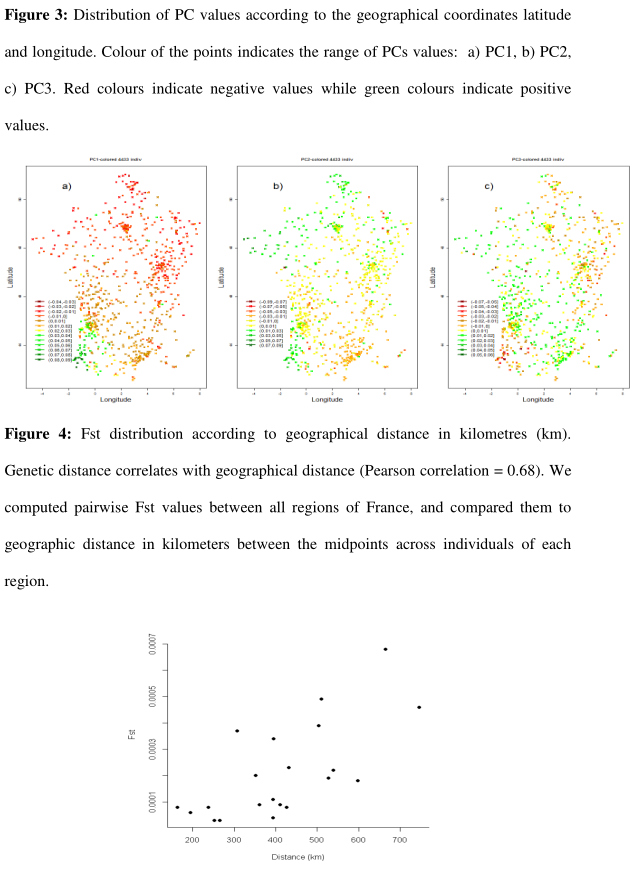
The fine-scale genetic structure of the French population (preprint):
The existence of population stratification is a major problem in case-control association studies and there is a need for a better assessment of allele frequency variation within populations at all geographic scales. Such efforts have been conducted in different European countries where strong patterns of geographic variations were found. The genome-wide extent of variations in allele frequencies of common variants has however never been documented at the scale of France. In this study, we describe these patterns of variation using genome-wide SNP chip data from 4,433 individuals, recruited as part of the Three-City study and whose places of birth in France were available. We show that there is a strong correlation between the top three principal components extracted from the genetic data and the latitude and longitude of birth places. Using multiple linear regression models, we were able to determine the birth places within less than 197 km of the reported origin for 50% of the individuals. Using model-based clustering with seven main geographic regions, we found that individuals were assigned in majority to their true region of origin. However, we found that information on ancestry could not be retrieved by using a small panel of Ancestry-Informative Markers (AIMs).
NW-SE cline of brain volume in Europe
The authors of Modeling the 3D Geometry of the Cortical Surface with Genetic Ancestry mention:


In our group’s previous study, we found that area measures of cortical surface and total brain volumes of individuals of European descent in the United States correlate significantly with their ancestral geographic locations in Europe [ 9 ].This 2011 study ("A Geographic Cline of Skull and Brain Morphology among Individuals of European Ancestry") is freely accessible:
Apparently the two main groups being compared in the neuroimaging sample are Americans of Northwestern European ancestry and Ashkenazi Jews ("ADNI subjects are spread out primarily along a NW-SE axis and form two distinct clusters corresponding to NW European and Ashkenazi Jewish ancestry"):Background: Human skull and brain morphology are strongly influenced by genetic factors, and skull size and shape vary worldwide. However, the relationship between specific brain morphology and genetically-determined ancestry is largely unknown. Methods: We used two independent data sets to characterize variation in skull and brain morphology among individuals of European ancestry. The first data set is a historical sample of 1,170 male skulls with 37 shape measurements drawn from 27 European populations. The second data set includes 626 North American individuals of European ancestry participating in the Alzheimer’s Disease Neuroimaging Initiative (ADNI) with magnetic resonance imaging, height and weight, neurological diagnosis, and genome-wide single nucleotide polymorphism (SNP) data. Results: We found that both skull and brain morphological variation exhibit a population-genetic fingerprint among individuals of European ancestry. This fingerprint shows a Northwest to Southeast gradient, is independent of body size, and involves frontotemporal cortical regions. Conclusion: Our findings are consistent with prior evidence for gene flow in Europe due to historical population movements and indicate that genetic background should be considered in studies seeking to identify genes involved in human cortical development and neuropsychiatric disease. [. . .]
To determine if brain morphometry exhibits similar geospatial population trends to the skull morphometry data, we estimated the ancestry of each individual in the ADNI sample using available genome-wide genotype data and confined attention to 626 individuals with a high probability of having European ancestry. In order to assign the European region of origin most likely to reflect the genetic background of each individual, genotypes from ADNI subjects were merged with publically available genotypes from 34 reference populations geographically distributed across Europe, and PCA was pursued. [. . .]
A plot of the first two principal components separates ADNI subjects into two main clusters: one overlaps NW populations and one lies SE of Europe ( fig. 3 a) and overlaps individuals with self-reported Ashkenazi Jewish ancestry (online suppl. fig. S5). [. . .]
We found that ADNI individuals with a NW ancestry are on average 4 cm taller than ADNI individuals with a SE or Ashkenazi Jewish ancestry (p = 7.3 ! 10–6 ), consistent with previously observed differences in height across Europe [30] . [. . .]

Plots of cranial measures from this study (left) and map of head size from Coon's 1939 book The Races of Europe (right):Intracranial and brain volumes and cortical surface area progressively increase with the amount of inferred NW European ancestry (fig. (fig.3b),3b), and these measures are approximately 5% larger in the 10% of individuals with the most NW European ancestry compared to the 10% with the most SE European ancestry. This percentage increase matches the percentage increase in cranial length and breadth observed along the same NW-SE geographic axis in the skull data set (fig. (fig.2b)2b) and cannot be attributed to a correlation with body size since we controlled for height and weight. This correlation involves specific – not global – brain morphology because hippocampal, basal ganglia, ventricular, and cerebellar volumes and average cortical thickness are not associated with NW-SE ancestry.
Next, we performed both a region of interest analysis and vertex-based tests across the cortex to test whether the surface area of specific cortical regions showed more significant association with the degree of NW-SE ancestry. We found that cortical surface area predominantly in the frontal and temporal lobes from both hemispheres is significantly associated (online suppl. table S4) and is 4–9% larger among 10% of individuals with the most NW European ancestry compared to 10% with the most SE European ancestry. We found a similar frontotemporal pattern of association with the degree of NW-SE ancestry with a vertex-based analysis (fig. (fig.4;4; online suppl. fig. S6).
[. . .] the existence of genetic and craniometric clines in modern European populations suggests at least two theories: (1) pre-historic population movements made such a dominant contribution to the structure of genetic variation in Europe that more recent gene flow has not masked it, and (2) local environmental factors and selection generated clinal variation or acted to restore clinal variation after gene flow occurred. One intriguing possibility for such an environmental factor is the cultural conditions associated with possessing agricultural technologies, e.g. sedentarism, altered diet including milk consumption [40] , and new disease exposures [41] . As these technologies spread progressively from SE to NW Europe over several 1,000 years [33] , natural selection may have acted either directly or indirectly to alter brain morphology, thus creating the clinal variation found in this study.


The trend observed here is also consistent with that reported by Maurice Fishberg over a century ago in The Jews: A Study of Race and Environment:
One of the methods of determining the volume of the brain case, and approximately the weight of the brain, is the determination of the cranial capacity. Very few direct measurements of this kind have been taken, because only few Jewish skulls have found their way into anthropological museums, where they could be studied carefully. But from the few studies of this character that have been made, it appears that the Jews are somewhat at a disadvantage. Lombroso's studies of the Jews in Turin, Italy, which were made in an indirect fashion, showed that the Jews have a smaller cranial capacity than the Catholics of that city.2 Weinberg collected measurements of seventeen Jewish skulls in various museums of Europe, which were made properly, and are not approximations. The average cranial capacity was 1421 c.cm., which is about thirty to forty c.cm. below the average cranial capacity of the population of Europe. Of course the small number of skulls thus measured is not sufficient to draw positive conclusions.As to the weight of the brain, there are also very few observations on record. The author knows only of twentythree Jewish brains reported by Giltchenko,3 four by Weisbach,4 and three by Weinberg.5 The average weight of these brains, as calculated by Weinberg, was 1320.4 gm. Since the average weight of the brain of the European is 1350 gms., the brain of Jews is rather lighter by 30 gms. , or nearly one ounce. Considering that the Jews are shorter of stature than the average Europeans, it would be expected that their brain should also be smaller. But, as Weinberg points out, the average for Germans was found to be 8.22 gm. of brain tissue for each centimetre of stature, while for the Jews it is only 8.05 gms. This shows the Jewish brain lighter not only absolutely, but also relatively.
A major Indo-European contribution to the spread lactase persistence after all?
Ewen Callaway ("DNA data explosion lights up the Bronze Age: Population-scale studies suggest that migrants spread steppe language and technology."):
Ancient population genomics also offer insights on physical and physiological traits. Allentoft’s team found that the ability to digest milk into adulthood — nearly universal in northern Europeans today — was rare in Bronze Age Europeans, contradicting earlier claims that the trait helped early European farmers to gain calories from milk. Of the 101 sequenced individuals, the Yamnaya were most likely to have the DNA variation responsible for lactose tolerance, hinting that the steppe migrants might have eventually introduced the trait to Europe.Related: More ancient DNA evidence of Indo-European mass migrations
More ancient DNA evidence of Indo-European mass migrations
Population genomics of Bronze Age Eurasia (figures; supplementary information):
The Bronze Age of Eurasia (around 3000–1000 BC) was a period of major cultural changes. However, there is debate about whether these changes resulted from the circulation of ideas or from human migrations, potentially also facilitating the spread of languages and certain phenotypic traits. We investigated this by using new, improved methods to sequence low-coverage genomes from 101 ancient humans from across Eurasia. We show that the Bronze Age was a highly dynamic period involving large-scale population migrations and replacements, responsible for shaping major parts of present-day demographic structure in both Europe and Asia. Our findings are consistent with the hypothesized spread of Indo-European languages during the Early Bronze Age. We also demonstrate that light skin pigmentation in Europeans was already present at high frequency in the Bronze Age, but not lactose tolerance, indicating a more recent onset of positive selection on lactose tolerance than previously thought.Dienekes links to the raw data:
Investigation of Bronze Age in Eurasia by sequencing from 101 ancient human remains.DNA Deciphers Roots of Modern Europeans (NYT):The Bronze Age (BA) of Eurasia (c. 3,000-1,000 years BC, 3-1 ka BC) was a period of major cultural changes. Earlier hunter-gathering and farming cultures in Europe and Asia were replaced by cultures associated with completely new perceptions and technologies inspired by early urban civilization. It remains debated if these cultural shifts simply represented the circulation of ideas or resulted from large-scale human migrations, potentially also facilitating the spread of Indo-European languages and certain phenotypic traits. To investigate this and the role of BA in the formation of Eurasian genetic structure, we used new methodological improvements to sequence low coverage genomes from 101 ancient humans (19 > 1X average depth) covering 3 ka BC to 600 AD from across Eurasia. We show that around 3 ka BC, Central and Northern Europe and Central Asia receive genetic input through people related to the Yamnaya Culture from the Pontic-Caspian Steppe, resulting in the formation of the Corded Ware Culture in Europe and the Afanasievo Culture in Central Asia. A thousand years later, genetic input from North-Central Europe into Central Asia gives rise to the Sintashta and Andronovo Cultures. During the late BA and Iron Age, the European-derived populations in Asia are gradually replaced by multi-ethnic cultures, of which some relate to contemporary Asian groups, while others share recent ancestry with Native Americans. Our findings are consistent with the hypothesised spread of Indo-European languages during early BA and reveal that major parts of the demographic structure of present-day Eurasian populations were shaped during this period. We also demonstrate that light skin pigmentation in Europeans was already present at high frequency during the BA, contrary to lactose tolerance, indicating a more recent onset of positive selection in the latter than previously believed.
About 4,500 years ago, the final piece of Europe’s genetic puzzle fell into place. A new infusion of DNA arrived — one that is still very common in living Europeans, especially in central and northern Europe.Related: Massive migration from the steppe is a source for Indo-European languages in Europe; Penny starting to drop for academicsThe closest match to this new DNA, both teams of scientists found, comes from skeletons found in Yamnaya graves in western Russia and Ukraine.
Archaeologists have long been fascinated by the Yamnaya, who left behind artifacts on the steppes of western Russia and Ukraine dating from 5,300 to 4,600 years ago. The Yamnaya used horses to manage huge herds of sheep, and followed their livestock across the steppes with wagons full of food and water.
It was an immensely successful way of life, allowing the Yamnaya to build huge funeral mounds for their dead, which they filled with jewelry, weapons and even entire chariots. [. . .]
The Copenhagen team’s study suggests that the Yamnaya didn’t just expand west into Europe, however. The scientists examined DNA from 4,700-year-old skeletons from a Siberian culture called the Afanasievo. It turns out that they inherited Yamnaya DNA, too.
Exploring Surnames, DNA & Genealogy in The Low Countries
Maarten Larmuseau - Exploring Surnames, DNA & Genealogy in The Low Countries
Published on Apr 27, 2015
There is limited knowledge on the biological relatedness between citizens and on the demographic dynamics within villages, towns and cities in pre-17th-century Western Europe. By combining Y-chromosomal genotypes, in-depth genealogies and surname data in a strict genetic genealogical approach, it has been possible to gain insights into the genetic diversity and the relatedness among indigenous paternal lineages within six Flemish communities at the time of surname adoption between 14th-15th century. Since these communities have been selected based on differences in geography and historical development, the genetic results provide relevant information in historical sciences, demography, forensic genetics and genealogy.
Dr. Maarten Larmuseau, evolutionary geneticist, University of Leuven - Dr. Maarten Larmuseau is a senior postdoctoral researcher at the University of Leuven (KU Leuven, Belgium). He is an evolutionary geneticist interested in the interaction between genetics, evolution and history in humans and animals. Currently he is making use of genetic genealogical tools within forensic, historical and human sociobiological research. His research in e.g. historical cuckoldry rates, the false identification of relics attributed to French kings, and the detection of forgotten historical migration events in the 16th century is well known by both academics and the broad public.
There is limited knowledge on the biological relatedness between citizens and on the demographical dynamics within villages, towns and cities in pre-17th century Western Europe. By combining Y-chromosomal genotypes, in-depth genealogies and surname data in a strict genetic genealogical approach, it is possible to provide insights into the genetic diversity and the relatedness between indigenous paternal lineages within a particular community at the time of the surname adoption. To obtain these insights, six Flemish communities were selected in this study based on the differences in geography and historical development. After rigorous selection of appropriate DNA donors, low relatedness between Y chromosomes of different surnames was found within each community, although there is co-occurrence of these surnames in each community since the start of the surname adoption between the 14th and 15th century. Next, the high communal diversity in Y-chromosomal lineages was comparable with the regional diversity across Flanders at that time. Moreover, clinal distributions of particular Y-chromosomal lineages between the communities were observed according to the clinal distributions earlier observed across the Flemish regions and Western Europe. No significant indication for genetic differences between communities with distinct historical development was found in the analysis. These genetic results provide relevant information for studies in historical sciences, archaeology, forensic genetics and genealogy.
Lifespan of the European Nobility from the Dark Ages to the Industrial Revolution
Neil Cummins summarizes his paper "Longevity and the Rise of the West: Lifespans of the European Elite, 800-1800":
European nobility specialized in the execution of violence. Their genealogies connected them to the Barbarian conquerors of Europe following the decline of the Roman Empire. A large proportion of noble men died in battle. To investigate precisely how many nobles died from violence, I employed a general version of the famous birthday problem. First year statistics students are often introduced to probability via the surprisingly low number of people it takes to have a high probability of a shared birthday. If we take the number of exact-date deaths per year, n, and the number of deaths on a given day, m, we can calculate the probability that a given n-m combination occurs randomly or is likely the result of a battle. I use this ‘clumping’ technique to estimate the proportion of nobles dying from violence. My estimates are presented in figure 1 below. Violence suddenly declines within this warrior caste in the 16th century. [. . .]From the paper:Nobles live significantly shorter lives in the South and East relative to the North and West. My analysis indicates that this Mortality pattern has existed since 1000AD.
These results have implications for theories of the rise of Europe. The European Mortality Pattern revealed above correlates with those regions which later experience the Industrial Revolution first. Recent research has suggested that “The Great Divergence” of East and West is preceded by a little divergence of East and West, within Europe, around the time of the Black Death (1347). This research shows that North-West Europe was differentiated from the rest of the continent by its demographics centuries before the Black Death.
A new set of stylised facts has been uncovered that seem to raise more questions than they answer. Why were noble lifespans longer in Northwest Europe in 1000AD? What caused noble lifespan to shoot upwards in 1400? Why did violence decline so suddenly in the 16th century? Future research will tell us more.
ABSTRACT I analyze the age at death of 121,524 European nobles from 800 to 1800. Longevity began increasing long before 1800 and the Industrial Revolution, with marked increases around 1400 and again around 1650. Declines in violence contributed to some of this increase, but the majority must reflect other changes in individual behavior. The areas of North-West Europe which later witnessed the Industrial Revolution achieved greater longevity than the rest of Europe even by 1000 AD. The data suggest that the 'Rise of the West' originates before the Black Death. [. . .]Further, a list of the 3,133 sources will be provided in a data file on my website, neilcummins.com. Following publication, replication files and data will be provided there too. [. . .]
This study has characterized noble lifespans from 800 to 1800. The results have many implications. Firstly, the sharp decline in the proportion of male nobles dying from violence, from at least 600 years of a steady 30% to less than 5% in the 16th century, predates the arrival of the Industrial Revolution by two centuries. The long run decline in violence 25 is cited as one of the principal correlates of the emergence of the modern World. Why did violence decline among European nobility? Was it a ‘bottom-up’ behavioral change (perhaps as a result of natural selection, as Clark (2007) suggests for the general population) or was it a response to changing ‘top-down’ institutional incentives (as argued by Acemoglu and Robinson (2012))? [. . .]
Finally, this paper documents a previously unknown European mortality pattern, Sim- ilar to that for marriage first documented by Hajnal (1965), the mortality gradient runs South-North and East-West, and has existed since before the Black Death 30 . The long existence of such a geographic effect has implications for recent work which stresses the ‘little divergence’ between the North-West of Europe and the South-East (Voigtländer and Voth (2013), Broadberry (2013) and de Pleijt and van Zanden (2013)). The Black Death is not the first turning point. There was something about the North-West of Europe long before 1346 that led to nobles living longer lives.
These results suggests that the ‘Rise of the West’ does not solely originate in institutional innovations of the 17th century (Acemoglu and Robinson (2012)) nor in social reactions to the Black Death (Voigtländer and Voth (2013)). Western exceptionalism exists in individual behavior differences that are present since at least the first millennium AD.
Social Mobility among the French Noblesse in the Later Middle Ages
A few figures are here necessary. Out of the 215 lignages that appear in records at one time or another in the thirteenth century, no less than 66, or 30.7% of the total, had disappeared before 1300, the male line having become extinct. During the next century, from 1300 to 1400, the rate of disappearance seems to have remained the same, in spite of the fact that it was a time of wars and pestilences: 80 of the 149 remaining families, or 53.6% of them, became extinct in their turn. Another 38, or 55% of the remaining 69, disappeared between 1400 and 1500. The process went on with the flow of time. By the time of the French Revolution no more than five of these 215 lines were still alive. Two of them remain to this day, if we rule out a third one which descends from a bastard branch but which managed to be maintained in its noble status by a decision of Louis XIV.15 From these figures it might be said that, roughly speaking, the nobility loses half its members within any given century. The average duration of a noble line is hardly more than three or four generations; let us say, to be on the safe side and to take account of the hazards of the records, between three and six generations, stretching from one to two centuries. This tallies with the findings of Mr. Sanders, who, analysing the descent of some 210 baronies from the Conquest to 1327, has shown (or rather I have worked out the figure from his catalogue) that only 36 of them remained more than two centuries in the hands of the same male line.16 English baronies, however, were partible between heiresses even when junior branches still possessed male members, so that the figures are not entirely comparable.
It must be pointed out here that this high rate of family-mortality bore no relation to the economic status of these lignages. Death strikes equally rich and poor, baron and squire, the eminent and the insignificant. Causes general to the times were at work: high mortality in spite of a high birth-rate; the hazards of war; those of political upheavals, with their train of attainders and confiscations - which, at least up to the fourteenth century, were less important in France than in England. Other causes are particular to such social groups as attain some sort of eminence. Thus, the necessity, in order to avoid splitting estates through partition between children, of sending younger sons into the Church, would sooner or later bring the line to an untimely end. [. . .]
New families were thus constantly replacing the dying ones. Some of the newcomers came from junior branches of the local nobility itself, who, through marriage with heiresses, replaced in their lordships the old lines now extinct.'9 Others belonged to the gentry of neighbouring provinces and settled in Forez in the same way.20 None of these was really bringing new blood into an otherwise dwindling social class. More important for our purpose are the new men, those who suddenly appeared as knights or squires with no known ancestry in the nobility and who, given the chance, founded new noble lignages. To know where they came from, we must work mostly by inference and generalise from a few well-documented cases. We can be sure, however, that these newcomers were not recruited from a well-defined social group, but came from widely different strata [. . .]
In a country and at a time when society was almost entirely rural, the largest group of new noblemen came, so it seems, from peasant- stock. In Forez, there was no sharp dividing line between peasants and poor squires, except their different birth. By the thirteenth century, serfdom was as unknown there as in Normandy; all peasants were freemen, even those who owed tallage and a few labour service restricted to one or two days a year.
[Edouard Perroy. Social Mobility among the French Noblesse in the Later Middle Ages]
SMBE 2014: more (several dozen) abstracts touching on recent evolution in humans
Detecting patterns of global and local positive selection by
examining novel variants in the exomes of 7 world-wide human populations
Laura Botigué
1, Jeff Kidd2, Brenna Henn1
1Stony Brook University, Stony Brook, New York, USA, 2University of Michigan, Ann Arbor, Michigan, USA
1Stony Brook University, Stony Brook, New York, USA, 2University of Michigan, Ann Arbor, Michigan, USA
Recent efforts to identify adaptive loci in humans relied
primarily on single nucleotide polymorphism array data. For many global
populations however, these datasets suffered from ascertainment bias
and did not allow for the identification of novel, adaptive variants
unique to different populations. In this study we use high coverage
exomes and low coverage full genomes from over 50 individuals from 7
human populations of geographically divergent groups from Namibia,
Congo, Algeria, Pakistan, Cambodia, Siberia and Mexico to differentiate
between local and global adaptation. We additionally apply the same
approach to examining 1000 Genomes data. In order to minimize the effect
of demography, we compare the site frequency spectrum of putatively
functional variants with the neutral site frequency spectrum as
estimated from synonymous sites or intergenic loci. We specifically
hypothesize that derived variants with a large predicted functional
impact found at high frequencies are not deleterious and potentially
beneficial. We further hypothesize that derived variants common across
populations are good candidates for adaptative traits common to the
human species, whereas variants that are at high frequency but
population specific are indicative of local adaptation. When we consider
only variants with an extreme functional effect, as predicted by GERP
scores, a total of 6% are shared across all populations, and 16% are
private to a given population at frequencies higher than 10%. We obtain a
subset of candidate genes under selection based on these hypotheses and
assess common features among then using gene ontology. Overall, results
may shed light to human adaptation at the species level, as well as the
local level, and finally have a better understanding of how exposure to
new environmental pressures affected early human expansion across the
globe.
As a first step, we have developed a statistical method for inferring segments of Neandertal local ancestry in modern humans and applied this method to construct a map of Neandertal ancestry in modern non-Africans, using data from Phase 1 of the 1000 genomes project combined with a high coverage (50×) Neandertal genome. This map reveals the adaptive impact of Neandertal gene flow as we find enhanced Neandertal ancestry in genes involved in keratin filament formation as well as other biological pathways. We also observe large regions with reduced Neandertal ancestry consistent with purifying selection against introgressing Neandertal alleles in part due to these alleles contributing to hybrid male sterility.
To extend this approach to other archaic-modern human introgression events, we generated deep genome sequences of 21 people from populations with substantial Denisovan ancestry: 16 Papua New Guineans, 2 Bougainville Islanders, and 3 aboriginal individuals from Australia. We also extend our method to infer Neandertal and Denisovan local ancestry in these populations. We test whether the same evidence for hybrid male sterility is observed in this introgression event as is observed between Neandertals and modern humans.
Inference of local ancestry in archaic-modern human admixture and its impact on modern human evolution
Sriram Sankararaman
1
,2, Swapan Mallick1
,2, Michael Danneman3, Kay Prufer3, Janet Kelso3, Svante Paabo3, Nick Patterson1
,2, David Reich1
,2
1Harvard Medical School, Boston, USA, 2Broad Institute, Cambridge, USA, 3Max Planck Institute for Evolutionary Anthropology, Leipzig, Germany
Analysis of archaic genomes has documented several examples of
admixture between archaic and modern human groups e.g. these analyses
have revealed that Neandertals interbred with the ancestors of all
non-Africans and the Denisovans interbred with the ancestors of
present-day Melanesians. To understand how these admixture events
shaped the evolution of modern humans, we need to build maps of archaic
ancestry in modern humans.1Harvard Medical School, Boston, USA, 2Broad Institute, Cambridge, USA, 3Max Planck Institute for Evolutionary Anthropology, Leipzig, Germany
As a first step, we have developed a statistical method for inferring segments of Neandertal local ancestry in modern humans and applied this method to construct a map of Neandertal ancestry in modern non-Africans, using data from Phase 1 of the 1000 genomes project combined with a high coverage (50×) Neandertal genome. This map reveals the adaptive impact of Neandertal gene flow as we find enhanced Neandertal ancestry in genes involved in keratin filament formation as well as other biological pathways. We also observe large regions with reduced Neandertal ancestry consistent with purifying selection against introgressing Neandertal alleles in part due to these alleles contributing to hybrid male sterility.
To extend this approach to other archaic-modern human introgression events, we generated deep genome sequences of 21 people from populations with substantial Denisovan ancestry: 16 Papua New Guineans, 2 Bougainville Islanders, and 3 aboriginal individuals from Australia. We also extend our method to infer Neandertal and Denisovan local ancestry in these populations. We test whether the same evidence for hybrid male sterility is observed in this introgression event as is observed between Neandertals and modern humans.
SMBE 2014: Whole genome sequencing of an Ashkenazi Jewish reference panel supports population-targeted personal genomics and illuminates Jewish and European origins
Whole genome sequencing of an Ashkenazi Jewish reference panel
supports population-targeted personal genomics and illuminates Jewish
and European origins
Shai Carmi
1, Ken Hui2, Ethan Kochav1, Xinmin Liu1, James Xue1, Fillan Grady1, Saurav Guha3
,5, Kinnari Upadhyay6, Danny Ben-Avraham6, Semanti Mukherjee3
,4, B. Monica Bowen2, Tinu Thomas7, Joseph Vijai7, Nir Barzilai6, Ariel Darvasi8, Kenneth Offit7, Susan Bressman9, Laurie Ozelius5, Inga Peter5, Judy Cho2, Harry Ostrer6, Gil Atzmon6, Lorraine Clark1, Todd Lencz3
,4, Itsik Pe'er1
1Columbia University, New York, NY, USA, 2Yale University, New Haven, CT, USA, 3The Feinstein Institute, Manhasset, NY, USA, 4The Zucker Hillside Hospital, Glen Oaks, NY, USA, 5Icahn School of Medicine at Mount Sinai, New York, NY, USA, 6Albert Einstein College of Medicine, New York, NY, USA, 7Memorial Sloan Kettering Cancer Center, New York, NY, USA, 8The Hebrew University of Jerusalem, Jerusalem, Israel, 9Beth Israel Medical Center, New York, NY, USA
The Ashkenazi Jewish (AJ) population is a genetic isolate, close
to European and Middle-Eastern populations. AJ experienced a severe
medieval bottleneck followed by rapid expansion, leading to genetic
diversity patterns conducive to powerful disease mapping. Here, we
report the high-depth sequencing of 128 complete genomes of AJ controls.
Compared to a European reference panel, our AJ panel is 47% richer in
novel variants and 8-fold more effective at filtering benign variants, a
necessary step for interpreting AJ clinical genomes. Our panel improves
the accuracy of imputation of AJ SNP arrays by 28%, and covers with
long, identical-by-descent segments at least one haplotype in ≈67% of
the genome of any other AJ individual. Reconstruction of recent AJ
history from such segments confirms and quantifies a recent bottleneck
of merely ≈350 individuals. Further modeling of ancient histories for AJ
and European populations using their joint allele frequency spectrum
determines AJ to be an admixture of European (50% of ancestry) and
likely Middle-Eastern (50%) origins. This composition facilitates
inferring that the split between the two ancestral populations occurred
as recently as ≈21 kya, suggesting a predominantly near-Eastern source
for the repopulation of Europe at the end of the Last Glacial Maximum.
1Columbia University, New York, NY, USA, 2Yale University, New Haven, CT, USA, 3The Feinstein Institute, Manhasset, NY, USA, 4The Zucker Hillside Hospital, Glen Oaks, NY, USA, 5Icahn School of Medicine at Mount Sinai, New York, NY, USA, 6Albert Einstein College of Medicine, New York, NY, USA, 7Memorial Sloan Kettering Cancer Center, New York, NY, USA, 8The Hebrew University of Jerusalem, Jerusalem, Israel, 9Beth Israel Medical Center, New York, NY, USA
SMBE 2014: Genotyping of 390,000 SNPs in more than forty 3,000-9,000 year old humans from the ancient Russian steppe
Genotyping of 390,000 SNPs in more than forty 3,000-9,000 year old humans from the ancient Russian steppe
David Reich
1
,2, Nadin Rohland1
,2, Swapan Mallick1
,2, Iosif Lazaridis1, Eadaoin Harney1, Susanne Nordenfelt1, Qiaomei Fu3, Matthias Meyer3, Dorcas Brown4, David Anthony4, Nick Patterson2
1Harvard Medical School, Boston, MA, USA, 2Broad Institute of Harvard and MIT, Cambridge, MA, USA, 3Max Planck Institute for Evolutionary Anthropology, Leipzig, Germany, 4Hartwick College, Oneonta, NY, USA
A central challenge in ancient DNA research is that for many
bones that contain genuine DNA, the great majority of molecules in
sequencing libraries are microbial. Thus, it has been impractical to
carry out whole genome analyses of substantial numbers of ancient
individuals. We report a strategy for in-solution capture of ancient
DNA from approximately 390,000 single nucleotide polymorphism (SNP)
targets, adapting a method of Fu et al. PNAS 2013 who enriched a 40,000
year old DNA sample for the entire chromosome 21. Of the SNPs targets,
the vast majority overlap the Affymetrix Human Origins array, allowing
us to compare the ancient samples to a database of more than 2,700
present-day humans from 250 groups.1Harvard Medical School, Boston, MA, USA, 2Broad Institute of Harvard and MIT, Cambridge, MA, USA, 3Max Planck Institute for Evolutionary Anthropology, Leipzig, Germany, 4Hartwick College, Oneonta, NY, USA
We applied the SNP capture as well as mitochondrial genome enrichment to a series of 65 bones dating to between 3,000-9,000 years ago from the Samara district of Russia in the far east of Europe, a region that has been suggested to be part of the Proto-Indo-European homeland. We successfully extracted nuclear data from 10-90% of targeted SNPs for more than 40 of the samples, and for all of these samples also obtained complete mitochondrial genomes. We report three key findings:
- Samples from the Samara region possess Ancient North Eurasian (ANE) admixture related to a recently published 24,000 year old Upper Paleolithic Siberian genome. This contrasts with both European agriculturalists and with European hunter-gatherers from Luxembourg and Iberia who had little such ancestry (Lazaridis et al. arXiv.org 2013). This suggests that European steppe groups may have been be implicated in the dispersal of ANE ancestry across Europe where it is currently pervasive.
- The mtDNA composition of the steppe population is primarily West Eurasian, in contrast with northwest Russian samples of this period (Der Sarkissian et al. PLoS Genetics 2013) where an East Eurasian presence is evident.
- Samara experienced major population turnovers over time: early samples (>6000 years) belong primarily to mtDNA haplogroups U4 and U5, typical of European hunter-gatherers but later ones include haplogroups W, H, T, I, K, J.
[Via Greg Cochran.]
ESHG 2014: A mitogenomic phylogeny of haplogroups U2e and U3: revealing the phylogenetic signals for population expansions in the Slavs prehistory
Title: J17.66 - A mitogenomic phylogeny of haplogroups U2e and U3: revealing the phylogenetic signals for population expansions in the Slavs prehistory
Keywords: mitochondrial DNA; molecular phylogeography; molecular evolution
Authors: B. Malyarchuk1, M. Derenko1, T. Grzybowski2, M. Perkova1, G. Denisova1, A. Litvinov1, U. Rogalla2, K. Skonieczna2; 1Institute of Biological Problems of the North, Magadan, Russian Federation, 2Institute of Forensic Medicine, Nicolaus Copernicus University, Bydgoszcz, Poland.
Keywords: mitochondrial DNA; molecular phylogeography; molecular evolution
Authors: B. Malyarchuk1, M. Derenko1, T. Grzybowski2, M. Perkova1, G. Denisova1, A. Litvinov1, U. Rogalla2, K. Skonieczna2; 1Institute of Biological Problems of the North, Magadan, Russian Federation, 2Institute of Forensic Medicine, Nicolaus Copernicus University, Bydgoszcz, Poland.
Abstract: To resolve the phylogeny of some uncommon and poorly studied West Eurasian mitochondrial DNA (mtDNA) haplogroups, we sequenced 32 U2e and 19 U3 complete mitogenomes of Central and Eastern Europeans (Czechs, Slovaks, Poles, Russians, Ukrainians and Belarusians) and re-analysed the available at the present time data on 74 U2e and 80 U3 complete mtDNAs. Molecular dating suggests that the coalescence time estimates are ~21 and ~35 thousand years (ky) for haplogroups U2e and U3, respectively. Detailed analysis of about 500 Slavic complete mitogenomes belonging to different haplogroups allowed us to identify a number of lineages that seem specific for Central and Eastern Europe (U3b1b, U4a2a1, U5a2a1c, U2e1b1a, U2e1b1, U3a1a, H5a1f, U5a1a1a1, U5a1c1, U2e2a1a, U4a2a, H5a2, U2e2a1d and U5a1b1b). These subhaplogroups consist of similar haplotypes revealed in different ethnic groups of modern Slavs, thereby proving the existence of ethnolinguistic community of Slavs through DNA testing. Evolutionary age of Slavic-specific subhaplogroups is calculated to approximately 3.9 ky (from 2.3 to 5.9 ky, according to the mutation rate proposed by Soares et al. (2009) for the entire mtDNA molecule). This indicates that the ancestors of modern Slavs inhabited areas of Central and Eastern Europe from the times of Bronze and Iron Ages, i.e. earlier than it was estimated on the basis of archaeological, historical and linguistic data. This study was supported by Russian Foundation for Basic Research (grant 14-04-00131) and the Program of Presidium of Russian Academy of Sciences (grant 12-I-P30-12).
ESHG 2014: Y chromosome haplogroups C, N and Q in Eurasian populations for the perspectives of proto-Bulgarian ancestry
Title: P17.92-M - Meta-analysis of Y chromosome haplogroups C, N and Q in Eurasian populations for the perspectives of proto-Bulgarian ancestry
Keywords: Y-chromosome; haplogroup; proto-Bulgarians
Authors: S. Karachanak1, D. Nesheva1, V. Grugni2, N. Al-Zahery2, V. Battaglia,2, A. S. Galabov3, D. Toncheva1; 1Department of Medical Genetics, Medical Faculty, Medical University of Sofia, Sofia, Bulgaria, 2Department of Biology and Biotechnologies “Lazzaro Spallanzani”. University of Pavia, Pavia, Italy, 3The Stephan Angeloff Institute of Microbiology, Bulgarian Academy of Sciences, Sofia, Bulgaria.
Keywords: Y-chromosome; haplogroup; proto-Bulgarians
Authors: S. Karachanak1, D. Nesheva1, V. Grugni2, N. Al-Zahery2, V. Battaglia,2, A. S. Galabov3, D. Toncheva1; 1Department of Medical Genetics, Medical Faculty, Medical University of Sofia, Sofia, Bulgaria, 2Department of Biology and Biotechnologies “Lazzaro Spallanzani”. University of Pavia, Pavia, Italy, 3The Stephan Angeloff Institute of Microbiology, Bulgarian Academy of Sciences, Sofia, Bulgaria.
Abstract: Bulgaria is situated on the presumed trajectory of the pioneer colonization of Europe. Since then it has been subjected to a series of demographic events with disputable impact on the contemporary Bulgarian gene pool. One of the most controversial issues of the Bulgarian past is the origin of the proto-Bulgarians, which were previously considered as a sparse Turkic population.
In order to delve into Bulgarian patrilineal origins we have performed a survey of Y-chromosome haplogroups followed by meta-analysis of haplogroups C, N and Q distinctive for Altaic populations. The analysis was performed on a sample comprising 808 Bulgarian males using RFLP and DHPLC analysis. We have found that only 1.49 % of the contemporary gene pool belongs to haplogroups C, N and Q. Our results were used to upgrade and extend the distribution maps of these haplogroups and to compare their frequency in 240 Eurasian (sub-) populations with more than 20 000 samples.
The comparison reveals a statistically significant difference in the distribution of the studied haplogroups between Bulgarians and Altaic populations as well as between Bulgarians and Eastern Slavic populations. Based on the novel historical studies which point to a substantial contribution of the proto-Bulgarians to the modern Bulgarian gene pool the obtained results suggest that there is no common genetic ancestry between proto-Bulgarians and present day Altaic populations as they reject the hypothesis of the Turkic origin of proto-Bulgarians.
Subscribe to:
Posts (Atom)